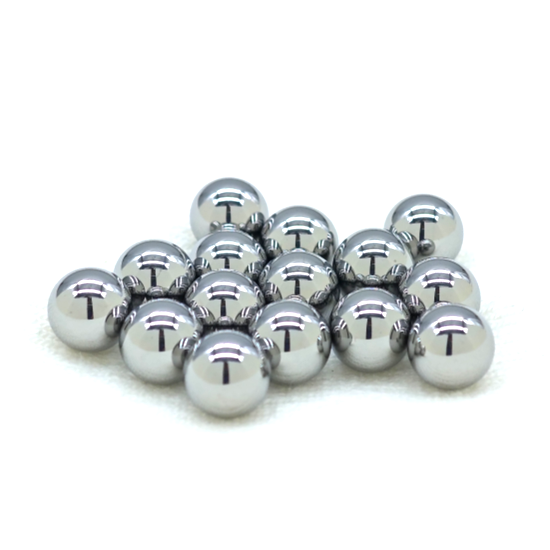
Hidden behind the scenes of our everyday lives, countless tiny steel balls quietly bear enormous pressure and responsibility. Whether in high-speed bearings, precision instruments, or extreme aerospace equipment, steel balls are indispensable components. Though small in size, they can withstand incredible forces. The secret lies in their hardness and fatigue life.
What Is the "Hardness" of a Steel Ball?
Hardness, simply put, is a material's ability to resist deformation or scratching. For steel balls, higher hardness means greater resistance to dents and wear caused by external forces.
Typically, steel ball hardness is measured using the Rockwell (HRC) or Brinell (HB) hardness scales. For example, commonly used high carbon chromium bearing steel balls (AISI 52100) can reach a Rockwell hardness of 58–66 HRC, hard enough to scratch ordinary metals easily.
Such high hardness results from carefully controlled material composition (such as carbon content) and precise heat treatment processes (like quenching and tempering).
Is Higher Hardness Always Better?
Not necessarily. While hardness is important, steel balls must balance strength and toughness. If the material becomes too hard, it may become brittle and prone to cracking under impact. Therefore, selecting the right hardness for different application environments is critical.
Fatigue Life — The True Test for Steel Balls
Steel balls must not only endure static pressure but also withstand long-term cyclic loads (repeated stress over time). Under these conditions, tiny damages gradually accumulate within the material, eventually leading to cracking or flaking — a phenomenon known as fatigue failure.
What Factors Affect Fatigue Life?
-
Material purity: Fewer impurities mean longer fatigue life.
-
Surface quality: Smoother, defect-free surfaces help resist crack initiation.
-
Internal structure: Proper heat treatment creates a dense, uniform martensitic structure, greatly improving fatigue resistance.
-
Operating environment: Dust, moisture, or corrosive substances can accelerate fatigue failure.
Studies show that high-quality bearing steel balls can endure hundreds of millions of cycles under standard load conditions without failure. Truly, these tiny steel spheres are the backbone of long-lasting, high-performance machinery!
Why Understanding Hardness and Fatigue Life Matters
In engineering design, understanding the hardness and fatigue life of steel balls helps in selecting the most suitable materials, extending equipment lifespan, and reducing maintenance costs.
For instance, the steel balls used in high-speed train bearings must not only have exceptional hardness but also outstanding fatigue resistance — any failure could lead to catastrophic consequences.