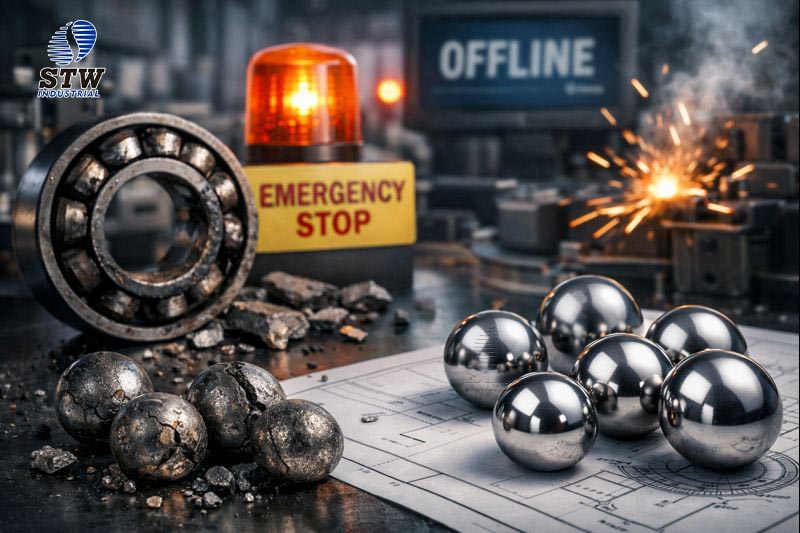
In bearings, pumps, valves, and transmission systems, steel balls are low-cost components but high-impact parts. While their unit price is small, their quality directly determines equipment reliability, service life, and operational continuity.
Many companies focus on the lowest purchase price when sourcing steel balls, only to face unexpected downtime, frequent maintenance, and costly production losses later. In industrial applications, cheap steel balls rarely mean real savings.
1. Common Quality Risks of Low-Cost Steel Balls
Inferior Raw Materials Lead to Early Failure
Low-priced steel balls are often manufactured using:
-
Recycled or low-grade steel with unstable chemical composition
-
Excessive sulfur and phosphorus content
-
Uncontrolled or non-standard material grades
These material issues result in:
-
Reduced load-bearing capacity
-
Poor fatigue resistance
-
Premature cracking under high-speed or high-load conditions
Unstable Heat Treatment Reduces Service Life
Proper heat treatment is essential to achieve balanced hardness and internal structure. Cheap steel balls frequently suffer from:
-
Inaccurate quenching temperatures
-
Insufficient or excessive tempering
-
Uneven hardness from surface to core
This leads to:
-
Surface spalling
-
Cracking or brittleness
-
Accelerated wear during operation
Poor Dimensional Accuracy Causes System-Level Problems
Steel ball precision directly affects:
-
Load distribution
-
Vibration levels
-
Noise and operational stability
Low-cost products often show:
-
Inconsistent ball diameter within the same batch
-
Poor roundness and surface finish
-
Loose tolerance control
These defects cause uneven stress concentration, resulting in early bearing damage and unstable system performance.
2. How Cheap Steel Balls Lead to Equipment Downtime
Stage 1: Micro Defects Trigger Abnormal Wear
Initially, the problem may appear minor:
-
Slight temperature increase
-
Unusual vibration or noise
However, surface defects generate metal debris that contaminates lubrication systems.
Stage 2: Accelerated Wear Damages Critical Components
As wear progresses:
-
Steel balls may spall or fracture
-
Bearings, valve seats, or sealing surfaces are damaged
At this stage, component replacement becomes unavoidable.
Stage 3: Local Failure Causes Full System Shutdown
In continuous-operation industries such as:
-
Automated production lines
-
Pumping systems
-
Industrial machinery
A single steel ball failure can force an entire system or production line to stop, resulting in significant downtime losses.
3. The Hidden Costs Behind “Cheap” Steel Balls
| Apparent Saving | Real Consequence |
|---|---|
| Lower unit price | Higher maintenance frequency |
| Reduced purchase cost | Increased downtime and labor cost |
| Frequent replacement | Higher inventory and logistics expenses |
| Short service life | Damage to brand reputation |
For B2B customers, the true cost is not the price per steel ball, but the cost per operating hour.
4. What a Professional Steel Ball Manufacturer Can Deliver
A reliable steel ball supplier helps prevent downtime through:
-
Strict raw material control with full traceability
-
Stable and proven heat treatment processes
-
Comprehensive dimensional and surface inspections
-
Consistent batch quality for long-term supply
-
Application-based material and grade recommendations
This approach reduces operational risk and ensures long-term equipment stability.
5. Conclusion: Small Component, Big Impact
Steel balls may seem insignificant, but their failure can trigger major operational disruptions. Cheap steel balls often introduce hidden risks that only surface after installation—when downtime costs are far greater than initial savings.
For industrial equipment:
Operational reliability is always more valuable than short-term cost reduction.
Choosing high-quality steel balls is an investment in:
-
Equipment longevity
-
Production efficiency
-
Long-term business performance