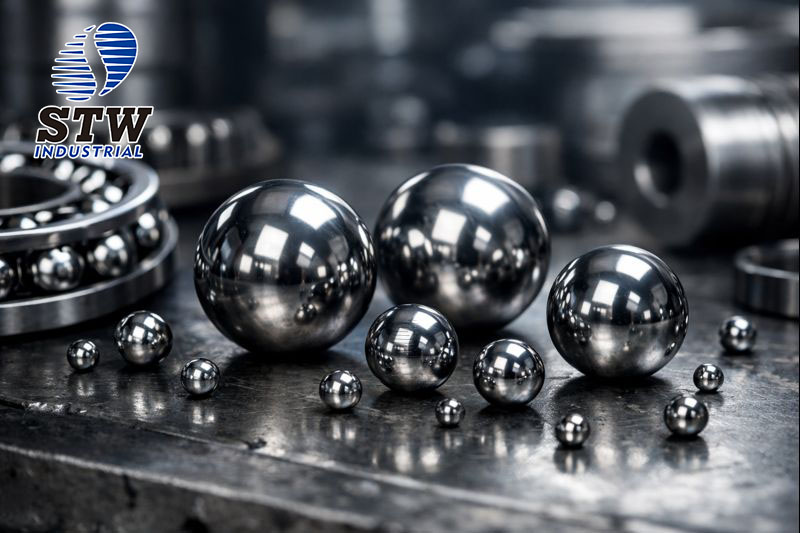
In industrial applications such as bearings, valves, pumps, transmission systems, and precision machinery, steel balls are often regarded as highly standardized components. Many buyers focus primarily on diameter, tolerance grade, and price. However, in real-world operation, a common issue frequently arises: steel balls with exactly the same diameter can exhibit dramatically different service lives.
This phenomenon is not accidental. It is the result of multiple technical factors related to material quality, manufacturing processes, precision control, and application matching.
1. Steelmaking Quality: The Root Cause of Service Life Differences
Even within the same material grade, different steelmaking routes can result in significant variations in purity and structural stability. High-quality steel balls are typically produced from refined steel with strict control of non-metallic inclusions such as oxides and sulfides.
These microscopic inclusions may be invisible to the naked eye, but under cyclic loads, they often become initiation points for fatigue cracks, significantly shortening service life.
2. Chemical Composition Consistency: Ensuring Batch Reliability
Steel balls are rarely used individually; they operate in batches over long periods. Variations in carbon content or alloying elements can lead to inconsistent hardness, wear resistance, and toughness within the same batch.
Such performance dispersion is a common reason why some steel balls fail prematurely while others continue to operate normally.
3. Heat Treatment Depth and Uniformity: The Invisible Performance Gap
Hardness values alone do not fully reflect the internal quality of a steel ball. Proper heat treatment focuses on achieving not only the correct hardness range, but also sufficient hardened depth, uniform microstructure, and controlled residual stress.
Well-executed quenching and tempering processes significantly improve fatigue resistance, especially under high load or impact conditions.
4. Roundness and Sphericity: Controlling Load Distribution
During high-speed rotation or heavy loading, steel balls do not experience uniform contact stress. Even slight deviations in roundness or true sphericity can cause localized stress concentration, accelerating surface fatigue.
High-precision grinding and grading ensure more even load distribution, directly contributing to longer service life.
5. Surface Integrity: Where Fatigue Failure Begins
Surface roughness values alone are not sufficient to evaluate surface quality. Micro-cracks, grinding burns, or machining marks can act as stress risers during repeated rolling contact.
Premium steel balls undergo multi-stage grinding and polishing processes to minimize surface defects and reduce the risk of early fatigue failure.
6. Dimensional Consistency: A System-Level Reliability Factor
Within an assembled system, dimensional consistency among steel balls is critical. Larger size deviations can cause uneven load sharing, forcing certain balls to carry excessive stress and fail prematurely, ultimately reducing the overall system lifespan.
7. Application Matching: Amplifying or Reducing Service Life
Steel balls with the same diameter may perform very differently under varying operating conditions, including speed, lubrication, temperature, and corrosive environments.
Experienced manufacturers recommend appropriate materials, hardness ranges, or surface treatments based on actual application requirements, rather than offering a one-size-fits-all solution.
8. Quality Control System: The Foundation of Long-Term Stability
Long service life is not achieved through individual inspections alone. It is the result of a comprehensive quality management system covering raw material inspection, in-process control, and final testing.
A stable manufacturing system minimizes batch-to-batch variation and ensures predictable, repeatable performance for industrial users.
Conclusion
Diameter determines whether a steel ball fits, but manufacturing quality determines how long it lasts.
The service life differences observed among steel balls of the same diameter reflect variations in material control, process capability, and application expertise. For industrial users, partnering with an integrated manufacturer with deep experience in steel ball production often delivers lower total lifecycle costs and higher operational reliability.