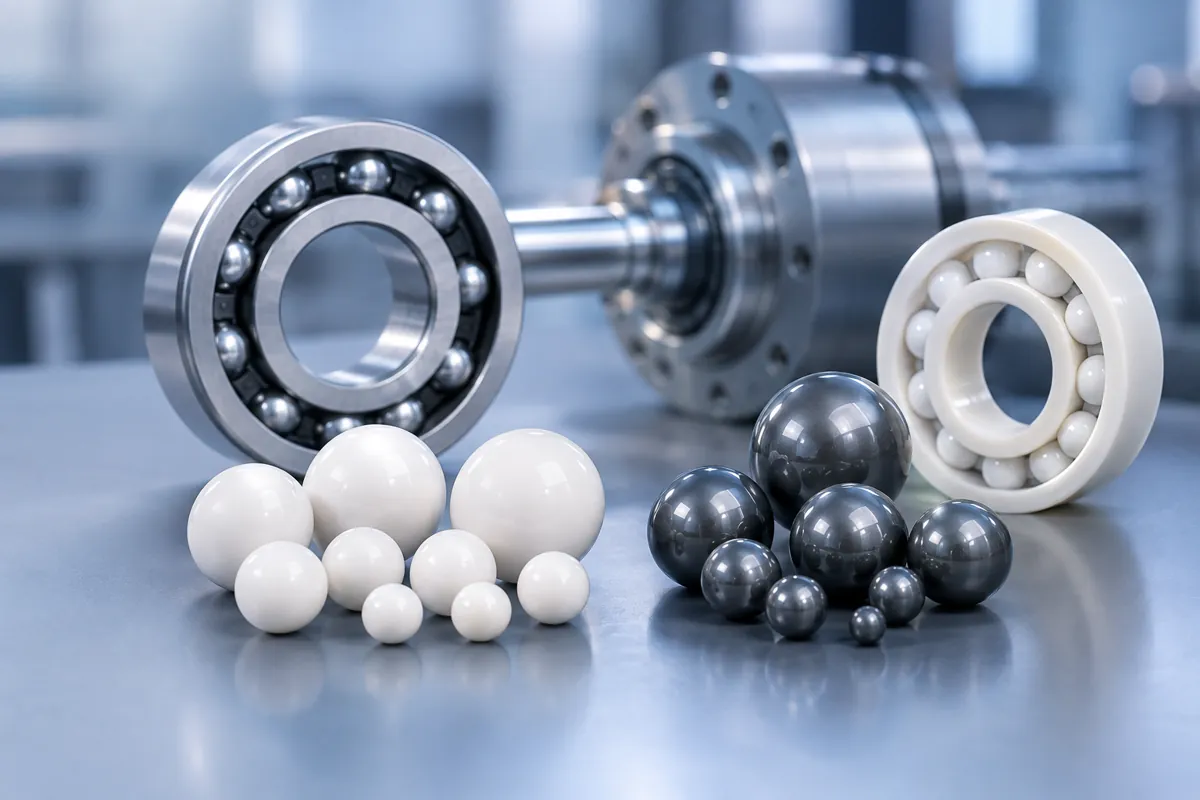
What Does Low Density Mean for Ceramic Balls?
Density refers to the mass of a material for a given volume.
When comparing balls of the same diameter, a lower-density material produces a lighter rolling element. Engineering ceramics such as silicon nitride (Si₃N₄) have a significantly lower density than conventional bearing steel.
This difference becomes especially important when the ball rotates at high speed.
A lighter rolling element has lower inertia and generates lower centrifugal forces during operation. As a result, the rolling element can place less dynamic stress on the bearing system.
Therefore, the low density of ceramic balls is not simply a weight-saving feature. It can contribute directly to the performance of high-speed rotating equipment.
1. Reduced Centrifugal Forces at High Speeds
One of the most significant benefits of low-density ceramic balls is their ability to reduce centrifugal effects during high-speed rotation.
In a high-speed bearing, the rolling elements rotate and orbit around the bearing raceway. As rotational speed increases, centrifugal forces become increasingly important.
Because ceramic balls are lighter than steel balls of the same size, they generate lower centrifugal forces under comparable operating conditions.
This can help:
- Reduce dynamic loads inside the bearing
- Reduce contact stress associated with high-speed operation
- Improve high-speed stability
- Reduce the mechanical load on the bearing system
- Support higher rotational speeds
This is one reason why ceramic balls are widely considered for high-speed bearing applications.
2. Lower Friction and Heat Generation
Friction is a major source of heat in rotating equipment.
As bearing speed increases, frictional losses can become more significant, resulting in higher operating temperatures. Excessive heat can affect lubricant performance, dimensional stability, and bearing service life.
The lower density of ceramic balls can reduce centrifugal effects and sliding-related losses under suitable bearing designs and operating conditions.
Combined with the favorable tribological properties of ceramic materials, this can contribute to:
- Lower friction
- Reduced heat generation
- Better temperature control
- Improved high-speed operation
- More stable lubrication conditions
For precision equipment where temperature control is critical, these characteristics can be particularly valuable.
3. Improved High-Speed Bearing Performance
High-speed performance is one of the most important reasons engineers choose ceramic balls.
A ceramic ball is lighter than a steel ball of the same diameter. During high-speed operation, this lower mass reduces centrifugal and gyroscopic effects acting on the rolling element.
As a result, ceramic balls can be particularly suitable for:
- High-speed electric motors
- CNC machine tool spindles
- Precision bearings
- High-speed compressors
- Turbomachinery
- Robotics
- Automation equipment
- Aerospace-related machinery
For applications requiring continuous operation at high rotational speeds, the material of the rolling elements can have a significant influence on bearing performance.
4. Lower Inertia for Dynamic Applications
Low mass also means lower inertia.
This can be particularly useful in equipment that frequently accelerates, decelerates, starts, and stops.
During these dynamic operating cycles, the rolling elements must continuously change their motion. A lower-mass ceramic ball can reduce the inertia associated with these changes.
This characteristic can benefit:
- Automated production equipment
- Robotic systems
- Precision motion mechanisms
- High-speed spindles
- Servo-driven machinery
For equipment designed for rapid and precise movement, reducing unnecessary moving mass can contribute to improved dynamic response.
5. Potential Reduction in Energy Loss
Energy efficiency has become an increasingly important consideration in industrial equipment design.
Although an individual ceramic ball is a relatively small component, the rolling elements inside a bearing continuously interact with the raceways during operation.
Under appropriate operating conditions, the combination of:
Lower density → Lower rolling-element mass → Lower centrifugal effects → Reduced friction-related losses
can contribute to improved energy efficiency.
The effect can become more meaningful in equipment that operates continuously for long periods or uses multiple high-speed bearings.
For manufacturers focused on reducing operating costs, selecting the appropriate rolling-element material can therefore be an important part of the overall equipment design.
6. Reduced Thermal Load on High-Speed Bearings
Heat management is critical in high-speed bearing applications.
When friction increases, bearing temperature can rise. If the operating temperature becomes excessive, lubricant degradation and material expansion may negatively affect bearing performance.
The lower density of ceramic balls can help reduce certain dynamic effects at high speed. Their excellent hardness and wear resistance can also contribute to stable rolling contact when the bearing is properly designed and lubricated.
This makes ceramic balls an attractive option for applications where:
- High rotational speed is required
- Operating temperature needs to be controlled
- Long-term stability is important
- Lubrication conditions are demanding
However, ceramic balls do not eliminate the need for proper lubrication. Bearing speed, load, clearance, lubricant type, and operating temperature must all be considered during system design.
7. High Hardness and Wear Resistance Add Further Benefits
Low density is only one advantage of ceramic balls.
For example, silicon nitride ceramic balls combine relatively low density with high hardness, excellent wear resistance, and good resistance to many corrosive environments.
This combination makes them particularly attractive for demanding mechanical applications.
Compared with conventional steel rolling elements, ceramic balls can offer advantages such as:
- Lower density
- High hardness
- Excellent wear resistance
- Good corrosion resistance
- Good dimensional stability
- Suitable performance at elevated temperatures
The actual performance, however, depends on the ceramic grade, manufacturing process, ball precision, surface finish, bearing design, and operating environment.
Ceramic Balls vs. Steel Balls: What Is the Difference?
Ceramic balls and steel balls each have their own advantages.
The right choice depends on the specific application rather than simply selecting the material with the highest performance.
| Property | Ceramic Balls | Steel Balls |
|---|---|---|
| Density | Lower | Higher |
| High-Speed Performance | Excellent | Good |
| Centrifugal Effects | Lower | Higher |
| Hardness | High | Depends on steel grade |
| Wear Resistance | Excellent | Good to excellent |
| Corrosion Resistance | Generally excellent | Depends on material |
| High-Temperature Performance | Generally good | Depends on steel grade and treatment |
| Cost | Generally higher | Generally lower |
| Typical Applications | High-speed and precision equipment | General industrial applications |
For demanding applications where high speed, low friction, precision, and long-term stability are priorities, ceramic balls can provide significant advantages.
For general-purpose machinery where cost efficiency and high toughness are more important, steel balls remain an excellent choice.
Where Are Low Density Ceramic Balls Used?
The unique combination of low density and other ceramic properties makes ceramic balls suitable for a wide range of industrial applications.
High-Speed Bearings
Ceramic balls are widely used as rolling elements in hybrid ceramic bearings, where ceramic balls are combined with steel inner and outer rings.
This configuration can provide an effective balance between the performance advantages of ceramic rolling elements and the toughness and cost advantages of steel bearing rings.
CNC Machine Tool Spindles
High-speed machine tool spindles require excellent rotational accuracy and thermal stability.
Ceramic balls can help reduce centrifugal effects and friction-related heat generation, making them suitable for high-speed spindle bearing applications.
Electric Motors
High-speed electric motors can benefit from rolling elements with lower mass and favorable friction characteristics.
Ceramic balls can be considered when high rotational speed and long-term operating stability are important design requirements.
Pumps and Valves
Ceramic materials offer good resistance to wear and many corrosive environments.
Therefore, ceramic balls can be used in selected pumps, valves, and fluid-handling components where conventional steel materials may not provide sufficient resistance.
Precision Machinery and Automation
Robotic systems, automated machinery, precision instruments, and other motion-control applications can benefit from the combination of low mass, high hardness, and dimensional stability offered by ceramic rolling elements.
What Should You Consider When Choosing Ceramic Balls?
Low density is important, but it should not be the only factor considered when selecting ceramic balls.
For industrial B2B applications, buyers should evaluate several technical specifications.
1. Ceramic Material
Common engineering ceramic materials include:
- Silicon Nitride (Si₃N₄)
- Zirconia (ZrO₂)
- Alumina (Al₂O₃)
- Silicon Carbide (SiC)
Each material has different characteristics in terms of density, hardness, toughness, thermal performance, and corrosion resistance.
2. Ball Diameter
The ball diameter should be selected according to the bearing design, mechanical structure, load requirements, and operating speed.
3. Ball Grade and Precision
For precision applications, important specifications may include:
- Ball diameter tolerance
- Sphericity
- Surface roughness
- Dimensional consistency
- Batch-to-batch consistency
These parameters can have a direct impact on bearing noise, vibration, rotational accuracy, and service performance.
4. Operating Conditions
Before placing a bulk order, it is important to evaluate:
- Rotational speed
- Radial and axial load
- Operating temperature
- Lubrication conditions
- Corrosive environment
- Required service life
- Installation and assembly conditions
A technically appropriate ceramic ball should be selected based on the complete operating environment rather than a single material property.
Why Manufacturing Quality Matters for Ceramic Balls
For industrial buyers, ceramic balls are precision components rather than ordinary spherical parts.
Even small variations in diameter, roundness, surface finish, or material quality can influence the performance of a precision bearing.
For this reason, reliable ceramic ball production should focus on:
Material consistency + Precision grinding + Surface quality + Dimensional inspection + Batch consistency + Stable supply
For OEMs, bearing manufacturers, machinery manufacturers, and industrial distributors, consistent quality from batch to batch is particularly important for long-term cooperation.
A capable ceramic ball supplier should therefore be able to provide appropriate material options, dimensional specifications, precision levels, inspection support, and customized solutions according to the customer's application.
Conclusion: Why Low Density Makes Ceramic Balls Ideal for High-Speed Equipment
The low density of ceramic balls is much more than a simple weight advantage.
For high-speed rotating equipment, lower density can help reduce centrifugal forces, inertia, friction-related losses, and thermal load, supporting better high-speed performance and operational stability.
When combined with the high hardness, wear resistance, corrosion resistance, and dimensional stability of engineering ceramics, these properties make ceramic balls particularly valuable for:
- High-speed bearings
- CNC machine tool spindles
- Electric motors
- Precision machinery
- Robotics and automation
- Pumps and valves
- Other demanding industrial applications
For equipment manufacturers and industrial buyers, the best ceramic ball is not necessarily the one with the lowest density or lowest price. The correct choice should balance material, diameter, precision grade, surface finish, load, speed, temperature, lubrication, and operating environment.
Choosing the right ceramic ball can help manufacturers achieve the performance, reliability, and service life required by modern high-speed equipment.