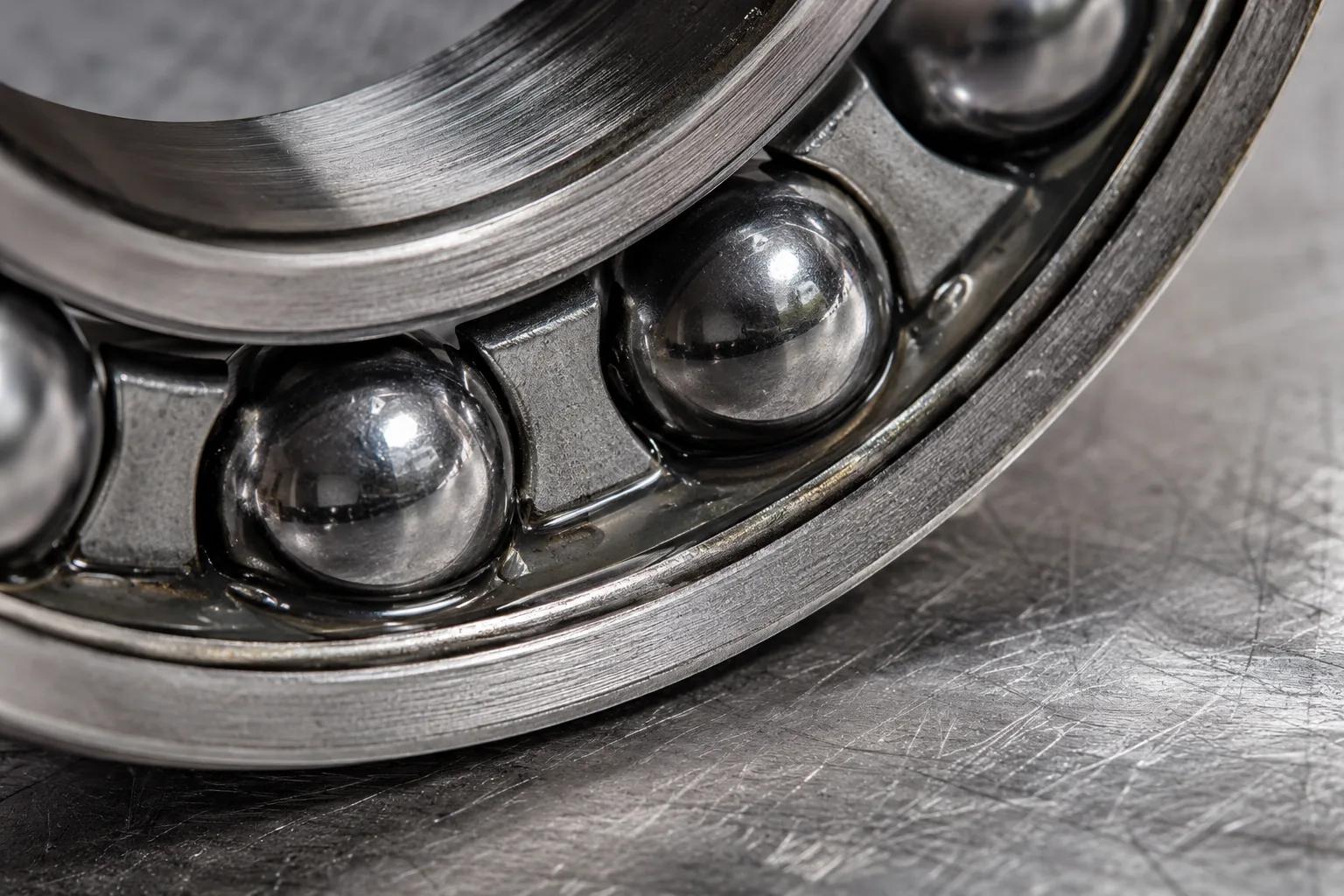
1. Why Are Lubrication Conditions Important for Bearing Steel Balls?
During bearing operation, steel balls roll between the inner and outer raceways while transmitting loads. Although rolling is the primary motion, localized sliding and friction can also occur, particularly under certain load, speed, and alignment conditions.
A suitable lubricant helps form a protective film between the contacting surfaces, reducing direct metal-to-metal contact and controlling friction and wear.
Proper lubrication provides several important benefits.
1.1 Reduces Friction and Wear
Lubrication helps minimize contact between microscopic surface irregularities on the steel balls and raceways. This reduces frictional losses and helps preserve the surface finish of precision bearing steel balls.
For bearings operating continuously under demanding conditions, maintaining an appropriate lubrication film is particularly important for controlling wear and supporting consistent performance.
1.2 Controls Operating Temperature
Friction generates heat during bearing operation. Appropriate lubrication can reduce frictional heat generation, while circulating oil systems can also help remove heat from the bearing assembly.
Excessive temperature may accelerate lubricant oxidation, reduce lubricant viscosity, and compromise lubrication performance. These effects can contribute to a higher risk of premature bearing damage.
1.3 Helps Reduce Rolling Contact Fatigue Risk
Bearing steel balls are subjected to repeated contact stresses during operation. Over time, these stresses may contribute to rolling contact fatigue.
An adequate lubricant film helps separate contacting surfaces and improve the lubrication regime, reducing damaging surface interactions under suitable operating conditions.
However, lubrication cannot eliminate rolling contact fatigue entirely. Material quality, contact stress, contamination, surface finish, and operating conditions must also be considered.
1.4 Provides Corrosion Protection
Depending on its formulation, a lubricant may help protect steel surfaces against moisture and corrosion. Effective seals and contamination control further reduce the risk of water, dust, and other harmful particles entering the bearing assembly.
This is especially important for industrial equipment operating in humid, dusty, or otherwise demanding environments.
2. How Can Insufficient Lubrication Shorten Bearing Service Life?
Insufficient lubrication is a common concern in bearing applications. When the lubricant supply or film thickness is inadequate, friction and surface interaction may increase, creating unfavorable operating conditions.
2.1 Inadequate Lubricant Film Thickness
Many rolling bearings operate under elastohydrodynamic lubrication (EHL), in which lubricant is drawn into highly loaded rolling contacts and forms a thin film between the surfaces.
Lubricant viscosity, operating temperature, rolling speed, surface roughness, and contact conditions all influence film formation.
If the lubricant viscosity is too low for the operating conditions, the lubricant supply is insufficient, or temperatures become excessive, the film may become too thin to adequately separate the contacting surfaces.
This can increase the risk of surface wear, micropitting, and other forms of contact damage.
2.2 Increased Friction and Heat Generation
Inadequate lubrication may increase friction and operating temperature. As temperature rises, the viscosity of many lubricating oils decreases, potentially reducing film thickness further.
Higher temperatures can also accelerate lubricant degradation, creating a cycle of deteriorating lubrication performance.
For high-speed motors, precision machinery, and industrial transmission systems, selecting an appropriate lubricant and maintaining suitable operating temperatures are essential.
2.3 Greater Risk of Surface Damage
Prolonged operation under poor lubrication conditions may contribute to surface scuffing, wear, micropitting, or fatigue-related flaking.
The actual damage mechanism depends on the steel ball material, load, speed, lubricant condition, contamination level, and bearing design.
Therefore, bearing service life should not be evaluated based on hardness alone. Lubrication performance and the complete operating environment must also be considered.
3. Can Excessive Lubrication Also Affect Bearing Life?
Yes. More lubricant does not always mean better lubrication.
In grease-lubricated bearings, excessive grease filling can increase churning resistance, frictional losses, and operating temperature, especially during running-in or at high speeds.
Overfilling may also interfere with proper grease distribution and accelerate lubricant deterioration under certain operating conditions.
The objective is to achieve the correct lubricant type, quantity, and replenishment interval for the specific bearing design.
Practical recommendation: For sealed bearings supplied with factory-filled grease, follow the bearing manufacturer's specifications. For relubricatable bearings, establish a maintenance schedule based on operating speed, load, temperature, environmental conditions, and lubricant performance.
4. How to Choose the Right Lubricant for Bearing Steel Balls
The choice between grease and oil depends on bearing design, operating speed, load, temperature, sealing arrangement, and maintenance requirements.
4.1 Grease Lubrication
Grease is widely used in electric motors, general machinery, household equipment, and many sealed bearing assemblies.
Its advantages include good retention within the bearing, relatively simple lubrication arrangements, and reduced dependence on continuous external oil supply systems.
When selecting bearing grease, consider the following factors:
-
Base oil viscosity: Choose a viscosity appropriate for the operating speed, load, and temperature.
-
Operating temperature range: Ensure the grease is suitable for both normal operating conditions and expected temperature variations.
-
Mechanical stability: Evaluate the grease's ability to maintain its properties under mechanical working.
-
Oxidation and corrosion protection: Consider the expected operating environment and maintenance interval.
-
Grease compatibility: Verify compatibility before mixing different grease formulations.
The correct grease quantity is equally important. Excessive filling may increase churning losses, particularly in high-speed precision bearings.
4.2 Oil Lubrication
Oil lubrication is commonly used in high-speed machinery, industrial transmission systems, and applications requiring continuous lubricant circulation or effective heat removal.
Depending on the system design, circulating oil can deliver lubricant to the bearing contact areas and help remove excess heat.
Important selection factors include:
-
Oil viscosity at the actual operating temperature.
-
Bearing speed and contact load.
-
Oxidation stability and anti-wear properties.
-
Oil supply method, flow rate, and filtration requirements.
-
Compatibility with seals and other system materials.
Oil that is too thin may not provide sufficient film thickness, while excessively viscous oil can increase frictional losses and churning resistance.
The appropriate oil grade should be selected according to the bearing manufacturer's recommendations and the actual operating conditions.
4.3 Grease vs. Oil: Which Is Better for Bearing Applications?
| Comparison | Grease Lubrication | Oil Lubrication |
|---|---|---|
| Main advantage | Good retention and relatively simple lubrication systems | Flexible supply and potential for effective heat removal |
| Typical applications | General machinery, electric motors, many sealed bearings | High-speed machinery and circulating lubrication systems |
| Maintenance focus | Grease quantity, replenishment, aging, and compatibility | Viscosity, oil flow, filtration, and replacement intervals |
| Selection criteria | Bearing design, speed, load, and temperature | Operating conditions, oil delivery, and cooling requirements |
Neither lubrication method is universally superior. The most suitable solution depends on the bearing configuration and application requirements.
5. How Do Operating Temperature, Speed, and Load Affect Lubrication?
Lubrication performance is closely linked to operating conditions. Temperature, speed, and load influence lubricant film formation, friction, and the risk of premature bearing damage.
5.1 Operating Temperature
As temperature increases, the viscosity of most lubricating oils decreases. High temperatures can also accelerate oxidation and deterioration of many lubricating greases.
For equipment operating continuously at elevated temperatures, lubricant selection should account for thermal stability, viscosity at operating temperature, and the expected maintenance interval.
Unexpected temperature increases should trigger a broader inspection of lubrication quantity, bearing load, installation conditions, seals, and other possible sources of friction.
5.2 Rotational Speed
Rotational speed affects lubricant distribution, shear behavior, and churning losses.
High-speed bearings generally require careful consideration of lubricant viscosity, grease filling quantity, oil supply, and heat dissipation.
For low-speed, heavily loaded applications, the ability to maintain an adequate lubricant film under high contact stress may be particularly important.
Understanding the intended application helps bearing manufacturers and component buyers select steel balls that meet the required material, precision, and surface quality specifications.
5.3 Applied Load
Higher loads can increase contact stress between steel balls and raceways. If the lubrication film is insufficient, surface interaction and the risk of contact damage may increase.
For heavy-load or shock-load applications, lubrication should be evaluated together with bearing design, material properties, hardness, dimensional accuracy, and the lubricant's load-carrying characteristics.
6. How Does Bearing Steel Ball Quality Affect Service Life?
Proper lubrication is essential, but it cannot compensate for every material or manufacturing defect.
For bearing manufacturers and industrial component buyers, the quality of the steel balls themselves is another important factor in long-term bearing reliability.
6.1 Material Quality and Internal Integrity
Bearing steel balls must meet the material and performance requirements of their intended applications. Harmful inclusions, internal defects, or inconsistent heat treatment may adversely affect rolling contact fatigue performance.
Selecting a supplier with reliable material control and manufacturing processes helps establish a consistent foundation for bearing performance.
6.2 Dimensional Accuracy and Sphericity
Diameter variation and deviations from a spherical shape can influence load distribution within a bearing.
Bearing steel balls manufactured to appropriate dimensional tolerances and sphericity requirements help support more consistent rolling contact and predictable bearing performance.
For precision applications, buyers should confirm the required ball diameter, dimensional variation, and applicable accuracy grade.
6.3 Surface Finish and Grinding Quality
Surface roughness influences the interaction between the lubricant film and microscopic surface irregularities.
When the lubricant film is relatively thin, surface finish becomes particularly important because surface irregularities may interact more directly.
Appropriate grinding and lapping processes help achieve the surface quality and precision required for the intended bearing application.
6.4 Hardness and Heat Treatment Consistency
Suitable hardness and controlled heat treatment help bearing steel balls withstand repeated contact loads and resist wear and permanent deformation.
However, maximum hardness is not necessarily the best solution for every application. Material grade, toughness, heat treatment, and operating loads must be considered together.
When sourcing bearing steel balls, buyers should evaluate material specifications, hardness, dimensional tolerances, sphericity, surface roughness, and inspection requirements rather than relying on a single quality parameter.
7. Practical Maintenance Tips to Extend Bearing Service Life
In addition to selecting the correct lubricant, a consistent maintenance program helps preserve bearing performance.
7.1 Keep Lubricants Clean
Dust, metal particles, and water can contaminate lubricants and increase the risk of abrasive wear or corrosion.
Use clean lubrication equipment, maintain appropriate seals, and follow the recommended filtration and contamination-control procedures.
7.2 Establish an Appropriate Lubrication Schedule
Grease replenishment and oil replacement intervals should be based on rotational speed, load, temperature, lubricant properties, and environmental conditions.
Applications involving high temperatures, high speeds, or significant contamination may require more frequent condition monitoring.
7.3 Monitor Temperature, Vibration, and Noise
Abnormal temperature increases, unusual noise, or rising vibration levels may indicate lubrication problems, contamination, installation errors, or other mechanical issues.
Monitoring operating trends helps identify developing problems before they lead to more serious damage.
7.4 Avoid Mixing Incompatible Lubricants
Different greases may contain different base oils, thickeners, and additive packages. Mixing incompatible products can change grease consistency and compromise lubrication performance.
Compatibility should be confirmed before changing or combining lubricants.
7.5 Maintain Proper Installation and Storage Conditions
During installation, avoid contamination, impact damage, and unnecessary handling of precision surfaces.
Unused bearing steel balls should be stored in clean, dry conditions with appropriate packaging to reduce the risk of corrosion and surface damage.
7.6 Investigate the Root Cause of Bearing Damage
When abnormal wear, flaking, excessive temperature, or unusual noise occurs, investigate lubricant condition, contamination, applied load, alignment, installation accuracy, and steel ball quality.
A systematic root-cause analysis is more effective than assuming that every bearing failure is caused by inadequate lubrication.
8. Why Choose a Reliable Bearing Steel Ball Supplier?
For bearing manufacturers, industrial equipment producers, and component distributors, consistent steel ball quality helps reduce batch variation and supports more predictable bearing performance.
When evaluating a bearing steel ball supplier, consider the following factors:
-
Product range: Availability of steel ball sizes and materials suitable for the intended application.
-
Precision control: Manufacturing and inspection capabilities that meet the required dimensional accuracy.
-
Material and heat treatment quality: Appropriate controls over material properties, hardness, and manufacturing consistency.
-
Batch consistency: Documented quality procedures, inspection records, and traceability where required.
-
Customization support: The ability to evaluate customer requirements for diameter, material, precision, and application conditions.
A reliable supplier should understand not only the product specifications but also the intended application. Information about rotational speed, load, temperature, lubrication method, and target precision can help determine the most appropriate steel ball specifications.
If you are sourcing bearing steel balls for industrial bearings or mechanical equipment, providing the required diameter, material grade, precision level, hardness requirements, and order quantity will help suppliers evaluate your needs more accurately.
9. Frequently Asked Questions About Bearing Steel Ball Life and Lubrication
Q1: Does better lubrication always increase bearing steel ball service life?
Not necessarily. Appropriate lubrication can reduce friction, improve rolling contact conditions, and lower certain wear risks. However, bearing service life also depends on material quality, load, speed, installation accuracy, contamination, and rolling contact fatigue.
Q2: Can insufficient lubrication cause bearing steel balls to flake or peel?
Insufficient lubrication can increase surface interaction and contribute to certain forms of surface damage and fatigue. However, flaking may also result from material defects, excessive loads, contamination, improper installation, or other factors. The actual cause should be assessed based on the damage characteristics and operating history.
Q3: Should bearing steel balls be lubricated with grease or oil?
The choice depends on bearing design, rotational speed, load, operating temperature, and lubrication system requirements. Grease is suitable for many general-purpose applications, while oil is often used in high-speed systems or applications requiring circulating lubrication and heat removal.
Q4: Can high-precision bearing steel balls reduce lubrication-related problems?
High-precision steel balls help control dimensional and shape deviations and support more consistent rolling contact. However, precision cannot replace proper lubrication. Inadequate lubricant selection or contamination may still cause wear and premature bearing damage.
Q5: What specifications should buyers confirm when sourcing bearing steel balls?
Buyers should typically confirm:
-
Ball diameter and dimensional tolerances.
-
Material grade and heat treatment requirements.
-
Hardness specifications.
-
Sphericity and surface roughness.
-
Applicable inspection standards and quality documentation.
-
Intended application, operating environment, and order quantity.
Clearly defined specifications help suppliers assess whether their products are suitable for the target bearing application.