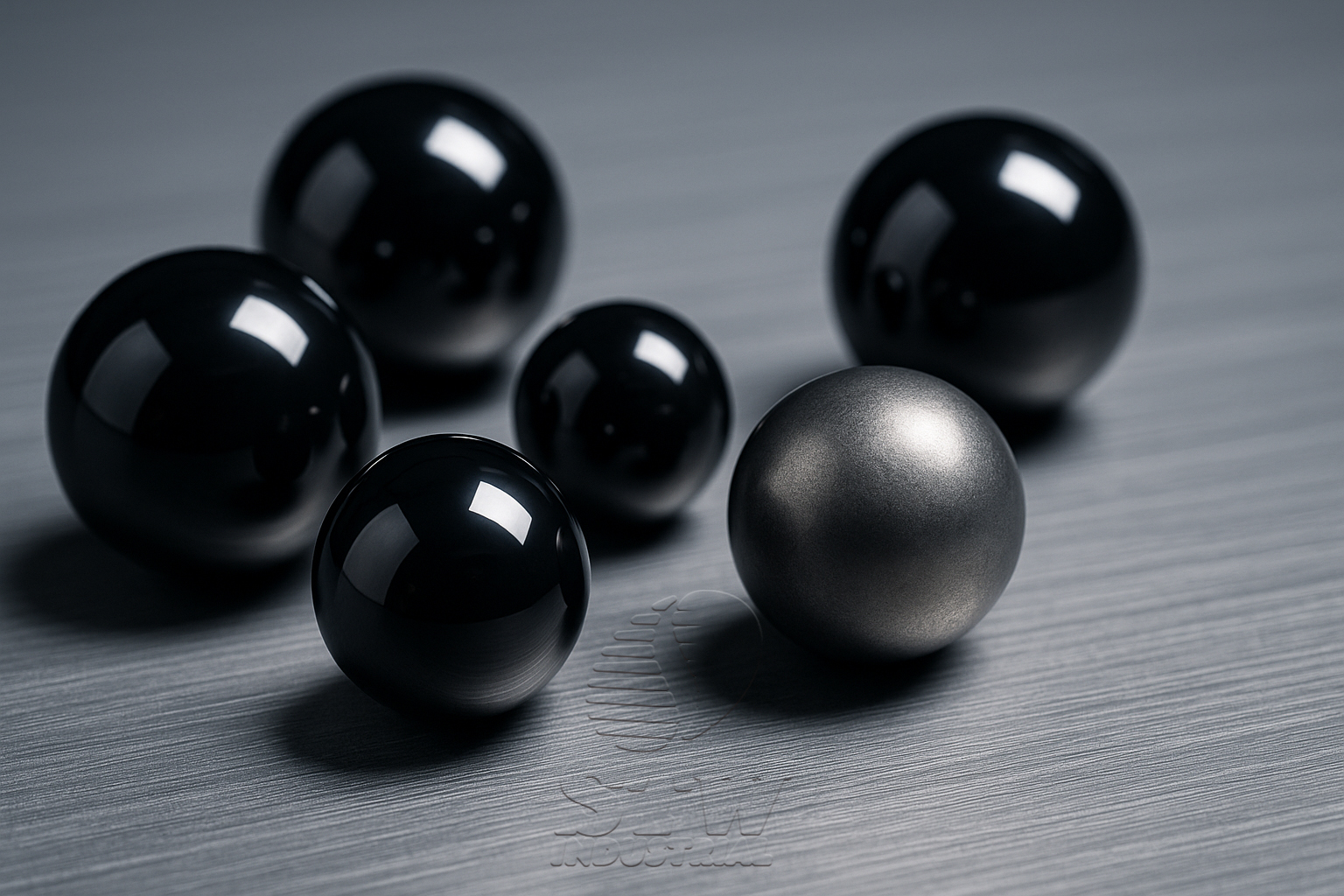
In the aerospace industry, every component is subject to stringent performance standards. As technology advances toward higher reliability, lighter structures, and longer service life, traditional metal balls are no longer sufficient. This has brought ceramic balls and tungsten carbide balls into the spotlight, earning their place in critical aerospace systems due to their exceptional material properties and performance.
1. From Material to Performance: Built for Extreme Demands
Ceramic Balls: Lightweight Strength for Harsh Environments
Ceramic balls (typically made of silicon nitride Si₃N₄, zirconia ZrO₂, or alumina Al₂O₃) exhibit excellent physical and chemical properties:
-
Low Density: Silicon nitride ceramic balls are nearly 50% lighter than traditional steel balls, reducing aircraft load.
-
High Hardness & Strength: With great shock resistance and rigidity, they are ideal for high-speed applications.
-
Outstanding Corrosion Resistance: They perform reliably in environments exposed to moisture, acids, and aviation fuel.
-
Excellent Heat Resistance: Certain ceramics withstand temperatures up to 1200°C, making them suitable for engines and combustion zones.
-
Electrical Insulation & Non-Magnetic: Perfect for systems sensitive to electromagnetic interference, like inertial navigation and avionics.
Tungsten Carbide Balls: Strength & Precision Under Pressure
Tungsten carbide balls (typically made from WC-Co hard alloy) offer superior mechanical strength and wear resistance:
-
Hardness Above HRA 90, far exceeding that of bearing steel.
-
Exceptional Compressive Strength, maintaining dimensional stability under heavy load.
-
Ultra-Low Wear Rate, leading to longer service life and minimal maintenance.
-
Shock & Vibration Resistance, making them suitable for gyroscopes, inertial modules, and stabilizers.
2. Widely Applied in Critical Aerospace Systems
Ceramic and tungsten carbide balls are trusted components in the following systems:
| Application | Ball Type | Role & Advantages |
|---|---|---|
| Satellite Attitude Control | Ceramic Ball | Non-magnetic, stable rotation, no EMI |
| Jet Engine Bearings | Ceramic & Tungsten Carbide | High-temp endurance, long life |
| Inertial Navigation Systems | Tungsten Carbide Ball | High accuracy, structural integrity |
| Gyroscopic Stabilizers | Ceramic Ball | Low thermal expansion, long-term stability |
| Flight Control Assemblies | Tungsten Carbide Ball | High strength and fast response |
| Satellite Motor Components | Ceramic Ball | High-speed durability, reduced friction |
3. Meeting Aviation-Grade Quality Standards
Our ceramic and tungsten carbide balls meet or exceed international aerospace standards:
-
AMS 5898 Aerospace Materials Specification
-
ISO 3290 / ABMA Grades G5–G3
-
MIL-STD-810 Environmental Testing
-
AS9100D Aerospace Quality Management System
All products undergo 100% inspection for size, tolerance, roundness, surface roughness, hardness, magnetism, and electrical resistance—ensuring they perform under the most demanding missions.
4. Industry Trend: Lighter, More Accurate, More Reliable
The demand for lighter, faster, and smarter aerospace components is accelerating. Ceramic and tungsten carbide balls are increasingly used in:
-
Commercial satellites
-
Unmanned aerial vehicles (UAVs)
-
Hypersonic aircraft
-
Advanced inertial guidance systems
Their total lifecycle cost advantage—thanks to lower maintenance, longer life, and greater safety—makes them a strategic investment for aerospace OEMs and Tier 1 suppliers alike.
5. Conclusion: Trusted Materials for Critical Missions
As a professional B2B manufacturer and global supplier of industrial ball solutions, we are committed to delivering aerospace-grade precision, durability, and performance.
From material sourcing and precision machining to bulk delivery and custom engineering, we serve aerospace clients with a deep understanding of what’s at stake—because even the smallest ball can carry the weight of a mission to the skies.