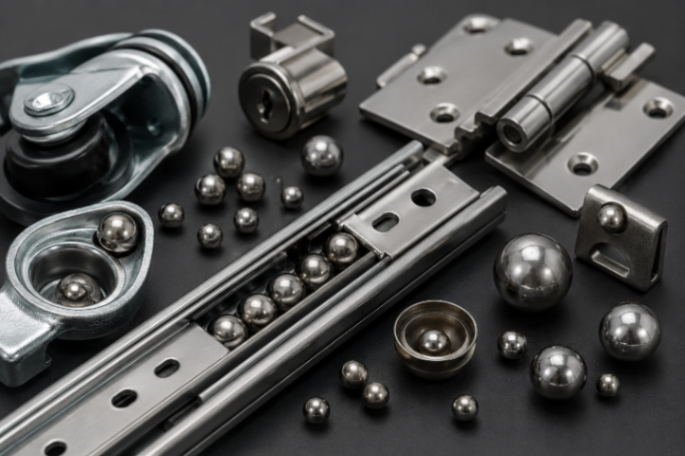
What Are Carbon Steel Balls?
Carbon steel balls are spherical components manufactured primarily from carbon steel. Depending on the application, they can be produced through processes such as cold heading, machining, heat treatment, grinding, lapping, and polishing.
Different carbon steel grades and heat treatment conditions can provide different combinations of hardness, toughness, wear resistance, and machinability.
Common categories include:
- Low-carbon steel balls
- High-carbon steel balls
- Soft or non-hardened carbon steel balls
- Heat-treated carbon steel balls
- Surface-treated carbon steel balls
The appropriate type depends on the working conditions and performance requirements of the final product.
For example, a soft carbon steel ball may be suitable for applications requiring further processing, while a hardened carbon steel ball can provide better wear resistance for repeated rolling or contact applications.
Why Are Carbon Steel Balls Widely Used in Hardware Fittings?
The hardware industry often requires components that provide a good balance between performance, manufacturing efficiency, availability, and cost.
Carbon steel balls meet many of these requirements.
1. Good Mechanical Strength
Carbon steel provides good mechanical properties and can achieve different hardness levels through appropriate material selection and heat treatment.
This makes carbon steel balls suitable for hardware components exposed to repeated loads, rolling contact, and mechanical movement.
2. Good Wear Resistance
Heat-treated carbon steel balls can achieve relatively high hardness, helping reduce wear during repeated rolling and contact.
This is particularly important for products such as drawer slides, casters, and mechanical components that undergo frequent movement.
3. Cost-Effective Solution
Cost is an important consideration in high-volume hardware manufacturing.
Because carbon steel is widely available and has an established manufacturing process, carbon steel balls can provide a practical balance between performance and cost for many general-purpose hardware applications.
For manufacturers purchasing thousands or millions of balls, even a small difference in unit cost can have a significant impact on overall production costs.
4. Flexible Specifications
Hardware manufacturers may require different ball diameters, tolerances, hardness levels, surface finishes, and packaging methods.
Professional steel ball manufacturers can provide customized specifications according to the customer's application, assembly structure, and production requirements.
Main Applications of Carbon Steel Balls in the Hardware Fittings Industry
1. Drawer Slides
Drawer slides are one of the most common applications for steel balls in the hardware industry.
In ball-bearing drawer slides, multiple steel balls are positioned between the slide members. The balls allow the components to move relative to each other through rolling contact.
This helps provide smooth opening and closing while supporting the load of the drawer.
Carbon steel balls are commonly considered for applications such as:
- Furniture drawer slides
- Office cabinet slides
- Tool cabinet slides
- Industrial storage systems
- Heavy-duty drawer systems
For drawer slide manufacturers, important steel ball specifications may include:
- Ball diameter
- Diameter tolerance
- Sphericity
- Hardness
- Surface finish
- Material grade
- Corrosion protection
Consistent ball dimensions are especially important in high-volume assembly because variations between balls can affect rolling performance and assembly consistency.
2. Furniture Casters and Industrial Casters
Carbon steel balls are also used in various casters and wheel assemblies.
Depending on the caster design, steel balls can be used to support rotation, enable directional movement, or distribute loads within the swivel mechanism.
Typical applications include:
- Office chair casters
- Furniture casters
- Equipment carts
- Tool trolleys
- Industrial transport equipment
The steel balls used in these applications may experience repeated loads and continuous movement. Therefore, hardness, dimensional consistency, and surface quality can all influence the service life of the component.
For higher-load or more demanding applications, the ball material and heat treatment should be selected according to the actual load and operating conditions.
3. Locks and Door Hardware
Carbon steel balls can be found in certain locks, door hardware, and mechanical locking mechanisms.
In these applications, small steel balls can serve functions such as positioning, locking, detenting, or controlled movement.
Because these components are usually small and incorporated into compact mechanisms, dimensional consistency is particularly important.
For applications exposed to humidity or moisture, surface protection should also be considered. Standard carbon steel can be susceptible to corrosion, so manufacturers may specify suitable protective treatments or consider stainless steel balls when corrosion resistance is a primary requirement.
4. Hinges and Rotational Hardware
Steel balls can also be used in certain hinges, pivot mechanisms, and rotational hardware.
In mechanical structures where components repeatedly rotate or move, rolling elements can help reduce friction and improve movement.
Potential applications include:
- Furniture hinges
- Industrial cabinet hardware
- Toolboxes
- Mechanical enclosures
- Door and window hardware
The appropriate ball specification depends on the load, frequency of movement, available installation space, and required service life.
5. Conveyor and Material Handling Equipment
Another important application is material handling equipment.
Ball transfer units use multiple balls to allow loads to move easily in different directions. They are commonly used in material handling systems where operators need to reposition heavy or bulky products.
Carbon steel balls can be suitable for many general industrial applications because of their mechanical properties and cost efficiency.
Depending on the operating environment, manufacturers may also select stainless steel balls or other materials when corrosion resistance or special performance requirements are involved.
6. Bicycle and Mechanical Components
Steel balls have a long history of use in various bicycle and mechanical components.
Depending on the design, balls can be used to support rotational movement and reduce friction between moving components.
Applications may include selected bicycle components and general mechanical assemblies.
However, material selection should always be based on actual operating conditions. Applications involving high speed, high loads, or precision bearing requirements may require bearing steel balls or other specialized materials rather than standard carbon steel balls.
How to Choose the Right Carbon Steel Balls for Hardware Applications
Choosing the correct steel ball involves more than selecting the right diameter.
1. Ball Diameter
The ball diameter must match the design of the raceway, retainer, housing, or mechanical assembly.
A ball that is too large may cause assembly problems or excessive interference, while a ball that is too small may reduce load capacity or affect mechanical performance.
Therefore, manufacturers should confirm the required nominal diameter and tolerance before placing a bulk order.
2. Hardness
Hardness is an important factor affecting wear resistance and resistance to deformation.
For applications involving continuous rolling or repeated contact, a properly heat-treated steel ball may provide better wear resistance.
However, not every application requires maximum hardness.
If the ball needs to undergo secondary processing, forming, welding, or other manufacturing operations, a softer material condition may be more appropriate.
3. Dimensional Accuracy
Dimensional accuracy is particularly important when multiple balls are installed in the same mechanism.
If the balls have significant dimensional variation, they may create inconsistent rolling resistance, uneven loading, or assembly problems.
For this reason, B2B buyers should pay attention not only to the nominal ball diameter but also to:
- Diameter tolerance
- Sphericity
- Surface roughness
- Batch consistency
- Inspection standards
4. Surface Finish
The surface finish of a steel ball affects its contact and rolling behavior.
For hardware components that require smooth movement, a clean and properly finished surface can contribute to more consistent operation.
Professional grinding and polishing processes are therefore important for applications where surface quality matters.
5. Surface Treatment and Corrosion Protection
Carbon steel is not naturally highly corrosion-resistant.
If carbon steel balls are exposed to moisture, humidity, or corrosive environments, suitable surface protection should be considered.
Possible options include:
- Rust-preventive oil
- Black oxide
- Zinc plating
- Nickel plating
- Phosphate treatment
- Other customized protective coatings
For applications requiring long-term corrosion resistance, stainless steel balls may be a better choice than standard carbon steel balls.
Carbon Steel Balls vs. Other Ball Materials
Different industrial applications require different material characteristics.
| Material | Main Advantages | Typical Applications |
|---|---|---|
| Carbon Steel Balls | Cost-effective, good mechanical properties | Hardware fittings, drawer slides, casters, locks |
| Bearing Steel Balls | High hardness, wear resistance, precision | Bearings and precision mechanical systems |
| Stainless Steel Balls | Excellent corrosion resistance | Wet, outdoor, food, medical, and chemical environments |
| Ceramic Balls | Lightweight, corrosion-resistant, high-speed capability | High-speed bearings and specialized applications |
There is no single material that is ideal for every application.
For general-purpose hardware fittings where cost efficiency and mechanical performance are important, carbon steel balls can be an effective choice.
For high-speed, high-precision, heavy-load, or highly corrosive environments, however, other materials may provide better performance.
What Should B2B Buyers Consider When Purchasing Carbon Steel Balls?
For international hardware manufacturers and industrial distributors, selecting a reliable supplier is just as important as selecting the right material.
Material Consistency
Stable raw material quality helps maintain consistent mechanical properties between production batches.
Dimensional Consistency
When large quantities of steel balls are used in automated assembly, consistent dimensions can help reduce production variation.
Heat Treatment
For hardened carbon steel balls, heat treatment has a direct influence on hardness, wear resistance, and overall performance.
Surface Treatment
The appropriate surface treatment should be selected according to the storage conditions, operating environment, and required corrosion protection.
Quality Inspection
A professional supplier should have appropriate inspection procedures for dimensions, hardness, surface quality, and other customer-specified requirements.
OEM and Custom Manufacturing
Different hardware products may require non-standard diameters, customized hardness, special surface treatments, packaging, or large-volume production.
Working with a manufacturer capable of supporting OEM and customized requirements can simplify long-term procurement.
Why Choose a Professional Carbon Steel Ball Manufacturer?
For hardware manufacturers, steel balls may be small components, but their quality can have a direct impact on the performance of the final product.
A professional manufacturer can control the complete production process, including:
Raw Material → Forming → Heat Treatment → Grinding → Polishing → Inspection → Packaging
This integrated approach helps improve consistency and allows manufacturers to provide more reliable products for different industrial applications.
Changzhou Huari Steel Ball Co., Ltd. is a professional manufacturer specializing in steel balls and related spherical components. Established in 2002, the company provides a range of products including carbon steel balls, bearing steel balls, stainless steel balls, copper balls, aluminum balls, bearings, and ball retainers.
Huari's steel ball product range covers diameters from approximately 0.5 mm to 250 mm, supporting a wide variety of industrial applications and customized requirements.
The products are used in industries including mechanical manufacturing, automotive components, bicycles, hardware fittings, and other industrial applications.
For international B2B customers, Huari focuses not only on product quality but also on material selection, dimensional requirements, quality control, customized production, packaging, and export support.