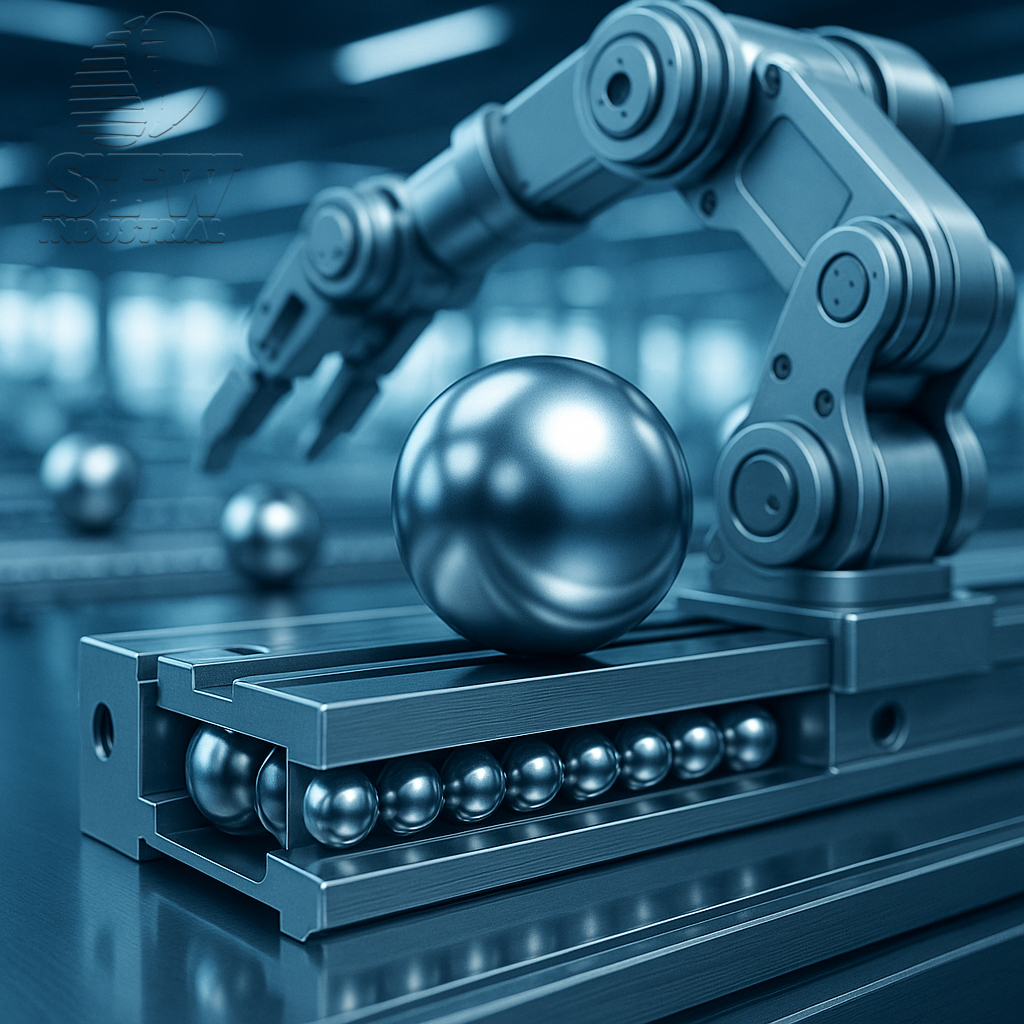
Tiny components that keep the wheels of smart manufacturing turning
In today’s rapidly evolving smart manufacturing landscape, automated assembly lines have become the backbone of modern factories. Designed to enhance efficiency, precision, and stability, these systems rely on thousands of interlinked components—among which industrial ball products play an unexpectedly critical yet often overlooked role. Acting much like “lubricants” in mechanical systems, these small spheres ensure smooth, stable, and efficient motion across various assemblies.
1. Small Components, Big Impact
Ball products—such as bearing steel balls, stainless steel balls, ceramic balls, and plastic balls—are widely used in the moving and transmission components of automation equipment. Their functions include friction reduction, motion transmission, positioning, buffering, and support. Typical applications include:
• Precision Bearings & Rotational Units
High-speed motors, robotic joints, and conveyor systems rely heavily on bearings, where the ball is the core element that enables rolling instead of sliding, thus minimizing friction and energy loss.
• Linear Guides & Slider Systems
Steel or ceramic balls in linear guideways allow precise, low-resistance linear motion, essential for devices like pick-and-place machines, dispensing units, and laser cutters.
• Transfer & Sorting Mechanisms
Ball transfer units and rolling tracks use balls to allow flexible positioning and smooth movement, making them ideal for material handling and product sorting systems.
• Robotic Grippers & End Effectors
Micro balls integrated in sliding joints or contact surfaces enhance the grip accuracy, cushioning effect, and flexibility of robotic hands and end effectors.
2. More Than Just Friction Reduction – Enabling Efficiency & Reliability
The “lubricating” role of ball products in automation goes beyond just minimizing friction. It includes:
-
Energy Efficiency: Rolling friction is far lower than sliding friction, easing motor loads and reducing power consumption
-
Durability: Less wear and tear on contact surfaces extends the lifespan of machines
-
Precision Control: The dimensional accuracy of balls directly affects mechanical precision
-
Operational Stability: Reduces vibration, improves equipment reliability
-
Adaptability: Specialized ball materials (e.g., ceramic, plastic) are suitable for harsh environments including high-temperature, corrosive, and cleanroom conditions
In high-speed, high-precision manufacturing, ball products are not just passive components—they are key contributors to dynamic coordination and overall system stability.
3. Choosing the Right Ball Product: A Foundational Investment in Automation
As a professional B2B manufacturer and supplier of ball products, we understand how critical it is to choose the right component. Our offerings include:
Wide Material Range: Bearing steel (GCr15), 304/316 stainless steel, zirconia ceramic, PEEK and nylon for specific needs
Precision Grades: From G1000 to G10, to meet both general and high-precision industrial applications
Durable Processing: Advanced heat treatment, fine grinding, anti-corrosion coatings for long-term performance
Customization Support: Tailor-made solutions in terms of size, material, and application—backed by technical expertise
We aim to provide cost-effective, high-performance ball solutions that support the smooth and reliable operation of your automation systems.
4. Conclusion: Tiny Giants Behind Smart Production
As the global manufacturing industry evolves toward faster, smarter, and more efficient systems, every tiny part counts. Ball products may be small, but they play a giant role in keeping automation equipment operating seamlessly.
We believe that every precision machine begins with a precision ball. Let us be your trusted partner in optimizing your automated assembly lines—one ball at a time.