In the industrial manufacturing chain, balls may be small in size, but their role is critical. Whether used in bearings, automotive parts, mechanical transmission systems, or precision instruments, their performance directly affects overall functionality and reliability. For B2B buyers, choosing a high-quality and dependable ball supplier is not just about finding the lowest price—it's a strategic decision tied to quality control, delivery efficiency, and brand reputation.
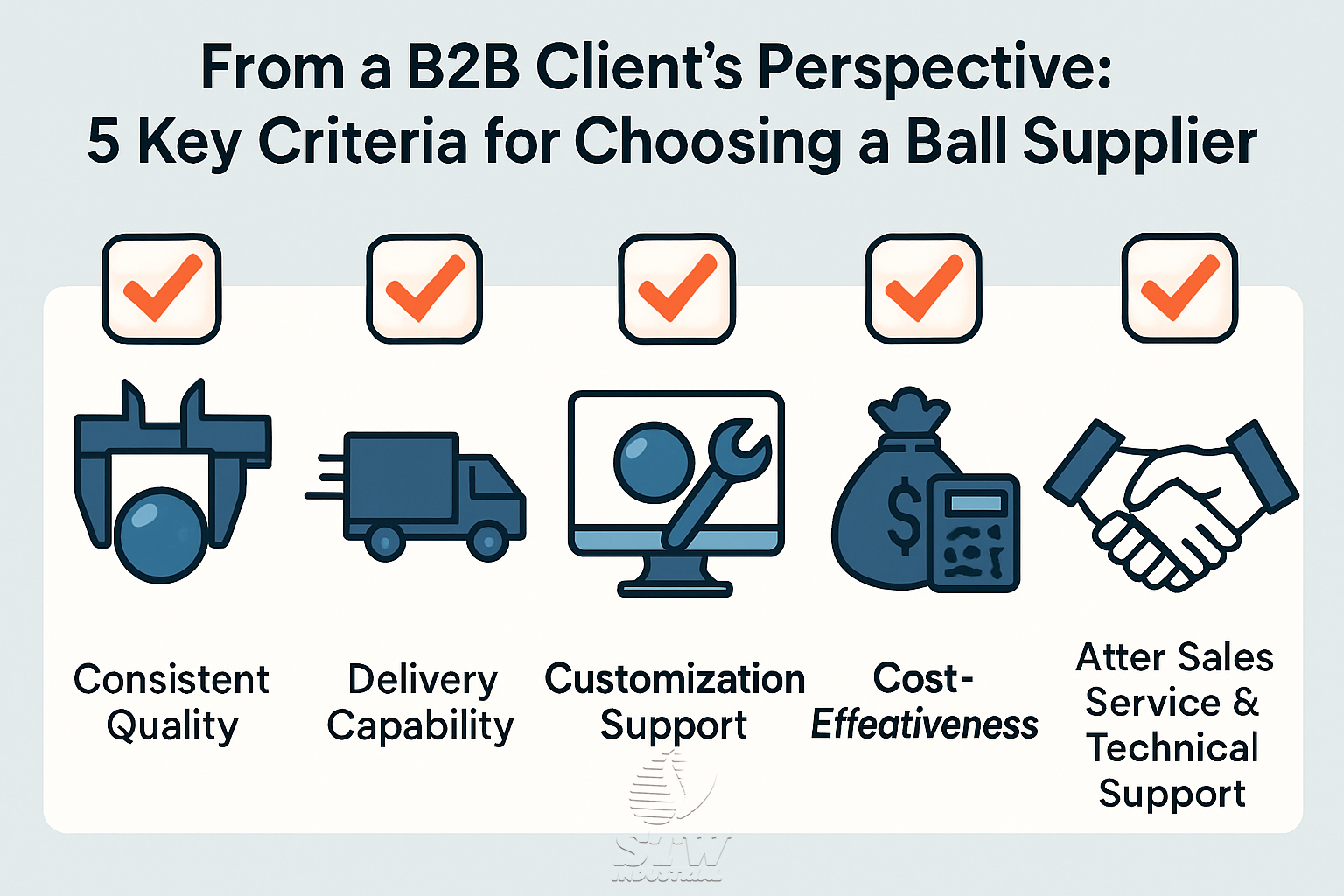
So, from a B2B customer’s point of view, what are the five essential criteria when evaluating a ball supplier?
1. Consistent Quality: Precision and Reliability First
Stable quality always outweighs short-term cost savings. An ideal ball supplier should meet the following quality standards:
-
Operates under a strict ISO-certified quality management system
-
Capable of producing high-precision balls (G10–G100 grades)
-
Equipped with advanced inspection devices (e.g., roundness testers, roughness meters, optical sorters)
-
Minimal batch-to-batch variation to ensure consistent performance
Reliable suppliers are often willing to provide detailed inspection reports and third-party certifications to back up their quality claims.
2. Delivery Capability: Timely Shipping with Agile Response
Delivery capacity is more than just fast shipping. B2B buyers need suppliers that can:
-
Maintain stable stock for standard models
-
Offer flexible production scheduling for urgent or small orders
-
Partner with efficient global logistics networks
-
Handle both small batch orders and mass production smoothly
A supplier who can respond quickly and reliably is crucial for manufacturers working under tight timelines.
3. Customization Support: Tailored to Diverse Applications
Different industries demand balls with unique materials, hardness levels, coatings, and even colors. A capable supplier should:
-
Offer a wide range of materials (bearing steel, stainless steel, copper, ceramic, carbon steel, etc.)
-
Support custom sizes, shapes, or surface treatments
-
Provide technical advice and help with application adaptation
Suppliers who engage in technical communication are more likely to deliver solutions—not just products.
4. Cost-Effectiveness & Transparent Pricing
In B2B, cost-effectiveness ≠ lowest price. Buyers consider a balance of quality, delivery time, support, and brand reliability. A trustworthy supplier should provide:
-
Clear and transparent pricing
-
Stable long-term pricing policies
-
Support for sample orders or small-volume testing
-
Reasonable Minimum Order Quantity (MOQ) terms
The more open and detailed the quotation, the stronger the buyer’s confidence.
5. After-Sales Service & Technical Support
Issues may arise, but how they are handled reflects a supplier’s professionalism. A trusted ball supplier should:
-
Offer a well-defined after-sales process
-
Have a fast replacement or return policy
-
Provide technical support such as installation advice, wear analysis, and service life recommendations
-
Maintain a multi-language customer service team for international communication
A great supplier is not just a vendor—but a reliable technical partner to your engineering and procurement teams.
Conclusion
In B2B partnerships, selecting the right ball supplier means more than securing good prices. It’s about long-term collaboration built on quality, delivery, customization, transparency, and support. At our company, we align our services with these five dimensions to create real value for our customers.