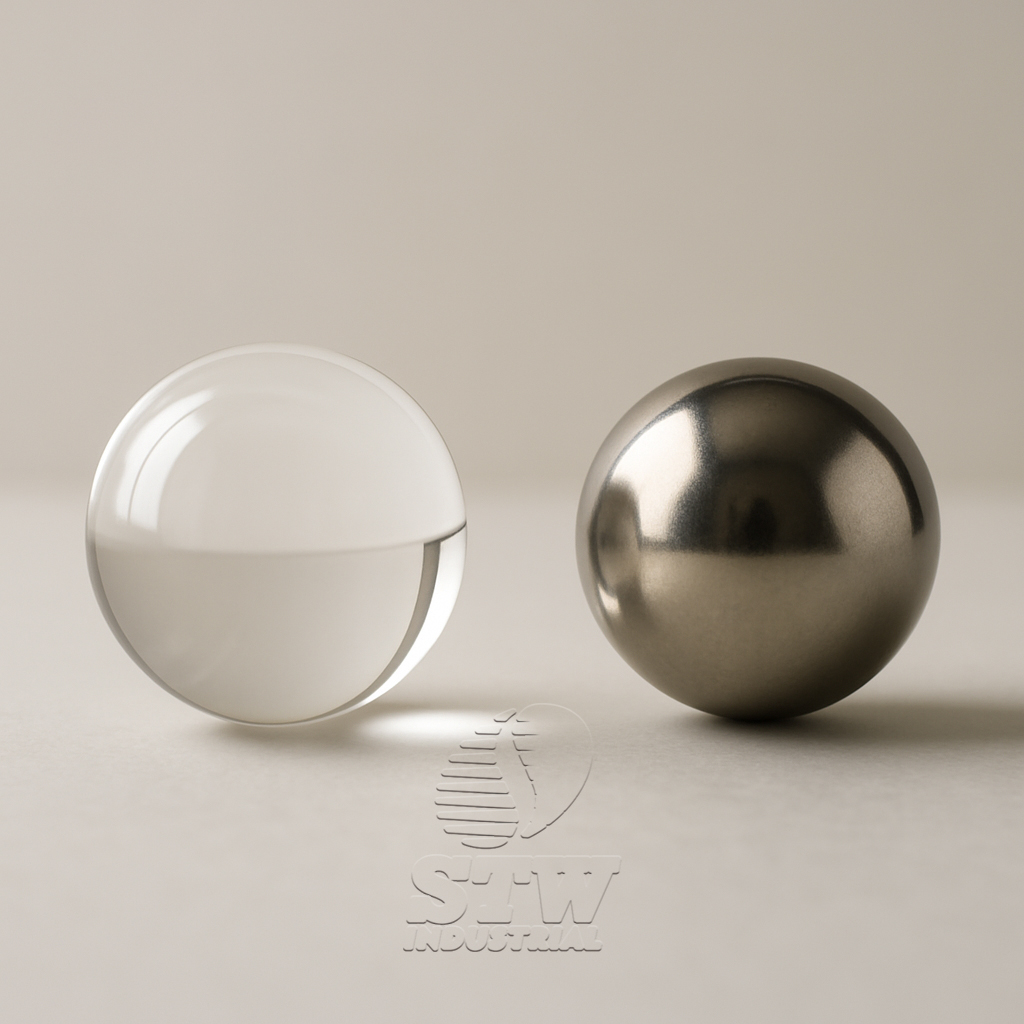
In the fields of industrial components, decorative materials, and functional fillers, spherical products play a key role. Among them, steel balls and glass beads may appear similar in shape, but their differences in material, performance, manufacturing process, and applications are significant.
This article dives deep into the material composition, performance characteristics, production methods, typical applications, and selection guidance of these two types of spheres — helping buyers make informed and accurate choices.
1. Material Matters: Different Cores, Different Strengths
Steel Balls – Built for Strength
Common steel ball materials include:
Bearing Steel (GCr15):
High hardness and wear resistance
Used in high-speed bearings, motors, and gear systems
Stainless Steel (SUS304, SUS316):
Excellent corrosion resistance
Suitable for food-grade, medical, and chemical environments
Carbon Steel:
Lower cost, medium hardness
Commonly used in hardware, toys, sliding rails
Glass Beads – Lightweight and Chemically Stable
Main glass materials include:
Soda-lime Glass:
Economical and transparent
Widely used in reflective paints, decorative fillers
Borosilicate Glass:
High thermal and chemical resistance
Used in high-temperature or laboratory environments
Quartz Glass:
Extremely heat resistant and insulating
Ideal for semiconductors and precision optics
2. Performance Comparison
| Category | Steel Balls | Glass Beads |
|---|---|---|
| Hardness | Very high (HRC 60+) | Moderate (Mohs 5–6) |
| Wear Resistance | Excellent | Moderate |
| Corrosion Resistance | Depends on material | Excellent (glass is non-reactive) |
| Density | High (approx. 7.8 g/cm³) | Low (approx. 2.5 g/cm³) |
| Conductivity | Good conductor | Electrical insulator |
| Appearance | Metallic sheen, industrial feel | Glossy, translucent, decorative |
Steel balls emphasize strength and precision. Glass beads offer chemical stability and aesthetic versatility.
3. Production Process: Precision vs. Volume
Steel Ball Manufacturing:
Cold Heading → 2. Flashing → 3. Heat Treatment
Rough Grinding → 5. Fine Grinding → 6. Polishing
Inspection & Sorting
Accuracy up to Grade G5 (tolerance <0.001mm)
Suitable for high-performance, high-precision industries
Glass Bead Manufacturing:
Glass Melting → 2. Drip Spheroidization → 3. Cooling
Annealing → 5. Polishing / Sandblasting → 6. Screening
Cost-effective for large-volume production
Perfect for non-load-bearing, non-precision uses
4. Common Applications
Steel Balls:
Bearings: Electric motors, fans, automotive hubs
Linear Rails: CNC machines, automation systems
Hardware: Sliding doors, locks, drawer runners
Medical Devices: Surgical guides, dental tools
Glass Beads:
Sandblasting Media: Surface finishing and cleaning
Decoration: Cosmetic packaging, toy fillings, ornaments
Reflective Paint: Road markings, traffic signs
Lab Use: Filtration, insulation, carriers in testing
5. Selection Guide
Choose based on performance requirements and usage environments:
| Need | Recommended Product |
|---|---|
| High load or rotational applications | Bearing Steel Balls (GCr15) |
| Corrosive or hygienic environments | Stainless Steel Balls |
| Budget-conscious general usage | Carbon Steel / Soda Glass |
| Aesthetic or non-load purposes | Glass Beads (clear/color) |
| Electrical insulation or non-conductive | Quartz Glass Beads |
6. Conclusion
Steel balls and glass beads may look similar, but their core attributes are entirely different. Steel balls are the "muscle and bones" of mechanical systems, designed for durability and precision. Glass beads, on the other hand, are versatile "multi-tools" used for decoration, light reflection, insulation, and chemical stability.
Understanding their properties ensures optimal performance in your applications. Need custom specs or bulk supply? Contact us for multi-material, multi-size ball solutions tailored to your industry.