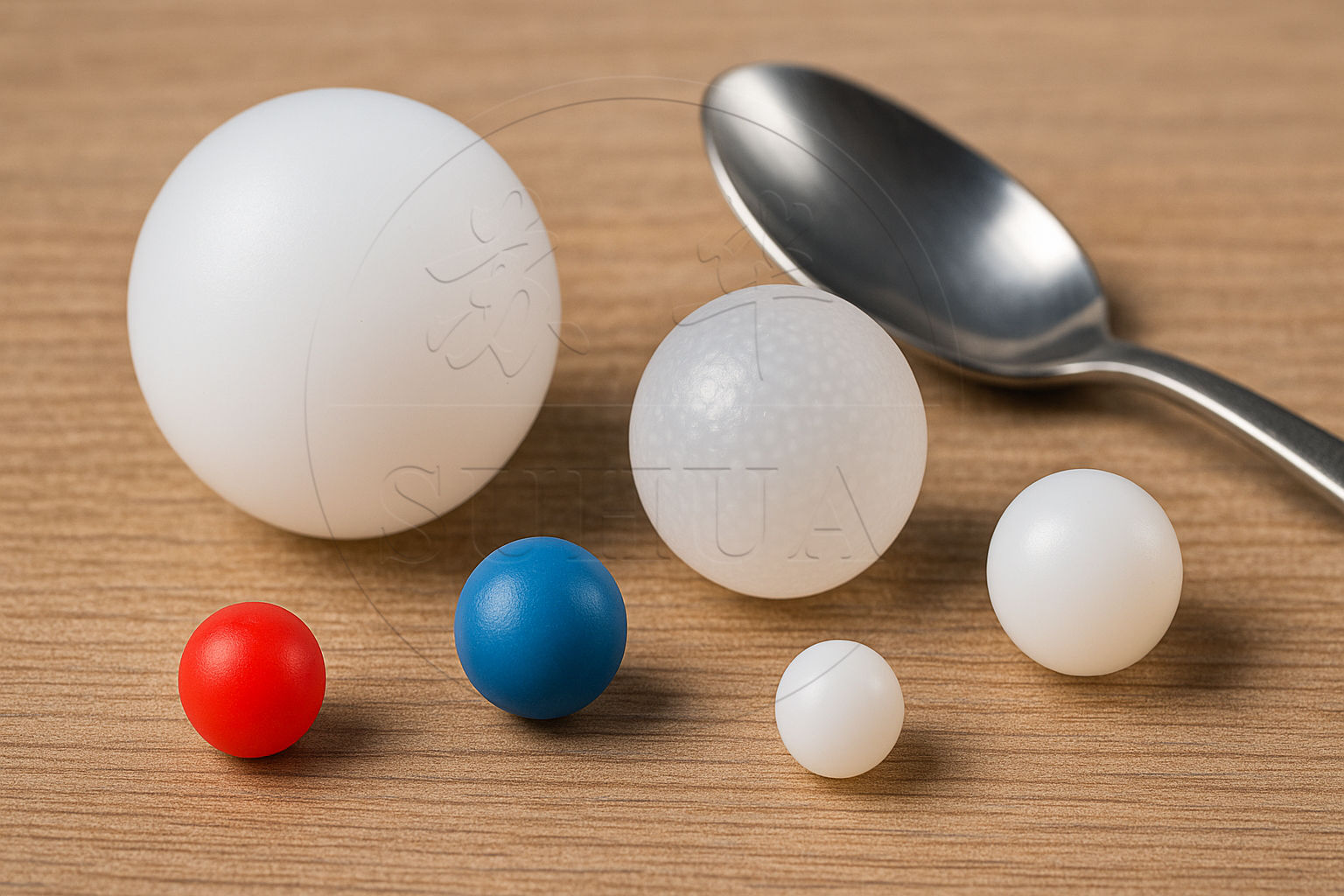
In the food processing, beverage filling, and pharmaceutical industries, plastic balls are not only essential components for mechanical transmission and valve sealing but also directly linked to food safety. As food-grade products, their manufacturing and testing must strictly comply with relevant standards to ensure they do not release harmful substances during long-term contact with food or beverages. Below are the key testing standards and requirements.
1. Material Safety Standards
The primary requirement for food-grade plastic balls is that the material must be safe, non-toxic, and odorless. Common materials include POM (Acetal), PP (Polypropylene), PE (Polyethylene), and PTFE (Teflon), which must meet:
-
FDA Certification — Ensures materials are safe for food contact.
-
EU Regulation 10/2011 — European safety standards for food contact plastics.
-
GB 4806 Series Standards — China’s national food safety standards (e.g., GB 4806.7 for plastics).
2. Migration Testing
Migration testing evaluates whether any chemical components migrate from the plastic into food under different temperatures, times, and media:
-
Overall Migration: The total amount of all substances migrating must be within limits (commonly ≤10 mg/dm²).
-
Specific Migration: Certain metals, monomers, or additives must be below regulated thresholds.
3. Physical and Mechanical Performance
Food-grade plastic balls must deliver high mechanical performance to withstand frequent operation and diverse media:
-
Hardness and Wear Resistance: Ensures long-term durability without deformation.
-
Dimensional Accuracy: Tolerances should meet ISO 3290 or GB/T 308 ball precision standards for proper transmission and sealing.
-
Temperature Resistance: No deformation or cracking after high-temperature sterilization (e.g., steam).
4. Hygiene and Surface Quality
-
The surface must be smooth, crack-free, and pore-free to prevent bacterial growth.
-
Optional polishing or fine grinding to reduce friction and improve hygiene.
5. Quality Management in Production
-
ISO 9001 Quality Management System — Ensures full production traceability.
-
ISO 22000 Food Safety Management System — Guarantees compliance from raw material to finished product.
6. Common Certification and Testing Agencies
-
SGS, TÜV, BV and other international third-party agencies.
-
Provide test reports, MSDS, and Declaration of Compliance for export or bidding.
Conclusion
Food-grade plastic balls must meet both mechanical performance and stringent food safety regulations. From material selection to final inspection, we strictly follow international and national standards, ensuring our products are safe and reliable for food, beverage, and pharmaceutical applications.