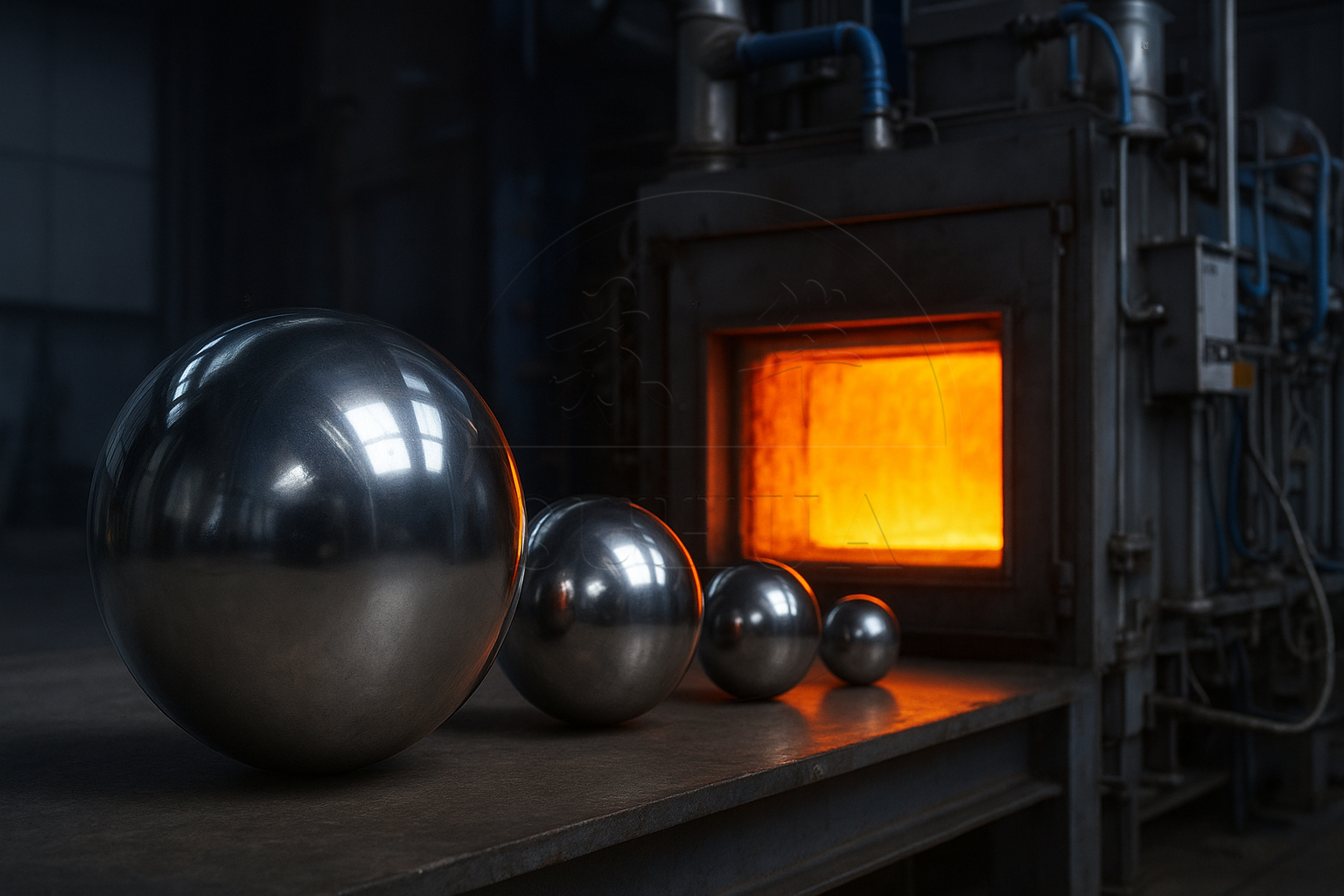
In modern industrial systems, bearing steel balls play an indispensable role in nearly every mechanical application. From automobile wheel hubs to high-precision machine tools, from wind turbines to aerospace equipment, they support and transmit power with minimal friction. Despite their small size, they bear enormous loads, impacts, and rotational speeds. Their toughness is built through strict material selection, precision manufacturing, and advanced heat treatment.
1. Material Selection – The First Gate to Performance
The performance of a bearing steel ball begins with the quality of the raw material. High-carbon chromium bearing steel (GCr15) is widely used for its:
-
High hardness and wear resistance – reduces rolling wear.
-
High contact fatigue strength – withstands billions of rolling impacts.
-
Excellent dimensional stability – resists deformation over time.
Special environments require alternative materials:
-
Stainless bearing steel – corrosion resistance for humid or chemical conditions.
-
Nitrided steel – balances wear resistance and corrosion protection.
-
Hybrid ceramic materials – lightweight, high-speed, and electrically insulating.
All incoming steel batches undergo chemical composition analysis, cleanliness inspection, and microstructure examination to ensure uniform and defect-free quality.
2. Precision Processing – Making the Ball “Rounder”
The geometric accuracy of the ball determines bearing smoothness.
-
Cold heading – cutting wire into segments and pressing them into near-spherical blanks.
-
Pre-heat-treatment machining – coarse grinding to remove burrs and oxidation.
-
Intermediate and fine grinding – ball roundness within 0.001mm, surface roughness to Ra 0.02μm.
-
Superfinishing (Lapping) – removes microscopic flaws for a mirror-like finish.
3. Heat Treatment – Giving the Ball a Tough Heart
Heat treatment transforms shape into performance:
-
Quenching: Heating to 830-860°C, then rapidly cooling to achieve hard martensitic structure, enhancing wear resistance and strength.
-
Tempering: Heating at 150-200°C to release quenching stress, improving toughness while maintaining hardness at HRC 60-66.
-
Cryogenic Treatment (Optional): Cooling below -80°C to eliminate retained austenite, improving dimensional stability and wear life.
Every furnace batch is monitored with precise temperature curves and verified through hardness, metallographic, and dimensional checks.
4. Inspection & Quality Assurance
Before shipment, each batch undergoes:
-
Dimensional and roundness checks (laser or pneumatic gauges)
-
Hardness testing (Rockwell)
-
Surface defect detection (eddy current, magnetic particle, or visual inspection)
-
Internal flaw detection (ultrasonic testing)
-
Fatigue life testing (simulated high-load rolling cycles)
5. Applications & Value
High-toughness bearing balls are widely used in:
-
Automotive & motorcycle bearings (high speed, long life)
-
Machine tool spindles (precision and stability)
-
Wind turbines (impact resistance and low maintenance)
-
Railway transportation (long-term high-load operation)
-
Aerospace mechanisms (high temperature and vibration resistance)
For customers, high-quality bearing balls extend equipment life, reduce downtime, and improve overall operational efficiency.
Conclusion
The toughness of a bearing steel ball is the result of a tightly controlled chain—from material selection to forming, from heat treatment to inspection. It is not only an industrial product but also a reflection of engineering expertise, quality management, and dedication. We ensure that every ball we produce delivers reliable performance in demanding applications worldwide.