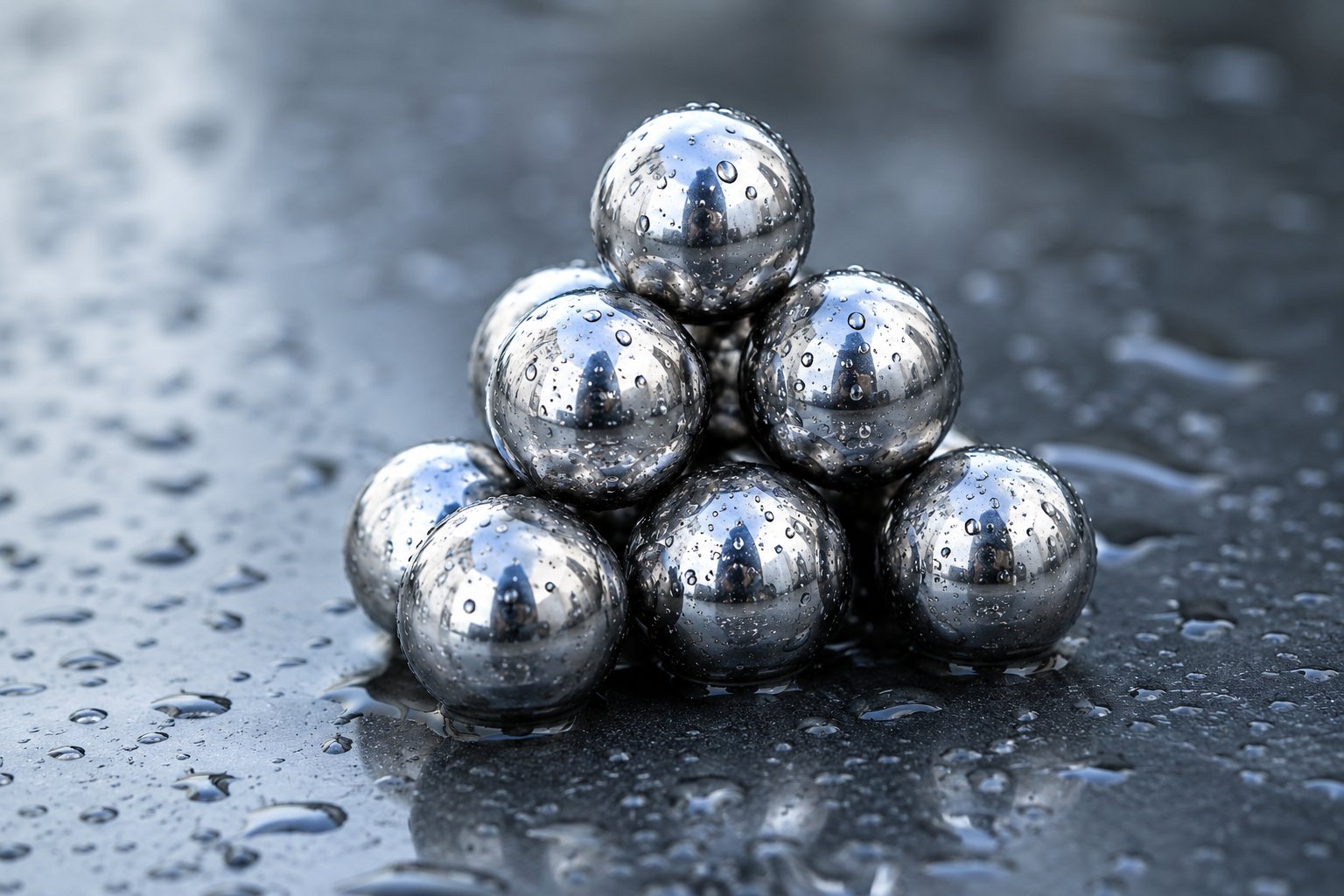
Why Humid Environments Accelerate Metal Corrosion
Moisture is one of the primary causes of metal degradation. When steel components are continuously exposed to humidity, condensation, rainwater, or salt-laden air, electrochemical reactions occur on the surface, leading to corrosion.
Common issues caused by corrosion include:
- Surface rust formation
- Increased friction and wear
- Reduced dimensional accuracy
- Higher operating noise
- Shortened equipment lifespan
For precision machinery and bearing systems, even minor corrosion can significantly affect performance and reliability.
Why Stainless Steel Balls Perform Better in Humid Conditions
The excellent corrosion resistance of stainless steel comes from its chromium content. Chromium reacts with oxygen to form a thin passive oxide layer on the surface of the material.
This protective layer provides several advantages:
- Prevents moisture from reaching the base metal
- Reduces oxidation and rust formation
- Offers self-healing properties when slightly damaged
- Maintains surface smoothness over time
As a result, stainless steel balls can maintain their appearance, precision, and mechanical performance even after long-term exposure to humid environments.
Common Stainless Steel Ball Materials and Their Corrosion Resistance
304 Stainless Steel Balls
304 stainless steel balls are among the most widely used corrosion-resistant ball products.
Key benefits include:
- Excellent rust resistance
- Good mechanical properties
- Cost-effective solution
- Suitable for most humid environments
Typical applications:
- Food processing equipment
- Packaging machinery
- Automation systems
- Household appliances
316 Stainless Steel Balls
316 stainless steel balls contain molybdenum, which significantly enhances corrosion resistance.
Advantages include:
- Superior resistance to pitting corrosion
- Excellent salt spray resistance
- Outstanding performance in marine environments
Typical applications:
- Marine equipment
- Shipbuilding systems
- Medical instruments
- Chemical processing equipment
For applications involving seawater or high-salinity conditions, 316 stainless steel balls are often the preferred choice.
420 Stainless Steel Balls
420 stainless steel balls can be heat treated to achieve higher hardness levels.
Characteristics include:
- High wear resistance
- Good mechanical strength
- Moderate corrosion resistance
Common applications:
- Precision bearings
- Valve components
- Industrial machinery
Long-Term Performance of Stainless Steel Balls in Humid Environments
Stable Surface Condition
High-quality stainless steel balls maintain a smooth and clean surface for extended periods, reducing the likelihood of rust spots and surface degradation.
Consistent Dimensional Accuracy
Minimal material loss due to corrosion helps preserve roundness, diameter tolerance, and overall precision.
Reliable Friction Performance
A corrosion-free surface reduces friction variation, supporting smoother and more efficient equipment operation.
Reduced Maintenance Costs
Longer service life means fewer replacements, less downtime, and lower maintenance expenses.
Factors Affecting Service Life
Although stainless steel balls provide excellent corrosion resistance, their lifespan is influenced by several factors:
Humidity Level
Higher humidity generally increases corrosion risks.
Salt Exposure
Marine and coastal environments accelerate corrosion and require higher-grade stainless steel materials.
Chemical Exposure
Acids, alkalis, and other corrosive substances may impact long-term performance.
Surface Finish Quality
Highly polished surfaces reduce contamination buildup and improve corrosion resistance.
Material Selection
Choosing the correct stainless steel grade is essential for maximizing service life under specific operating conditions.
How to Select Stainless Steel Balls for Humid Environments
When sourcing stainless steel balls, buyers should evaluate:
- Material grade (304, 316, 420, etc.)
- Precision grade
- Surface finish quality
- Hardness requirements
- Corrosion resistance performance
- Supplier manufacturing capability
Requesting material certifications and quality inspection reports can help minimize procurement risks and ensure consistent product performance.
Why Choose Huarui Precision Balls?
As a professional ball manufacturer, Huarui provides high-quality stainless steel balls for global industrial customers.
Our advantages include:
- 304, 316, and 420 stainless steel ball production
- High-precision dimensional control
- Strict quality inspection procedures
- Stable large-volume supply capability
- OEM and custom manufacturing services
- Extensive international export experience
Our stainless steel balls are widely used in food processing, medical equipment, marine engineering, chemical industries, and automation systems worldwide.