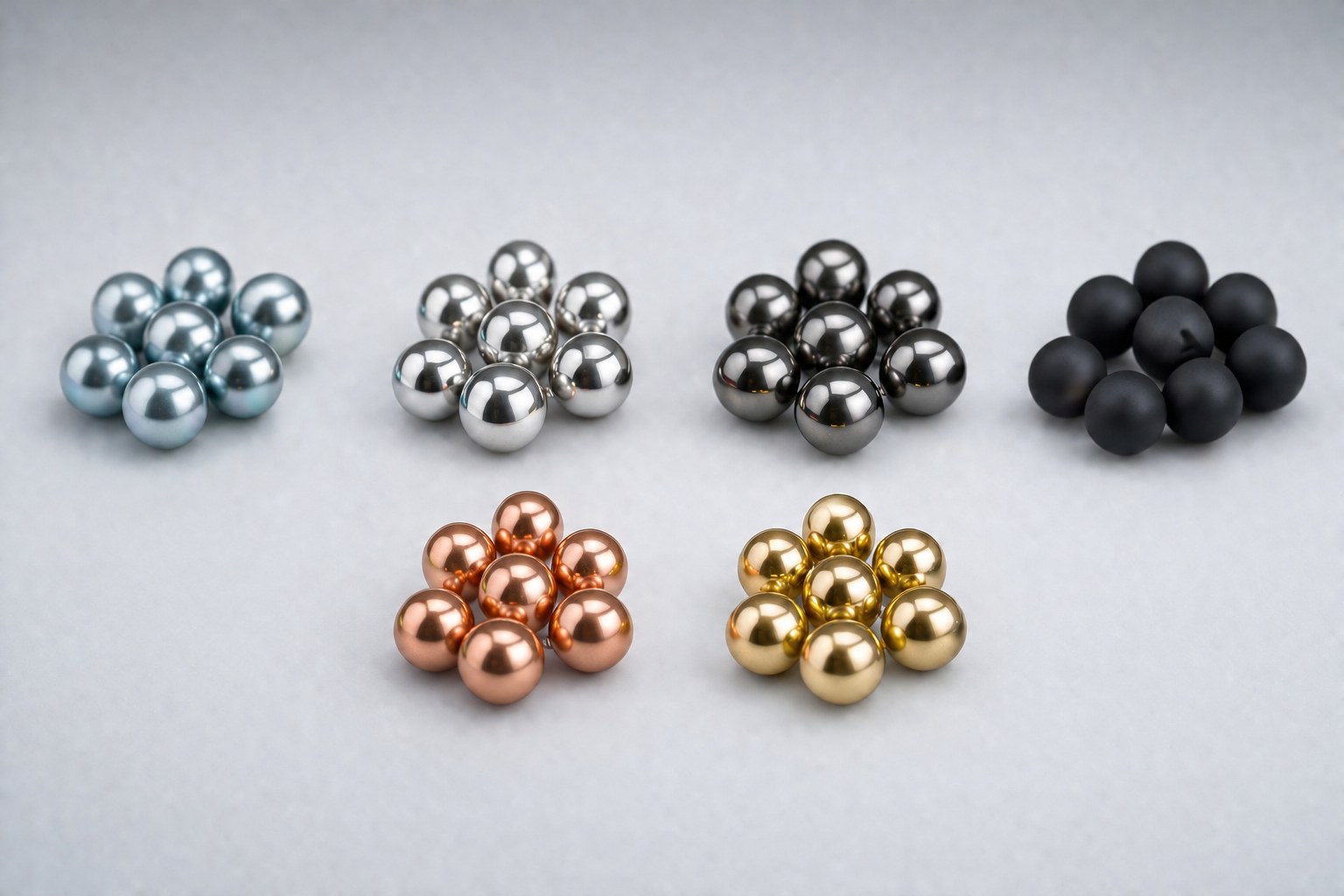
Why Do Carbon Steel Balls Need Surface Treatment?
Although carbon steel offers high mechanical strength and excellent processing performance, untreated carbon steel balls may suffer from:
- Rust and corrosion
- Surface wear during continuous operation
- Reduced service life
- Poor aesthetic appearance
- Limited performance in humid or chemical environments
A suitable surface treatment can significantly enhance product performance by providing:
- Excellent corrosion resistance
- Improved wear resistance
- Lower friction coefficient
- Enhanced appearance
- Longer service life
- Better compliance with international quality standards
Common Surface Treatment Options for Carbon Steel Balls
1. Zinc Plating (Electro Galvanizing)
Zinc plating is one of the most widely used protective coatings for carbon steel balls. A layer of zinc is deposited onto the steel surface through electroplating, providing sacrificial corrosion protection.
Advantages
- Excellent rust prevention
- Economical solution
- Mature and reliable process
- Suitable for high-volume production
- Available in blue zinc, yellow zinc, black zinc, and clear zinc finishes
Typical Applications
- Furniture hardware
- Bicycle components
- Construction hardware
- Fasteners
- General industrial machinery
2. Nickel Plating
Nickel plating provides a bright metallic finish while improving corrosion and wear resistance.
Two common processes include:
- Electro Nickel Plating
- Electroless Nickel Plating
Electroless nickel offers a more uniform coating thickness and superior corrosion protection.
Advantages
- High corrosion resistance
- Attractive appearance
- Increased surface hardness
- Excellent wear resistance
- Smooth and uniform finish
Typical Applications
- Automotive components
- Precision instruments
- Industrial equipment
- Decorative hardware
- Medical equipment parts
3. Chrome Plating
Chrome plating produces an extremely hard and wear-resistant surface with a mirror-like appearance.
It is ideal for applications involving continuous friction or heavy mechanical loads.
Advantages
- Outstanding hardness
- Excellent wear resistance
- Bright mirror finish
- High temperature resistance
- Good oxidation resistance
Typical Applications
- Precision machinery
- Guide rails
- Industrial rollers
- Mold components
4. Black Oxide Treatment
Black oxide is a chemical conversion coating that creates a thin black oxide layer on the steel surface.
Although it provides moderate corrosion protection, it is commonly combined with rust-preventive oil for enhanced performance.
Advantages
- Cost-effective
- Minimal dimensional change
- Uniform black appearance
- Suitable for precision components
Typical Applications
- Mechanical assemblies
- Industrial tools
- Standard hardware
- Machine components
5. Phosphating
Phosphating forms a phosphate conversion layer that improves corrosion resistance while creating an ideal base for lubrication or additional coatings.
Advantages
- Better lubricant retention
- Reduced friction
- Improved wear resistance
- Enhanced paint adhesion
- Increased corrosion protection
Typical Applications
- Automotive industry
- Fasteners
- Mechanical components
- Industrial hardware
6. Copper Plating
Copper plating is primarily used when electrical conductivity or decorative appearance is required.
It also serves as an intermediate layer before nickel or chrome plating.
Advantages
- Excellent electrical conductivity
- Good solderability
- Attractive appearance
- Ideal base coating
Typical Applications
- Electrical components
- Conductive assemblies
- Decorative hardware
7. Alloy Coatings
For demanding industrial environments, alloy coatings provide superior corrosion resistance compared to conventional electroplating.
Common alloy coatings include:
- Zinc-Nickel Alloy
- Zinc-Iron Alloy
- Nickel-Phosphorus Alloy
Advantages
- Outstanding salt spray resistance
- Longer service life
- Superior corrosion protection
- Excellent performance in harsh environments
Typical Applications
- Automotive industry
- Heavy equipment
- Marine applications
- Industrial automation
8. Anti-Rust Oil Coating
Anti-rust oil is a temporary protective treatment commonly applied before storage or international shipment.
Although it is not a permanent coating, it effectively prevents oxidation during transportation.
Advantages
- Lowest cost
- Easy application
- No dimensional changes
- Easy removal before installation
Typical Applications
- Export packaging
- Warehouse storage
- Temporary protection
- Industrial logistics
How to Choose the Right Surface Treatment
The ideal surface treatment depends on the working environment, performance requirements, and budget.
| Application Requirement | Recommended Surface Treatment |
|---|---|
| General corrosion protection | Zinc Plating |
| High wear resistance | Chrome Plating |
| Decorative appearance | Nickel Plating |
| Precision components | Black Oxide |
| Electrical conductivity | Copper Plating |
| Severe corrosion environments | Electroless Nickel or Zinc-Nickel Alloy |
| Export transportation | Anti-Rust Oil |
When selecting a surface treatment, buyers should also evaluate:
- Operating environment
- Humidity and chemical exposure
- Load capacity
- Friction conditions
- Expected service life
- Cost considerations
- Environmental compliance (RoHS & REACH)
What to Look for in a Carbon Steel Ball Manufacturer
A reliable manufacturer should provide more than just quality products. Look for suppliers that offer:
- Fully integrated manufacturing and surface treatment capabilities
- Precision cold heading, heat treatment, and grinding equipment
- Strict dimensional and roundness inspection
- Salt spray testing and coating thickness inspection
- Custom sizes and surface finishes
- OEM & ODM manufacturing services
- Stable global supply chain
- Compliance with ISO 9001 quality management standards
- RoHS and REACH compliant products
Partnering with an experienced manufacturer helps ensure consistent product quality, shorter lead times, competitive pricing, and professional engineering support.
Why Choose a One-Stop Carbon Steel Ball Manufacturer?
A vertically integrated manufacturer can provide significant advantages, including:
- Competitive factory-direct pricing
- Stable product quality
- Flexible customization
- Fast delivery
- Comprehensive quality inspection
- Technical consultation
- Professional export packaging
- Global shipping experience
Whether you require standard carbon steel balls or customized surface-treated solutions, working directly with an experienced manufacturer reduces procurement risks and improves long-term supply reliability.