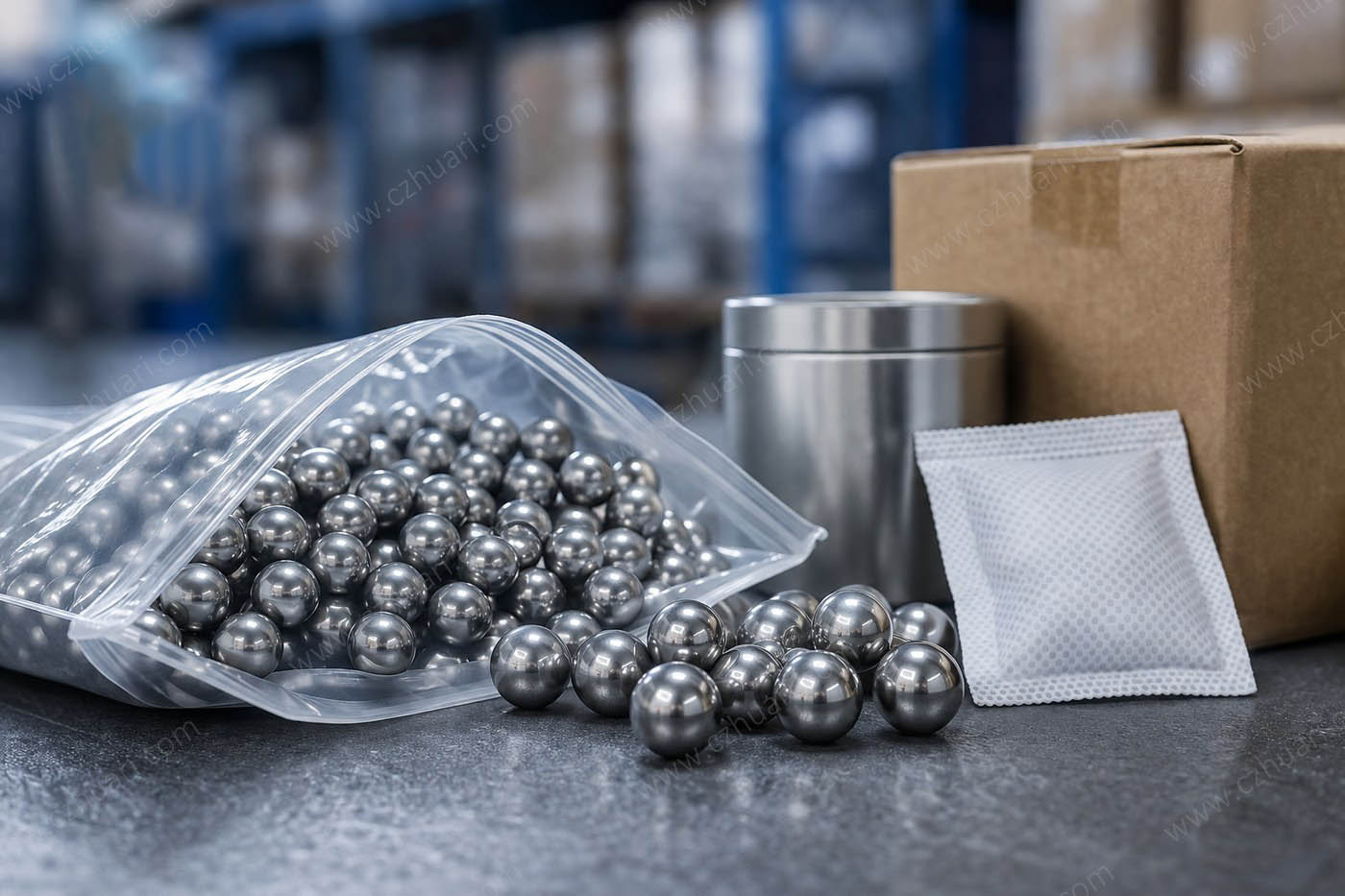
Why Do Stainless Steel Balls Need Protection During Long-Term Storage?
The corrosion resistance of stainless steel mainly comes from the passive oxide layer that naturally forms on its surface. Under suitable environmental conditions, this passive layer helps protect the underlying metal from corrosion.
However, during long-term storage, several external factors may affect the stability of this protective layer and the overall surface condition of stainless steel balls.
Common risk factors include:
- High humidity
- Condensation caused by temperature fluctuations
- Salt spray and chloride exposure
- Acidic or alkaline contaminants
- Dust and industrial pollutants
- Improper packaging materials
- Moisture trapped inside packaging
- Cross-contamination from other metals
- Long storage periods without regular inspection
The corrosion resistance of stainless steel balls also depends on the specific grade of stainless steel. For example, 304 stainless steel balls and 316 stainless steel balls have different levels of corrosion resistance. In environments containing salt or chlorides, 316 stainless steel generally provides better resistance to pitting corrosion.
For this reason, long-term storage protection should always consider both the material grade and the actual storage environment.
1. Store Stainless Steel Balls in a Clean and Dry Environment
The first step in protecting stainless steel balls during long-term storage is to control the warehouse environment.
Ideally, stainless steel balls should be stored in:
- A clean and dry indoor warehouse
- A well-ventilated storage area
- An environment with relatively stable temperatures
- Areas protected from rain and direct moisture
- Locations away from corrosive chemicals
- Areas with minimal exposure to industrial dust and pollutants
Humidity control is particularly important.
When humidity is high, temperature fluctuations may cause condensation inside packaging or on metal surfaces. Over time, this moisture can contribute to water spots, surface discoloration, oxidation, or corrosion.
For precision stainless steel balls used in bearings, instrumentation, medical equipment, and high-performance machinery, environmental control becomes even more important.
A clean, dry, and stable warehouse can significantly reduce the risk of surface deterioration during extended storage.
2. Use Moisture-Resistant Protective Packaging
Protective packaging is one of the most important factors in long-term stainless steel ball storage.
After stainless steel balls have been cleaned, inspected, and properly dried, the packaging method should be selected according to the expected storage period, transportation conditions, and application requirements.
Common packaging solutions include:
- Anti-rust paper
- VCI (Volatile Corrosion Inhibitor) bags
- Moisture-resistant plastic bags
- Vacuum packaging
- Desiccant packs
- Sealed inner packaging with protective outer cartons
For products expected to remain in storage for an extended period, sealed packaging combined with desiccants can help reduce moisture exposure.
However, one critical point should not be overlooked: stainless steel balls must be completely dry before they are sealed.
If moisture remains on the ball surface before packaging, sealing the product may trap moisture inside the package. Instead of protecting the stainless steel balls, this can create a humid micro-environment that increases the risk of surface oxidation.
An effective long-term storage process should therefore follow the basic sequence:
Cleaning → Drying → Surface Protection → Packaging → Storage
This simple process can make a significant difference in maintaining product quality.
3. Apply Appropriate Corrosion Protection
Although stainless steel balls naturally provide good corrosion resistance, additional protection may be beneficial when products are stored for long periods or exposed to humid environments and international transportation.
Depending on the application, protective measures may include:
- Stainless steel-compatible rust preventive oil
- VCI corrosion protection materials
- Anti-rust paper
- Moisture-resistant packaging
- Desiccants for humidity control
The choice of corrosion protection should always consider the customer's final application.
For example, stainless steel balls used in food processing equipment, medical devices, or clean environments may have strict requirements regarding surface cleanliness and chemical residues.
In these applications, the cleaning and protection process should be carefully selected to ensure that protective materials do not interfere with subsequent assembly, cleaning, or end use.
For general industrial applications, the protection method can be optimized according to the material grade, storage period, packaging requirements, and transportation conditions.
4. Prevent Contact with Contaminants
Stainless steel balls often undergo precision grinding, lapping, and polishing processes. As a result, surface cleanliness and surface quality are critical to their final performance.
During long-term storage, stainless steel balls should be protected from direct contact with:
- Salt
- Chlorides
- Acidic substances
- Alkaline substances
- Industrial oils and contaminants
- Carbon steel dust
- Iron particles
One important issue is iron contamination.
Carbon steel dust or iron particles can adhere to the surface of stainless steel balls. When exposed to moisture, these contaminants may oxidize and create visible rust-like spots.
In some cases, the apparent "rust" may not indicate severe corrosion of the stainless steel substrate itself, but rather surface contamination caused by external iron particles.
Therefore, stainless steel balls should ideally be stored separately from carbon steel balls and other carbon steel components.
Proper material segregation can help reduce cross-contamination and maintain the original surface condition of stainless steel balls.
5. Manage Inventory and Storage Periods Properly
Long-term protection does not mean that stainless steel balls can be stored indefinitely without inspection.
For B2B industrial products, a systematic inventory management process is recommended.
Each batch of stainless steel balls should ideally be tracked according to:
- Material grade
- Ball diameter
- Quantity
- Production date
- Packaging date
- Warehouse entry date
- Customer order information
- Protective treatment
- Packaging method
The FIFO (First In, First Out) inventory principle can be used to prioritize products that entered the warehouse earlier.
For products that have remained in storage for an extended period, packaging integrity and surface condition should be checked before shipment.
Good inventory management helps reduce storage-related risks while improving warehouse efficiency and product traceability.
6. Conduct Regular Storage Inspections
Regular inspection is essential when stainless steel balls are stored for long periods.
A proper inspection program should cover three main areas.
Packaging Inspection
Check whether the packaging has:
- Tears or damage
- Signs of moisture
- Cracks
- Loose seals
- Water penetration
If packaging damage is discovered, the products should be re-packed using appropriate protective materials.
Surface Inspection
Check the stainless steel ball surface for:
- Discoloration
- Water spots
- Oxidation marks
- Corrosion
- Scratches
- Dents or impact damage
Warehouse Environment Inspection
The storage environment should also be checked for:
- Excessive humidity
- Water leakage
- Condensation
- Corrosive gases
- Chemical contamination
Regular inspection allows potential problems to be identified early, reducing the risk of discovering quality issues only after products have been stored for a long period.
7. Choose the Right Storage Strategy for Different Stainless Steel Grades
Stainless steel balls are available in different material grades, and their properties are not identical.
Common stainless steel ball materials include:
- 304 Stainless Steel Balls
- 316 Stainless Steel Balls
- 420 Stainless Steel Balls
- 440C Stainless Steel Balls
Different grades offer different combinations of:
- Corrosion resistance
- Hardness
- Wear resistance
- Magnetic properties
- Mechanical performance
Therefore, storage and corrosion protection strategies should be selected according to the specific material.
For example, 304 and 316 stainless steel balls are often selected for applications where corrosion resistance and surface cleanliness are important.
420 and 440C stainless steel balls are commonly used in applications requiring higher hardness and wear resistance, including bearings, valves, and other precision mechanical components. These products also require proper protection during long-term storage.
For B2B buyers, selecting the right stainless steel grade based on the actual operating environment is often more important than simply choosing the highest-grade material available.
8. Consider Cleaning Requirements Before Final Use
After long-term storage, stainless steel balls may require cleaning or surface treatment before they are put into service.
This is especially important for applications such as:
- Precision bearings
- Medical equipment
- Food processing machinery
- Pharmaceutical equipment
- High-cleanliness industrial systems
These industries may have strict requirements for surface cleanliness, oil residues, and foreign particles.
Therefore, long-term storage protection should be considered as part of a complete product management process:
Manufacturing → Cleaning → Inspection → Drying → Protection → Packaging → Storage → Regular Inspection → Shipment → Pre-use Cleaning
A well-controlled process helps maintain the surface condition, dimensional accuracy, and functional performance of stainless steel balls throughout the entire supply chain.
9. How Can a Professional Stainless Steel Ball Supplier Reduce Storage Risks?
For international B2B buyers, stainless steel balls may need to travel long distances by sea or air before reaching the customer's warehouse.
During international transportation, products may be exposed to:
- High humidity
- Temperature fluctuations
- Condensation
- Salt air
- Extended transportation times
Therefore, packaging and shipment preparation by the supplier play an important role in long-term product protection.
A professional stainless steel ball manufacturer should be able to provide suitable packaging solutions based on customer requirements, including:
- Standard export packaging
- Moisture-resistant packaging
- Anti-rust packaging
- Customized labeling
- Batch traceability
- Separate packaging for different sizes
- Long-term transportation protection
For customers with long inventory cycles, suppliers can also recommend suitable packaging and protection methods based on the stainless steel grade, ball size, application, transportation method, and expected storage period.
A reliable B2B supplier should provide more than just products. Professional support across material selection, precision manufacturing, surface treatment, quality inspection, packaging, transportation, and after-sales service can help customers build a more stable and reliable supply chain.
Why Choose Huarui?
With professional manufacturing capabilities, strict quality control, and extensive experience in stainless steel ball production, Huarui provides reliable stainless steel balls for global B2B customers. From material selection and precision manufacturing to inspection and protective packaging, we focus on consistent quality and dependable supply to meet diverse industrial requirements.
Choose Huarui for reliable quality, professional service, and long-term cooperation.