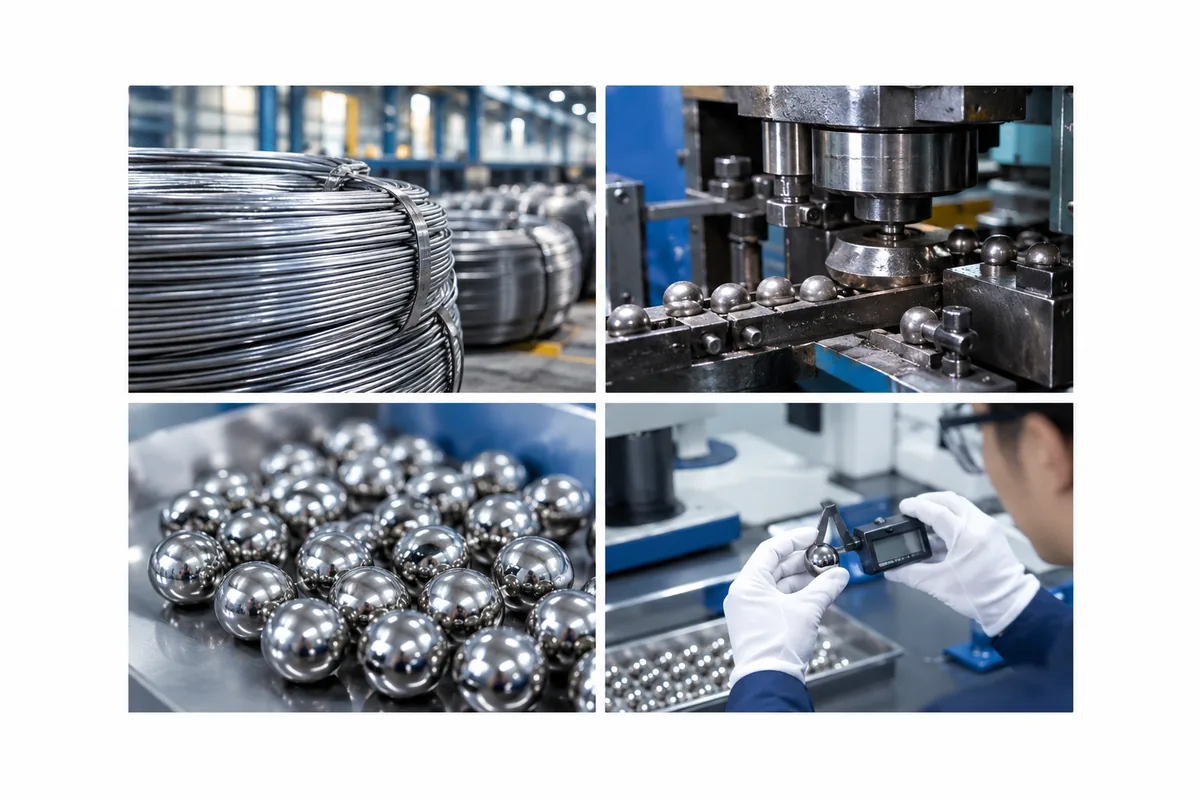
1. Raw Material Selection: The Foundation of Steel Ball Quality
Raw material selection is one of the most important factors affecting steel ball performance. Different applications require different combinations of hardness, wear resistance, corrosion resistance, load capacity, and magnetic properties.
Choosing the appropriate material helps establish a reliable foundation for subsequent manufacturing operations.
Common materials used in industrial steel ball manufacturing include the following.
Bearing Steel Balls
Bearing steel balls are commonly manufactured from suitable high-carbon chromium bearing steels, such as AISI 52100 or equivalent grades.
These materials are widely used in rolling bearings because of their potential to achieve high hardness, good wear resistance, and favorable rolling contact fatigue performance when properly processed.
Typical applications include:
-
Ball bearings and precision bearings
-
Automotive and industrial machinery
-
Electric motors and transmission systems
-
Mechanical assemblies requiring controlled rolling contact
The final performance of bearing steel balls depends not only on the steel grade but also on material cleanliness, heat treatment, internal structure, and manufacturing precision.
Stainless Steel Balls
Stainless steel balls are selected for applications where corrosion resistance and material compatibility are important.
Common grades include AISI 304, AISI 316, and AISI 440C. These grades have different properties and should be selected according to the operating environment and performance requirements.
For example, 304 and 316 stainless steels are often considered for corrosion-resistant applications, while heat-treatable 440C stainless steel may be suitable for applications requiring higher hardness and wear resistance.
Typical applications include valves, pumps, fluid handling equipment, food-processing machinery, and specialized industrial components, subject to the relevant material and application requirements.
Carbon Steel Balls
Carbon steel balls are often selected for general industrial applications where cost efficiency and suitable mechanical properties are important.
Depending on the material grade and manufacturing process, they may be used in drawer slides, furniture hardware, rolling mechanisms, and various mechanical components.
Carbon steel balls can offer an economical solution for applications that do not require the same corrosion resistance or performance characteristics as certain stainless or bearing steel grades.
Why Raw Material Inspection Matters
Before production begins, manufacturers should verify relevant material information, including:
-
Material grade and chemical composition
-
Material condition and suitability for processing
-
Surface defects and other visible abnormalities
-
Hardness or other specified material properties
-
Material certificates and traceability records, where required
For demanding applications, additional controls may be necessary to evaluate cleanliness, inclusions, and internal material quality.
Selecting the right raw material is the first step toward producing steel balls with consistent and application-appropriate performance.
2. Cold Heading and Forming: Creating the Initial Ball Shape
After material selection and preparation, the manufacturing process moves to forming.
Depending on the material, ball diameter, production volume, and product specifications, manufacturers may use cold heading, cutting and forming, or other suitable forming methods.
Cold heading is a common process for producing steel ball blanks in high-volume manufacturing. Metal is shaped under controlled pressure using specialized dies to create a near-spherical blank for subsequent processing.
The main objectives of the forming stage include:
-
Establishing a consistent initial shape and size
-
Supporting efficient high-volume production
-
Reducing unnecessary material waste
-
Providing appropriate machining allowance for later operations
Forming quality directly affects the workload of downstream grinding and finishing processes.
Excessive dimensional variation, inconsistent blank geometry, or surface defects may increase processing requirements and make it more difficult to achieve the desired final accuracy.
For this reason, stable equipment operation, suitable die design, preventive maintenance, and in-process inspection are essential parts of the steel ball manufacturing process.
3. Flash Removal and Grinding: Improving Shape and Dimensional Accuracy
After forming, steel ball blanks generally require additional processing to remove excess material and improve their geometry.
Depending on the production route, this may involve flash removal, rough grinding, and intermediate grinding operations.
During grinding, steel balls move between specialized grinding surfaces under controlled pressure and motion. Material is gradually removed to improve the ball's shape, diameter, and surface condition.
Several quality characteristics require attention at this stage.
Diameter variation: Consistent diameter helps ensure proper dimensional compatibility with mating components.
Sphericity: The closer a ball is to a true sphere, the better its geometric consistency.
Surface condition: Scratches, dents, cracks, and other defects may compromise product reliability, depending on their severity and location.
Machining allowance: Appropriate material removal is necessary to prepare the ball for heat treatment or subsequent finishing operations.
For precision steel balls, stable grinding conditions are important for achieving the required geometry while maintaining efficient production.
Effective control at this stage also helps reduce unnecessary rework during final lapping.
4. Heat Treatment: Improving Hardness and Mechanical Performance
Heat treatment is a critical operation in the manufacture of many bearing steel balls and other high-hardness steel balls.
Through controlled heating, holding, and cooling, manufacturers can modify the material's microstructure and mechanical properties to meet specified performance requirements.
For high-carbon chromium bearing steel balls, the heat treatment process must be developed according to the material grade, ball diameter, required hardness, applicable specifications, and intended service conditions.
Key Benefits of Proper Heat Treatment
Hardness and wear resistance
Appropriate hardness helps steel balls resist indentation and wear under suitable operating conditions.
Rolling contact fatigue performance
For bearing applications, material structure and heat treatment quality are important factors influencing resistance to repeated contact stresses.
Dimensional stability
Heat treatment can cause dimensional changes. These changes must be controlled through appropriate process parameters and subsequent finishing operations.
Consistency between production batches
A stable heat treatment process helps manufacturers achieve more consistent mechanical properties across production batches.
It is important to recognize that different steel grades require different heat treatment approaches.
Bearing steel, stainless steel, and low-carbon steel have different metallurgical characteristics. Some carbon steel balls may require hardening, while others are intentionally supplied in a softer condition for general-purpose applications.
Therefore, heat treatment should be selected according to the material and product requirements rather than applying one process to every type of steel ball.
5. Precision Lapping and Polishing: Achieving the Required Finish
Following heat treatment and any necessary intermediate processing, steel balls may undergo precision grinding, lapping, or polishing to achieve their final dimensional and surface requirements.
Precision lapping is particularly important for high-accuracy steel balls. The process uses controlled contact between the balls and specialized lapping surfaces to gradually improve dimensional accuracy, spherical geometry, and surface finish.
Important parameters include processing pressure, lapping plate condition, abrasive characteristics, motion patterns, and processing time.
Key Quality Parameters in Precision Steel Ball Finishing
Dimensional accuracy
The finished ball diameter must meet the specified nominal size and tolerance.
Lot-to-lot consistency
Controlling dimensional variation within and between production batches is important for reliable assembly and repeatable performance.
Sphericity
Sphericity describes how closely the actual ball conforms to an ideal sphere. It is an important geometric characteristic in precision applications.
Surface roughness
A suitable surface finish helps support the required contact conditions between the ball and its mating components.
Surface integrity
The finishing process should avoid unacceptable scratches, dents, cracks, and other surface abnormalities.
For precision bearing steel balls, achieving the correct diameter alone is not sufficient. Sphericity, surface quality, hardness, and other specified characteristics must also be considered.
Manufacturers should therefore select finishing parameters according to the required precision grade, material properties, ball size, and final application.
6. Steel Ball Quality Control: Verifying Product Performance
Quality inspection is essential for confirming that finished steel balls meet the agreed technical requirements.
A suitable inspection plan helps identify nonconforming products, monitor process stability, and provide customers with appropriate quality documentation.
The exact inspection requirements depend on the material, product grade, intended application, and customer specifications.
6.1 Diameter Inspection
Precision measuring instruments are used to verify ball diameter against the specified dimensional tolerances.
For applicable products, inspection may also evaluate diameter variation within a batch and differences between production lots.
6.2 Sphericity Measurement
Specialized measuring equipment can be used to evaluate spherical form error.
This parameter is particularly important for precision steel balls used in bearings and other applications where geometric consistency affects performance.
6.3 Hardness Testing
Hardness testing verifies whether the finished product meets the required hardness range.
The testing method must be appropriate for the material, ball diameter, surface condition, and applicable technical standard.
6.4 Surface Inspection
Visual or optical inspection can identify scratches, dents, corrosion, cracks, and other unacceptable surface defects.
For demanding applications, additional inspection methods may be necessary to evaluate specific defect types.
6.5 Material and Internal Quality Verification
Where required, manufacturers may use material certificates, metallographic examination, nondestructive testing, or other appropriate methods to verify material characteristics and internal quality.
Not every steel ball requires every inspection method. A practical quality control plan should reflect the product's risk level, performance requirements, and agreed acceptance criteria.
Why Quality Control Matters to Industrial Buyers
Effective steel ball quality control helps manufacturers:
-
Reduce the risk of dimensional nonconformity
-
Improve production consistency
-
Verify compliance with customer specifications
-
Support batch identification and traceability
-
Provide more reliable quality documentation
A clear inspection process also helps buyers evaluate suppliers on measurable technical criteria rather than general claims of high quality.
7. Cleaning, Rust Prevention, and Packaging: Protecting Finished Products
After final inspection, steel balls may undergo cleaning, drying, rust prevention, and packaging before shipment.
These steps are important because product quality must be maintained not only during manufacturing but also throughout storage, handling, and transportation.
Cleaning and Drying
Residual processing fluids, particles, and moisture should be removed as required by the product specifications.
Proper cleaning helps maintain surface condition and prepares the balls for subsequent handling or assembly.
Rust Prevention
Carbon steel balls and certain bearing steel balls may require suitable rust-preventive treatment to reduce the risk of corrosion during storage and transportation.
Although stainless steel balls generally offer greater corrosion resistance than ordinary carbon steel balls, their actual corrosion performance depends on the grade, surface condition, environment, and exposure conditions.
Appropriate storage and handling remain important for all materials.
Packaging and Transportation
Packaging should reflect the ball diameter, material, precision requirements, shipment distance, and customer preferences.
For precision products, packaging should help prevent contamination, surface damage, and unnecessary contact during transportation.
Where required, batch identification and traceability information should also be maintained.
Proper finishing and packaging help preserve product condition between the manufacturing facility and the customer's production line.
8. What Determines the Final Quality of Steel Balls?
Steel ball quality is the combined result of material selection, process control, finishing accuracy, and inspection.
The following table summarizes the main factors and their effects.
| Quality Factor | Influence on Finished Steel Balls |
|---|---|
| Raw material quality | Affects material properties, internal defect risk, and processability |
| Forming process | Determines initial geometry and machining allowance |
| Heat treatment | Influences hardness, microstructure, and dimensional stability |
| Grinding and lapping | Improve diameter accuracy, sphericity, and surface finish |
| Quality inspection | Verifies compliance with technical requirements |
| Cleaning and packaging | Help maintain cleanliness, corrosion protection, and delivery condition |
These factors are closely interconnected.
For example, high-quality raw material cannot fully compensate for an unstable heat treatment process. Similarly, precision lapping cannot eliminate every type of internal material defect.
Consistent steel ball quality requires a coordinated approach that combines suitable materials, controlled manufacturing processes, and effective inspection.
9. How to Choose a Reliable Steel Ball Manufacturer
For international B2B buyers, choosing a steel ball supplier involves more than comparing unit prices.
Manufacturing capability, technical support, quality assurance, customization options, and delivery reliability should all be considered.
1. Confirm the Available Materials and Product Range
Check whether the supplier can provide the required material grades, ball diameters, precision levels, and surface treatments.
Common purchasing categories include bearing steel balls, stainless steel balls, and carbon steel balls.
2. Evaluate Manufacturing and Process Control
Ask about the supplier's relevant manufacturing processes, including forming, heat treatment, grinding, lapping, and final inspection.
The supplier's capabilities should match the technical requirements of the intended application.
3. Define Technical Specifications Clearly
Before placing an order, confirm key parameters such as:
-
Material grade
-
Nominal ball diameter and dimensional tolerance
-
Precision grade or applicable standard
-
Required hardness range
-
Surface finish and appearance requirements
-
Packaging and corrosion protection
-
Inspection and acceptance criteria
Clear specifications help reduce misunderstandings and improve consistency between orders.
4. Review Quality Documentation
Depending on the application, buyers may need material certificates, inspection reports, batch records, or other supporting documents.
Confirm in advance which documents are available and whether they meet the project's requirements.
5. Check Customization and Communication Capabilities
Some industrial applications require non-standard diameters, specific materials, customized packaging, or additional surface treatments.
A supplier that can communicate clearly about technical feasibility, manufacturing limitations, and inspection requirements can help simplify the procurement process.
For long-term B2B cooperation, reliable technical communication and consistent product quality are often just as important as competitive pricing.
10. Conclusion: Building Reliable Steel Ball Quality from Start to Finish
Material selection establishes the foundation. Forming and grinding develop the initial geometry. Heat treatment adjusts mechanical properties. Precision lapping improves dimensional accuracy and surface finish. Finally, quality inspection verifies whether the product meets the agreed specifications.
For industrial applications, a reliable steel ball must offer the right combination of material properties, dimensional accuracy, hardness, surface quality, and batch consistency for its intended operating conditions.
As an industrial ball supplier, we understand the importance of matching product specifications with application requirements. We aim to support industrial buyers with suitable ball products, clear technical communication, and solutions tailored to their purchasing needs.
Whether you are sourcing bearing steel balls, stainless steel balls, or carbon steel balls, confirming the material grade, diameter, precision requirements, hardness, and intended application is an important first step toward selecting the right product.