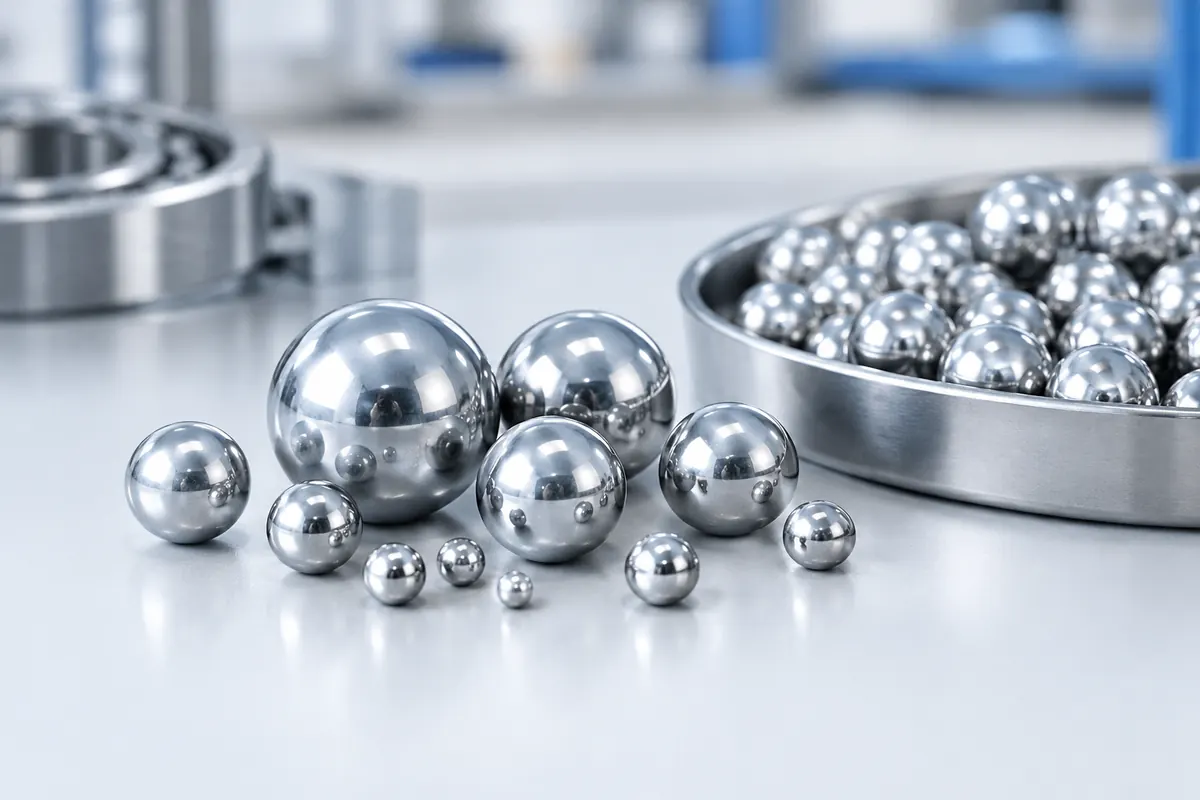
1. What Are Zinc-Plated Carbon Steel Balls?
Zinc-plated carbon steel balls are precision or industrial steel balls made from carbon steel and finished with a protective zinc coating. The carbon steel substrate provides the ball's basic mechanical properties, while the zinc layer helps protect the underlying steel against corrosion.
Zinc coatings provide protection through a combination of barrier protection and sacrificial action. When exposed to corrosive conditions, zinc can corrode preferentially to the underlying steel, helping delay the onset of substrate corrosion.
The final performance depends on several factors, including the carbon steel grade, ball diameter, surface finish, zinc coating thickness, passivation treatment, and operating environment.
Zinc-plated carbon steel balls are particularly worth considering when standard carbon steel requires additional corrosion protection without the cost of switching to a more corrosion-resistant material.
2. Key Advantages of Zinc-Plated Carbon Steel Balls
2.1 Improved Corrosion Resistance
One of the primary advantages of zinc-plated carbon steel balls is their improved resistance to corrosion compared with uncoated carbon steel under suitable conditions.
The zinc layer acts as a protective coating, reducing direct exposure of the steel substrate to moisture and other corrosive agents. Depending on the coating specification and environment, this treatment can help reduce rust formation during storage, transportation, and service.
However, zinc plating does not make carbon steel balls rust-proof. Prolonged exposure to moisture, aggressive chemicals, damaged coatings, or unsuitable storage conditions can still lead to corrosion.
2.2 Cost-Effective Material Selection
Carbon steel is a practical material for many industrial applications because of its availability and competitive cost.
When corrosion protection is required, zinc plating offers an additional surface treatment without necessarily requiring a change to stainless steel or another higher-cost material.
For bulk purchasing, OEM production, and industrial distribution, zinc-plated carbon steel balls can provide a cost-effective solution when the application does not require the corrosion resistance of stainless steel.
The actual cost advantage depends on the ball specification, coating requirements, order quantity, and expected service conditions.
2.3 Suitable for a Variety of Industrial Components
Carbon steel balls are used in a broad range of mechanical and industrial components. Depending on their grade, heat treatment, dimensional accuracy, and surface quality, they may be suitable for applications involving movement, positioning, rolling, or general mechanical contact.
Zinc plating adds a protective surface finish that may be beneficial in components exposed to ordinary indoor humidity or occasional moisture.
For applications requiring high precision, repeated rolling contact, or heavy mechanical loads, the suitability of the plated ball must be evaluated against the component's design requirements.
2.4 Enhanced Appearance and Surface Finish
Zinc-plated carbon steel balls typically have a metallic appearance that may range from bright silver to a slightly bluish or other specified finish, depending on the plating and passivation process.
A consistent appearance can be useful in visible mechanical components, assembled products, and standardized industrial parts.
For bulk orders, buyers should confirm the required color, brightness, coating uniformity, and acceptable surface defects with the supplier before production.
2.5 Flexible Surface Treatment Options
Zinc-plated steel balls can be specified with different coating and finishing requirements according to the intended application.
Possible options include:
-
Zinc plating with a bright or silver appearance
-
Zinc plating with clear or colored passivation
-
Additional compatible protective treatments, where technically suitable
-
Customized coating requirements based on the operating environment
The appropriate finish should be selected according to corrosion exposure, dimensional requirements, appearance, and compatibility with the final assembly.
3. Common Applications of Zinc-Plated Carbon Steel Balls
The following applications are potential uses rather than universal recommendations. Actual suitability depends on the ball's material properties, coating quality, operating conditions, and component design.
3.1 Hardware and General Mechanical Components
Zinc-plated carbon steel balls may be used in selected hardware products and mechanical assemblies where moderate corrosion protection and economical material selection are required.
Potential applications include positioning mechanisms, mechanical accessories, selected sliding or rolling components, and other general-purpose assemblies.
For applications involving continuous rolling contact or high rotational speeds, buyers should confirm whether the zinc coating can withstand the expected contact stress and wear.
3.2 Automotive and Transportation Components
Selected automotive accessories and transportation-related mechanisms may use zinc-plated steel components to improve protection against ordinary environmental exposure.
Potential uses for zinc-plated carbon steel balls depend on the design of the assembly and may include selected positioning or movement mechanisms.
For safety-critical automotive systems, high-load bearings, or components subject to strict durability requirements, material qualification and application-specific testing are essential. Zinc-plated carbon steel balls should not be assumed suitable for these uses without validation.
3.3 Furniture and Sliding Mechanisms
Some furniture fittings, adjustable mechanisms, and compact mechanical assemblies use steel balls for positioning or movement.
Where the design permits, zinc-plated carbon steel balls may offer a balance of affordability, functional performance, and surface protection.
The required diameter, dimensional tolerance, surface finish, and resistance to wear should be evaluated according to the mechanism's structure and expected service life.
3.4 Industrial Equipment and Automation Accessories
Selected industrial accessories and automation-related mechanisms may benefit from zinc-plated steel balls when the components operate in relatively mild environments.
Possible uses include certain positioning devices, mechanical linkages, and general-purpose ball mechanisms.
For precision automation systems, the buyer should specify the required dimensional tolerance, sphericity, surface roughness, load conditions, and movement frequency.
3.5 General-Purpose Consumer and Commercial Products
Zinc-plated carbon steel balls may also be considered for selected commercial products and consumer mechanisms where cost control and improved surface protection are important.
Their suitability depends on the product's intended environment and whether the ball is used for decorative, positioning, or mechanical functions.
Products intended for food contact, medical applications, or other regulated uses require separate material and compliance assessments.
4. Zinc-Plated Carbon Steel Balls vs. Uncoated Carbon Steel Balls
The key difference is the presence of a protective zinc layer.
| Comparison factor | Zinc-plated carbon steel balls | Uncoated carbon steel balls |
|---|---|---|
| Corrosion protection | Improved under suitable conditions | More susceptible to rust |
| Surface appearance | Metallic finish, depending on treatment | Usually the natural steel finish |
| Material cost | Includes an additional plating process | Generally lower initial processing cost |
| Surface requirements | Coating thickness and uniformity matter | No zinc coating to specify |
| Dimensional considerations | Coating adds to the finished diameter | No coating-related dimensional buildup |
| Best suited for | Applications needing added surface protection | Applications where coating is unnecessary or undesirable |
For applications exposed to moisture or humidity, zinc plating may be preferable to an uncoated surface. However, for continuous rolling contact, the effect of the coating on friction, wear, dimensional accuracy, and contact performance must also be considered.
5. Important Factors When Selecting Zinc-Plated Carbon Steel Balls
Choosing the right product requires more than specifying a diameter and requesting zinc plating.
5.1 Ball Diameter and Dimensional Tolerance
The ball diameter directly affects its fit and function within the assembly.
Buyers should specify the nominal diameter, dimensional tolerance, and any additional requirements for sphericity or surface finish.
Because the zinc coating adds material to the surface, the finished diameter must be considered during production planning. Where close tolerances are required, the coating process and final inspection method should be agreed upon in advance.
5.2 Carbon Steel Grade and Hardness
Different carbon steel grades offer different mechanical properties. Heat treatment can also affect hardness, strength, wear resistance, and dimensional stability.
Before ordering, confirm whether the application requires a soft, medium-hardness, or hardened steel ball, and verify that the selected material is compatible with the intended zinc-plating process.
For high-hardness or high-strength steel, the risk of hydrogen embrittlement associated with certain plating processes must be assessed and managed where applicable.
5.3 Zinc Coating Thickness
Coating thickness influences corrosion protection, dimensional buildup, and the final surface characteristics.
A thicker coating does not automatically guarantee better overall performance. The appropriate thickness should be determined by the service environment, dimensional requirements, and applicable specifications.
For small-diameter balls, even a relatively thin coating can affect the finished dimensions and clearance of a precision assembly.
5.4 Passivation and Additional Protection
Passivation or other compatible post-treatment processes may improve the corrosion performance of zinc-plated surfaces.
When evaluating a supplier, buyers should clarify the complete surface treatment system rather than simply requesting “zinc plated.” The specification should identify the required finish, coating thickness, and any applicable corrosion-test criteria.
5.5 Operating Environment
The service environment is a major factor in determining whether zinc-plated carbon steel balls are appropriate.
Consider the following conditions:
-
Indoor or outdoor use
-
Humidity and exposure to water
-
Contact with cleaning agents or chemicals
-
Operating temperature
-
Mechanical contact, friction, and repeated loading
-
Storage, packaging, and transportation conditions
For marine environments, frequent saltwater exposure, aggressive chemicals, or applications requiring long-term corrosion resistance, a more suitable coating system or stainless steel grade may be necessary.
6. Quality Control for Zinc-Plated Carbon Steel Balls
For B2B purchasing, consistent quality is essential, particularly when the balls will be incorporated into larger assemblies or supplied to OEM customers.
A comprehensive quality-control process may include the following checks:
Material verification: Confirm the carbon steel grade and any specified heat-treatment requirements.
Dimensional inspection: Measure ball diameter and verify compliance with the agreed tolerance.
Surface inspection: Check for visible defects, uneven plating, discoloration, peeling, or other unacceptable surface conditions.
Coating verification: Assess coating thickness and uniformity using an appropriate inspection method.
Corrosion testing: Where required, perform corrosion testing according to the agreed test method and acceptance criteria.
Packaging inspection: Ensure that packaging helps prevent contamination, moisture exposure, and damage during transportation.
Acceptance criteria should be defined before production, especially for large-volume orders or repeat purchases.
7. Why Choose a Reliable Zinc-Plated Carbon Steel Ball Supplier?
Selecting a qualified supplier helps reduce sourcing risks and supports consistent product quality.
When evaluating suppliers, industrial buyers should consider:
-
Material and surface treatment traceability
-
Clear dimensional and coating specifications
-
Consistent quality-control procedures
-
Support for customized diameters and tolerances, where available
-
Sample evaluation before bulk production
-
Reliable packaging and export documentation
-
Clear communication about technical limitations and application suitability
For distributors, equipment manufacturers, and industrial wholesalers, a supplier that understands both ball specifications and surface treatment requirements can help streamline product selection and procurement.
8. Conclusion
Zinc-plated carbon steel balls offer a practical combination of economical carbon steel construction and improved surface corrosion protection. They can be considered for selected hardware products, mechanical accessories, positioning mechanisms, and general-purpose industrial assemblies where the operating conditions are compatible with zinc plating.
The best results come from selecting the right carbon steel grade, dimensional tolerance, coating thickness, surface finish, and quality-control requirements for the intended application.
If you are sourcing zinc-plated carbon steel balls for an industrial project, OEM assembly, or wholesale distribution, defining these requirements clearly will help you identify a suitable product and reduce the risk of specification mismatches.
Contact our team to discuss your zinc-plated carbon steel ball requirements, including ball diameter, material grade, surface finish, tolerance, order quantity, and customized specifications.
Frequently Asked Questions (FAQ)
Q1: Are zinc-plated carbon steel balls rust-proof?
No. Zinc plating improves corrosion resistance but does not make carbon steel completely rust-proof. Performance depends on coating quality, environmental exposure, storage conditions, and maintenance.
Q2: What is the difference between zinc-plated and stainless steel balls?
Zinc-plated carbon steel balls use a carbon steel substrate with a protective zinc layer. Stainless steel balls rely on the corrosion resistance of the stainless steel itself. The better choice depends on the environment, required mechanical properties, budget, and application.
Q3: Can zinc-plated carbon steel balls be used in precision applications?
They may be suitable for selected precision assemblies, provided the finished diameter, coating uniformity, surface quality, and functional performance meet the application requirements. High-precision rolling applications require particular attention to coating effects and wear.
Q4: Can zinc-plated carbon steel balls be customized?
Depending on manufacturing capabilities, customization may include ball diameter, dimensional tolerance, material grade, coating finish, and packaging. Confirm the available specifications and minimum order quantity with the supplier.
Q5: What information should I provide when requesting a quotation?
Provide the ball diameter, material or hardness requirements, zinc coating specification, dimensional tolerance, intended application, estimated order quantity, and packaging requirements. Drawings or technical specifications are helpful when available.