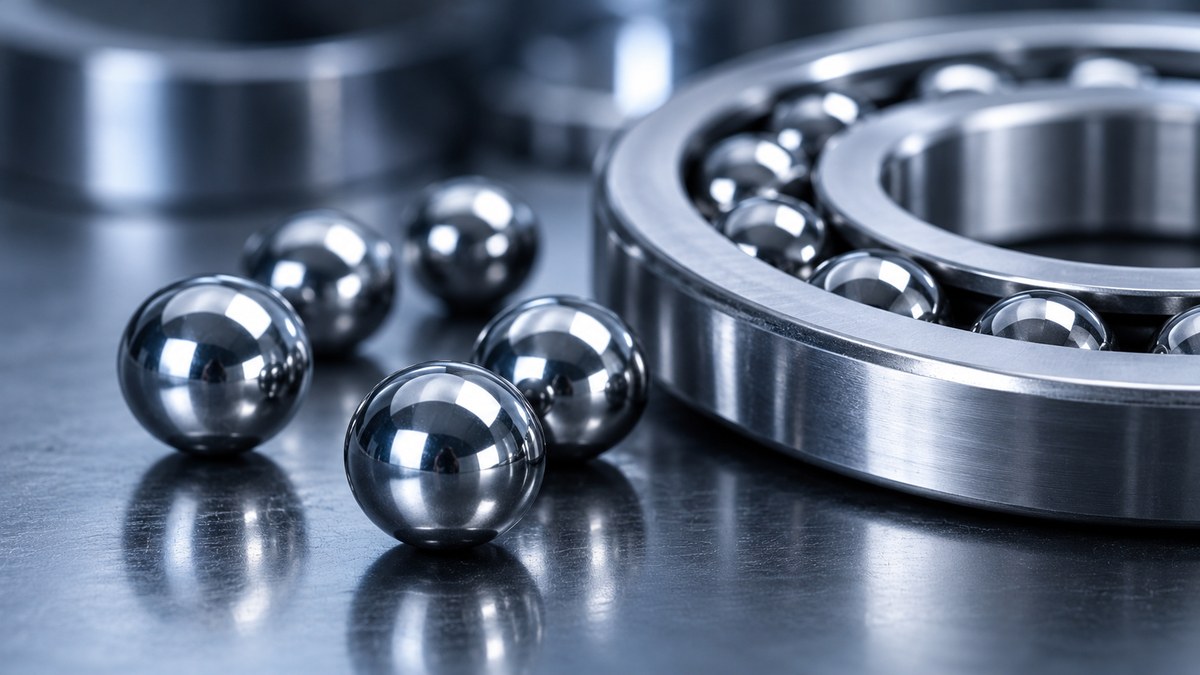
1. Why Is Hardness Important for Bearing Steel Balls?
Bearing steel balls are commonly used in bearings, mechanical transmission systems, precision equipment, and various industrial components. During operation, they are subjected to repeated rolling contact, friction, and contact stress.
Hardness plays an important role in helping steel balls maintain their shape and surface condition under these conditions.
Higher hardness, within an appropriate range, can provide several benefits:
-
Improved wear resistance: Helps reduce material loss caused by repeated contact and friction.
-
Better resistance to deformation: Helps steel balls maintain their shape under contact pressure.
-
Dimensional stability: Supports consistent performance during long-term operation.
-
Reliable operating performance: Helps meet the demands of applications involving repeated rolling contact.
These advantages make hardness an important quality parameter when selecting bearing steel balls. However, hardness alone cannot determine the overall quality or service life of a steel ball.
2. Does Higher Hardness Always Mean Better Wear Resistance?
Increasing hardness can generally improve a steel ball's resistance to wear, particularly when the material and operating conditions are properly matched. However, this relationship is not unlimited.
Once a bearing steel ball reaches an appropriate hardness level for its material and application, further increases in hardness may not provide significant additional benefits.
Wear resistance is also influenced by many other factors, including:
-
Surface finish and roughness
-
Lubrication conditions
-
Contact load and operating speed
-
Material composition and microstructure
-
Manufacturing quality
-
Environmental conditions
For example, bearing steel balls operating under proper lubrication and stable loads may achieve excellent wear performance. However, under poor lubrication, contamination, or abnormal loading conditions, even high-hardness steel balls may experience surface damage, excessive wear, or premature failure.
Therefore, selecting bearing steel balls based solely on the highest hardness value is not always the most effective approach.
3. What Are the Potential Risks of Excessive Hardness?
Hardness must be controlled within an appropriate range to ensure balanced mechanical properties. Excessively high hardness, particularly when associated with improper material conditions or heat treatment, may create other performance concerns.
3.1 Toughness and Resistance to Damage
Hardness and toughness are different mechanical properties. Hardness refers to a material's resistance to localized deformation, while toughness relates to its ability to withstand energy and resist damage before fracture.
In bearing steel balls, a suitable combination of hardness and toughness is important for handling normal operating loads and maintaining reliable performance.
If the material condition is unsuitable for the application, the component may become more sensitive to impact, stress concentration, or abnormal loading.
3.2 Greater Manufacturing Requirements
Higher hardness requirements may increase the demands on manufacturing processes, including heat treatment, grinding, lapping, and final inspection.
Manufacturers must maintain stable processing conditions to achieve the required hardness while ensuring dimensional accuracy, surface quality, and consistency across production batches.
Achieving a target hardness is important, but maintaining uniform quality throughout the entire batch is equally essential.
3.3 Hardness Cannot Prevent Every Type of Failure
Bearing steel balls may experience wear, fatigue, surface damage, corrosion, or indentation during operation.
These problems are not necessarily caused by insufficient hardness. Material quality, internal defects, surface finish, lubrication, assembly conditions, and operating environments may all contribute to component failure.
Increasing hardness alone cannot solve every performance issue.
4. How Does Hardness Affect Bearing Steel Ball Fatigue Life?
Bearing steel balls typically operate under repeated rolling contact. During continuous operation, the contact areas experience cyclic stresses that may gradually lead to material fatigue.
Proper hardness helps bearing steel balls resist surface deformation and contact stress. However, fatigue life depends on a combination of material and operating factors rather than hardness alone.
Key factors affecting fatigue performance include:
-
Raw material quality and steel cleanliness
-
Internal microstructure and carbide distribution
-
Heat treatment quality and hardness uniformity
-
Ball roundness and dimensional accuracy
-
Surface finish and manufacturing defects
-
Load distribution within the bearing
-
Lubrication quality and operating environment
For bearing systems designed for long-term operation, consistent material quality, precise manufacturing, and controlled hardness are often more important than simply achieving a higher hardness value.
5. Different Applications Require Different Hardness Levels
The appropriate hardness of bearing steel balls varies depending on the application, mechanical design, operating conditions, and performance expectations.
Different industrial applications may require different combinations of hardness, wear resistance, precision, and reliability.
| Application | Key Performance Requirements |
|---|---|
| Precision bearings | Hardness uniformity, dimensional accuracy, stable rolling performance |
| Heavy-load machinery | Load resistance, wear resistance, reliable material properties |
| High-speed equipment | Precision, surface quality, operational stability, fatigue performance |
| Industrial transmission systems | Wear resistance, dimensional stability, long-term reliability |
| General mechanical components | Balanced performance, cost efficiency, application suitability |
For industrial buyers, selecting the right bearing steel ball requires understanding the actual working environment rather than focusing on hardness alone.
6. Why Is Hardness Uniformity Equally Important?
For bulk purchases of bearing steel balls, hardness uniformity is an important quality consideration.
If steel balls within the same batch have significant hardness variations, their wear behavior, deformation resistance, and operating performance may also differ. This can be particularly important in precision bearings and mechanical systems that require consistent performance.
Reliable manufacturing processes should focus on:
-
Stable heat treatment procedures
-
Consistent hardness within the specified range
-
Uniform product quality across batches
-
Appropriate inspection and testing procedures
-
Compliance with customer specifications and applicable standards
For B2B buyers, consistent product quality helps reduce performance variations, improve production reliability, and support long-term supply relationships.
7. What Should Buyers Consider When Purchasing Bearing Steel Balls?
When sourcing bearing steel balls, buyers should evaluate several technical and quality factors instead of using hardness as the only selection criterion.
Hardness
Confirm that the hardness meets the requirements of the application and the specified technical standards.
Material
Check the material grade and ensure it is suitable for the intended operating environment and mechanical requirements.
Dimensional Accuracy
Ball diameter, tolerance, and dimensional consistency are essential for proper fitting, assembly, and operational performance.
Surface Finish
Evaluate surface roughness and appearance to ensure the balls meet the requirements of the intended application.
Hardness Uniformity
Consistent hardness across individual balls and production batches is important for stable product performance.
Manufacturing Quality
Evaluate the supplier's manufacturing processes, quality inspection procedures, production consistency, and delivery capability.
By considering these factors together, buyers can select bearing steel balls that better match their equipment requirements and application conditions.
8. The Right Hardness Matters More Than the Highest Hardness
Higher hardness can improve the wear resistance and deformation resistance of bearing steel balls, but it does not automatically guarantee better overall performance.
Excessive focus on hardness without considering toughness, material microstructure, manufacturing precision, lubrication, and operating conditions may not deliver the expected benefits.
For industrial applications, reliable bearing steel balls should offer an appropriate hardness level, consistent material properties, precise dimensions, good surface quality, and stable performance under actual working conditions.
Choosing the right hardness based on application requirements is more important than simply pursuing the highest possible value.
At HUARI, we specialize in the manufacturing and supply of steel balls and other spherical components for industrial applications. We focus on manufacturing quality, processing precision, and product consistency to meet the diverse requirements of global B2B customers.
Whether you are sourcing bearing steel balls for bearings, machinery, transmission systems, or other industrial components, HUARI is committed to providing reliable products and professional support for your sourcing needs.
HUARI – Reliable Spherical Components for Industrial Applications.
Contact HUARI to learn more about our steel ball specifications, material options, and customized solutions for your business.