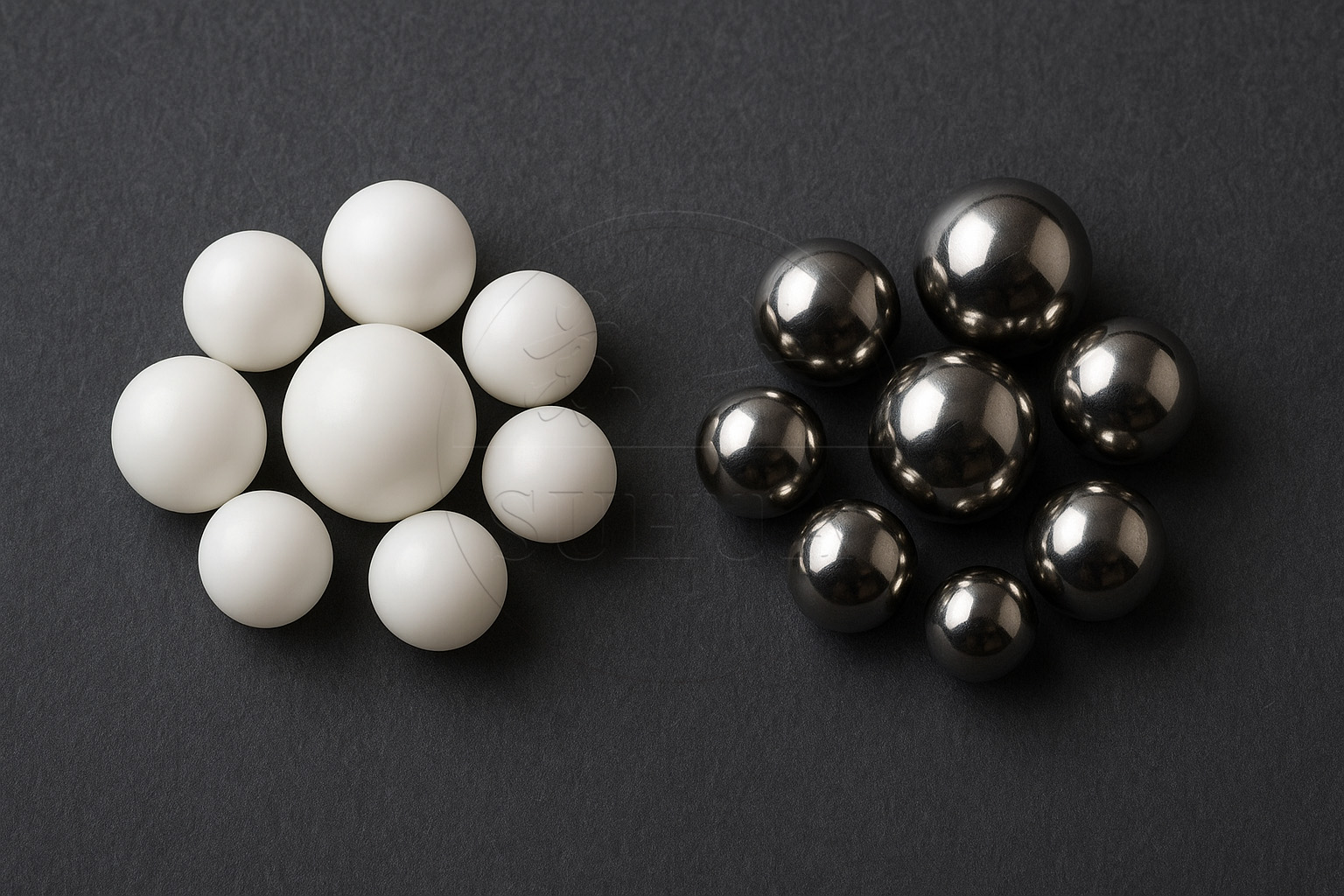
1. Service Life Characteristics of Plastic Balls
Plastic balls, typically made from POM, PTFE, Nylon, PP, or PEEK, are valued for their unique properties.
Advantages:
-
Lightweight: Reduces equipment load and energy consumption.
-
Corrosion resistance: Withstand acids, alkalis, and solvents, making them ideal for chemical, food, and medical industries.
-
Low friction and noise: Smooth running with minimal sound, suitable for precision instruments and household appliances.
-
Cost-effective: Lower production cost, suitable for short-term or disposable use.
Limitations:
-
Low wear resistance: Prone to abrasion in high-speed or heavy-load conditions.
-
Temperature limits: Most plastics degrade above 100–150℃.
-
Lower load capacity: Susceptible to deformation under heavy impact.
Service Life Example:
In food machinery, plastic balls can last 6–12 months, but in high-load bearings, their lifespan may shrink to weeks or months.
2. Service Life Characteristics of Metal Balls
Metal balls, including stainless steel, bearing steel, carbon steel, brass, and tungsten carbide, are known for their durability.
Advantages:
-
High hardness and strength: Excellent resistance to impact and pressure, suitable for heavy loads.
-
Superior wear resistance: Maintain precision and roundness even under continuous friction.
-
High-temperature endurance: Remain stable at 200–500℃ depending on material.
-
Extended service life: Can last 5–10 years in demanding industrial environments.
Limitations:
-
Corrosion risk: Carbon and bearing steel require protective treatment in corrosive environments.
-
Higher weight: Increases transport and energy costs.
-
Higher cost: Especially for tungsten carbide or ceramic balls.
Service Life Example:
In automotive bearings, steel balls typically last 5–10 years; in precision instruments, stainless steel balls can work reliably for over a decade.
3. Comparison and Selection
| Dimension | Plastic Balls | Metal Balls |
|---|---|---|
| Wear resistance | Moderate, limited | Excellent, durable |
| Corrosion resistance | Excellent | Depends on material |
| High-temp tolerance | Limited (≤150℃) | Excellent (200–500℃) |
| Load capacity | Light to medium | Heavy duty |
| Overall lifespan | Short to medium | Long-term |
Recommendations:
-
Choose plastic balls for lightweight, corrosion-resistant, and cost-sensitive environments.
-
Choose metal balls for high load, high temperature, and long service life needs.
-
In some cases, a combination of plastic and metal balls achieves both performance and cost optimization.
4. Conclusion and Our Advantage
Conclusion: Plastic balls are ideal for lightweight and corrosion-resistant applications, while metal balls outperform in durability, strength, and long-term use.
Our Advantage:
With over 36 years of expertise in ball manufacturing and trading, we provide:
-
A wide range of materials: stainless steel, bearing steel, carbon steel, copper, tungsten carbide, plastic, ceramic, glass, and more.
-
Strict quality control and precision testing for guaranteed performance.
-
Customized solutions and technical consultation based on customer requirements.
Partner with us for long-lasting, reliable ball solutions.