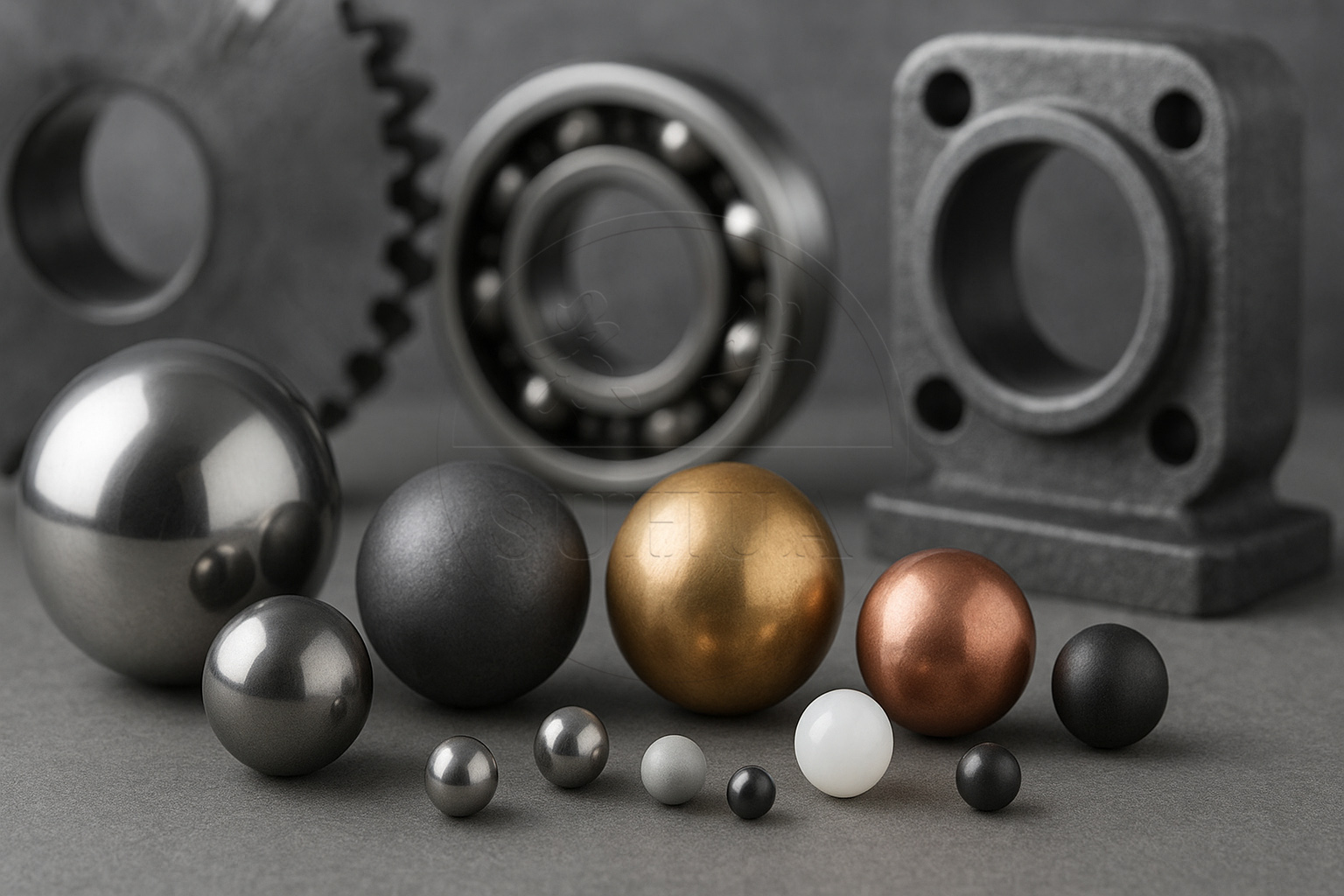
In the world of industrial manufacturing, balls are widely applied in bearings, valves, transmissions, automotive parts, medical devices, and even electronic products. Although they may appear simple, industrial balls must meet demanding requirements for precision, strength, and service life. Among these factors, material selection plays the decisive role. To guide customers in making optimal choices, we introduce the “Golden Triangle Principle”: Strength, Corrosion Resistance, and Cost.
1. Strength: The Foundation of Durability
For applications involving heavy loads, high speeds, or strong impacts, strength and hardness are critical.
-
Bearing steel balls (e.g., GCr15) provide outstanding hardness and wear resistance, ideal for precision bearings.
-
Tungsten carbide balls deliver extreme hardness and wear resistance, suitable for severe abrasion conditions.
-
Ceramic balls combine light weight, high strength, and temperature resistance, making them indispensable in aerospace and high-speed machinery.
Key takeaway: Strength determines whether the ball can endure its intended workload.
2. Corrosion Resistance: The Shield of Stability
In chemical, food, and medical industries, corrosion resistance ensures long-term reliability.
-
Stainless steel balls (304, 316) are widely used for their resistance to rust and excellent safety performance.
-
Plastic and glass balls perform well in weak acid/alkali and insulating environments.
-
Copper and brass balls offer electrical conductivity and moderate corrosion resistance, ideal for electrical components and low-voltage switches.
Key takeaway: Corrosion resistance is essential when the environment involves liquids, gases, or chemicals.
3. Cost: Balancing Performance and Economics
Even the best material must be economically viable.
-
Carbon steel balls are affordable and suitable for large-volume, cost-sensitive applications such as toys, conveyors, and rolling devices.
-
Bearing steel balls provide a balance of strength and cost for general industrial use.
-
For industries demanding extreme performance, tungsten carbide and ceramic balls, though more expensive, deliver excellent value over time.
Key takeaway: Cost ensures that material selection remains both effective and sustainable.
Applying the Golden Triangle
The three factors—strength, corrosion resistance, and cost—form a balanced triangle:
-
Higher strength and corrosion resistance typically mean higher costs.
-
Cost-effective options require reasonable compromises on performance.
-
Smart selection depends on application requirements, industry standards, and budget goals.
As a specialized B2B ball manufacturer and trading supplier, we provide a full range of materials, including stainless steel, bearing steel, carbon steel, copper, tungsten carbide, ceramic, plastic, and glass balls. More importantly, we offer one-stop technical consultation and customized solutions to help our clients achieve the best balance under the Golden Triangle Principle.
Conclusion
Material selection is not about a single property, but about striking the right balance between performance and economics. By applying the Golden Triangle Principle, customers can make smarter choices that ensure equipment stability, extended service life, and long-term value. With professional expertise and a complete supply chain, we are committed to delivering reliable, high-quality ball products for diverse industries worldwide.