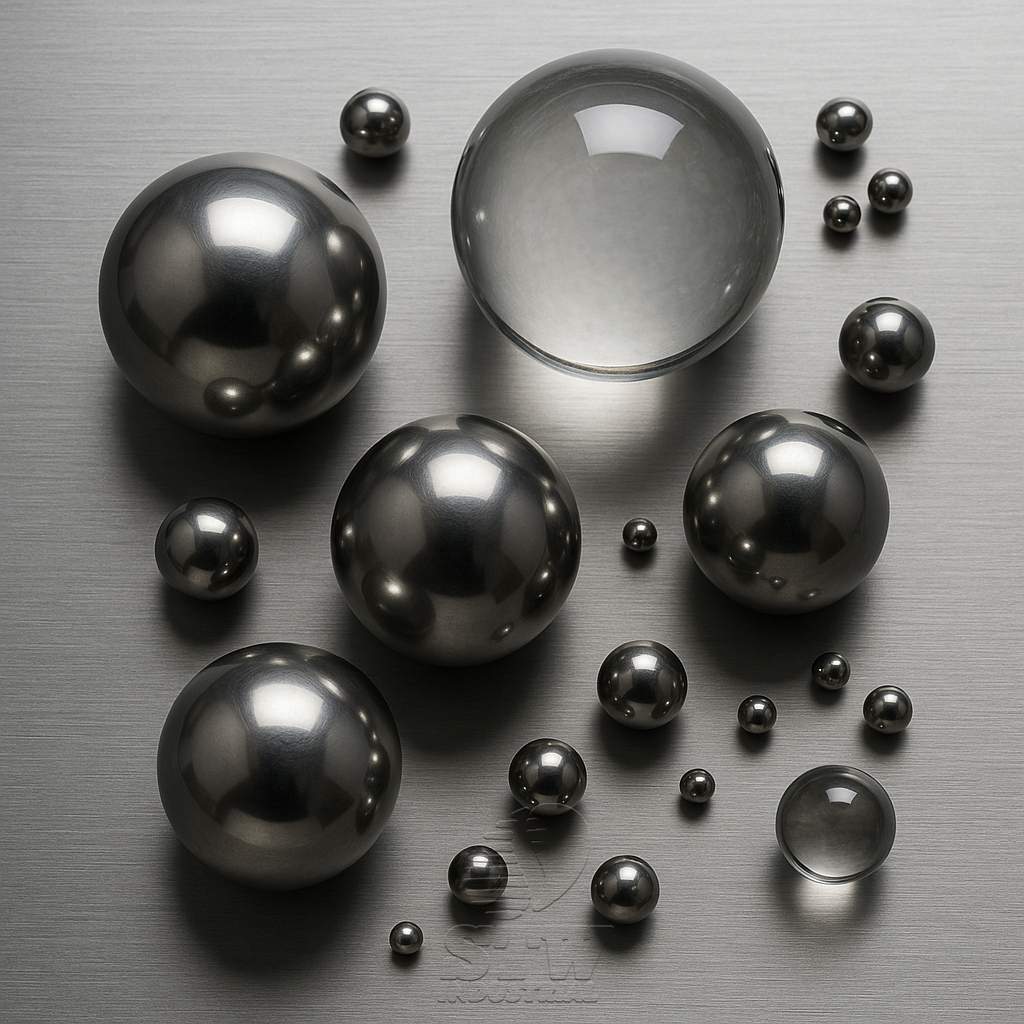
In high-load and high-impact environments, standard through-hardened steel balls may not provide the optimal balance between hardness and toughness. Surface hardened steel balls are engineered to deliver superior wear resistance on the outer layer while maintaining a tough, ductile core.
This dual-structure design significantly improves fatigue life, impact resistance, and overall operational reliability across demanding industrial applications.
What Are Surface Hardened Steel Balls?
Surface hardened steel balls are manufactured through controlled heat treatment or thermochemical processes that harden only the outer layer while preserving core toughness.
This “hard shell + tough core” structure provides:
-
High surface hardness (typically HRC 58–65)
-
Excellent wear resistance
-
Superior impact resistance
-
Reduced risk of brittle fracture
-
Extended rolling contact fatigue life
Compared to fully through-hardened balls, surface hardened balls perform more reliably under dynamic and shock loading conditions.
Key Surface Hardening Processes
1. Carburizing
Carburizing is one of the most widely used surface hardening methods for low-carbon alloy steels.
Process principle:
Carbon atoms diffuse into the steel surface at elevated temperatures, followed by quenching to form a high-hardness martensitic layer.
Advantages:
-
Deep hardened case depth
-
Tough core structure
-
Strong resistance to impact loads
-
Cost-effective for mass production
Commonly used in automotive transmission components and heavy-duty mechanical systems.
2. Induction Hardening
Induction hardening uses high-frequency electromagnetic induction to rapidly heat the steel surface before quenching.
Key benefits:
-
Precise heating control
-
Minimal distortion
-
Adjustable case depth
-
High production efficiency
This method is ideal for medium-carbon steels and large-scale manufacturing.
3. Nitriding
Nitriding strengthens the surface layer by diffusing nitrogen atoms into the steel matrix.
Advantages include:
-
Improved wear resistance
-
Enhanced corrosion resistance
-
Increased fatigue strength due to compressive residual stress
-
Minimal deformation (no high-temperature quenching required)
Nitrided steel balls are often used in precision machinery and high-end industrial systems.
Industrial Applications of Surface Hardened Steel Balls
Automotive Industry
Used in gear mechanisms, clutch systems, and transmission assemblies where high fatigue strength and impact resistance are critical.
Heavy Machinery
Mining equipment, construction machinery, and industrial presses require steel balls that withstand extreme compressive forces and abrasive conditions.
Precision Bearing Systems
Surface hardened balls improve rolling contact fatigue life in high-cycle applications.
Oil & Energy Equipment
In high-pressure and high-friction environments, hardened case layers ensure structural stability and longer service intervals.
Material Selection for Surface Hardening
Common materials include:
-
Low-carbon alloy steel
-
Medium-carbon steel
-
20MnCr5
-
AISI 8620 alloy steel
Material selection should consider:
-
Load type (static or dynamic)
-
Operating temperature
-
Required service life
-
Cost-performance balance
As an integrated manufacturing supplier, we provide customized material recommendations and optimized heat treatment solutions based on specific application requirements.
Quality Control and Inspection Standards
To ensure consistent surface hardening performance, strict process control is essential:
-
Case depth verification
-
Surface hardness uniformity
-
Core hardness gradient testing
-
Metallographic structure inspection
-
Surface roughness measurement
-
Precision grading (G10–G100 tolerance levels)
Comprehensive quality inspection ensures compliance with international standards and stable batch-to-batch performance.
Advantages of Surface Hardened Steel Balls
-
Extended service life
-
Higher load-bearing capacity
-
Improved wear resistance
-
Reduced maintenance costs
-
Enhanced operational reliability
For demanding industrial environments, surface hardened steel balls offer an optimal combination of durability, mechanical strength, and cost efficiency.