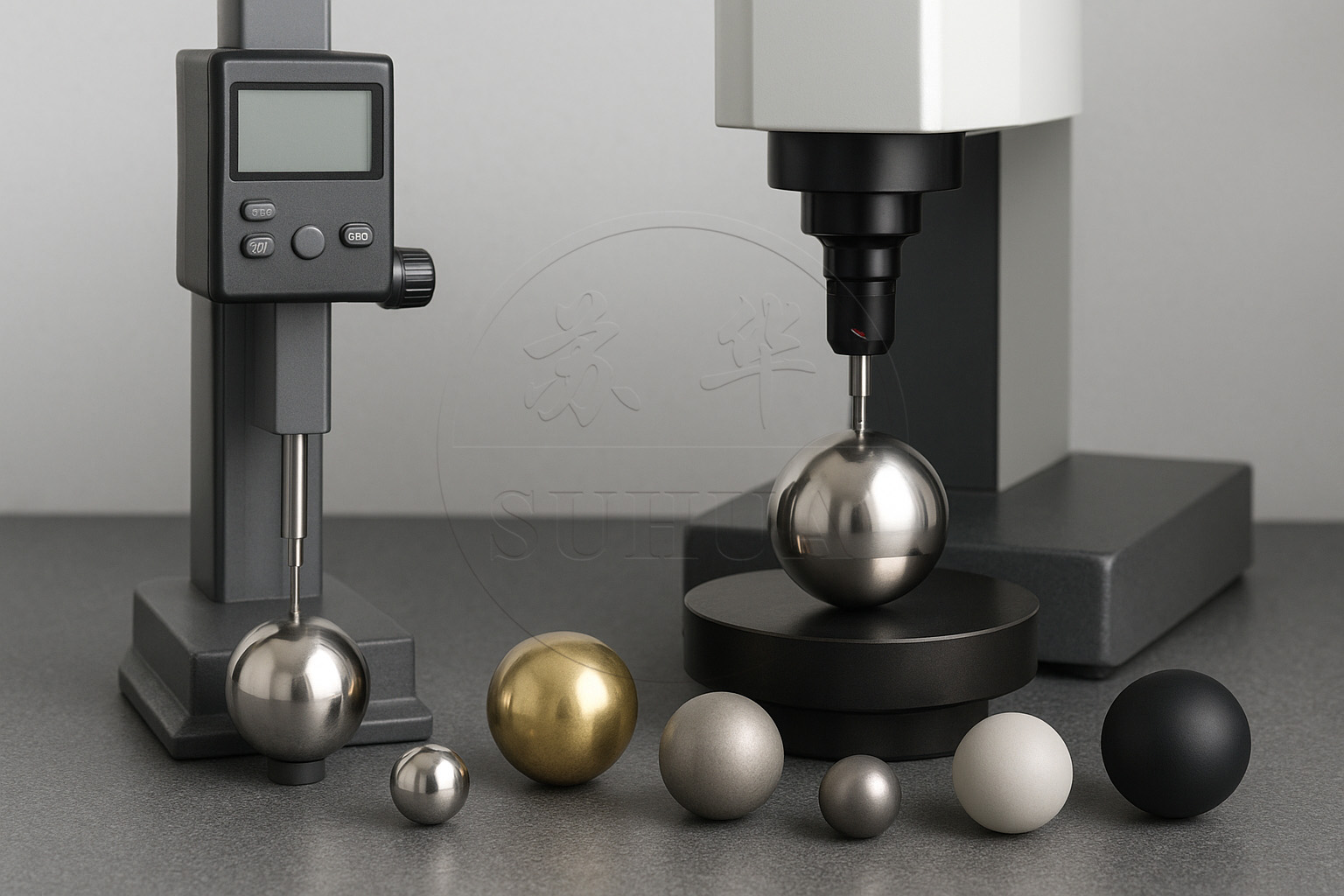
In industrial manufacturing and precision engineering, balls are critical components used in bearings, valves, medical devices, automotive parts, electronic products, and chemical equipment. The dimensional accuracy of these balls determines assembly fit, operating efficiency, and service life. Among all technical parameters, diameter tolerance is one of the most crucial.
What Is Diameter Tolerance?
Diameter tolerance refers to the permissible deviation between the actual ball diameter and the nominal design diameter. It reflects the precision of ball manufacturing. The smaller the tolerance, the closer the ball is to its theoretical size, ensuring higher uniformity and consistency.
Global standards such as ISO 3290 and ANSI/ABMA define tolerance grades (e.g., G10, G100, G500) based on factors like diameter deviation, roundness, surface roughness, and batch consistency.
Key Impacts of Diameter Tolerance on Applications
-
Bearing Performance and Smoothness
Large tolerances cause uneven load distribution, vibration, and noise in high-speed bearings. Precision-grade balls, however, ensure smooth operation and longer lifespan. -
Valve and Seal Tightness
In valves and fluid control systems, diameter variations affect sealing performance. Tight tolerance balls ensure leak-free operation and higher reliability. -
Medical and High-Precision Fields
Applications in artificial joints, dental instruments, and measuring devices require strict tolerance control. Even a slight deviation can compromise accuracy and safety. -
Assembly Consistency in Mass Production
In industries like electronics, conveyors, and toys, inconsistent tolerances lead to assembly issues, higher rejection rates, and increased costs.
Advantages of Strict Tolerance Control
-
Improved product performance by reducing friction and energy loss
-
Extended equipment lifespan through uniform wear resistance
-
Enhanced safety in critical applications such as aerospace and medical devices
-
Stronger customer trust due to higher product reliability
Our Strengths
As a B2B ball manufacturer and trading supplier, we provide:
-
Wide material options: stainless steel, bearing steel, carbon steel, copper, ceramic, and plastic balls
-
Advanced inspection equipment: 3D coordinate measuring machines, surface roughness testers, and precision projectors
-
Custom services: tolerance grades ranging from G10 to G1000
-
Quality assurance: complete traceability from raw material to final shipment
Conclusion
Though diameter tolerance may seem minor, it directly determines performance, safety, and long-term reliability in real-world applications. Choosing high-precision balls with strictly controlled tolerance is the key to reducing risks and improving competitiveness.
We are committed to delivering precision, quality, and trust, providing reliable ball solutions to customers worldwide.