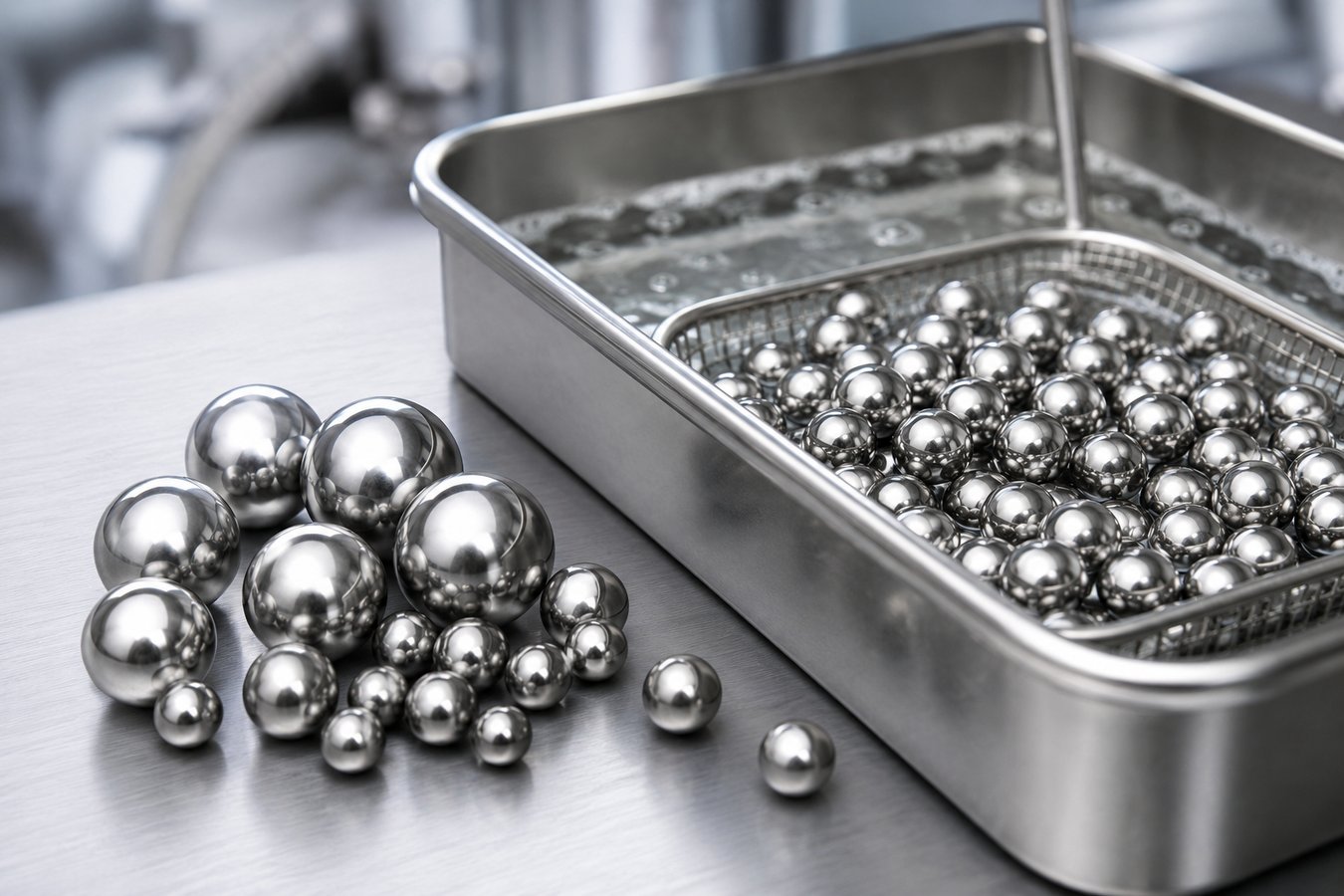
What Is Passivation Treatment for Stainless Steel Balls?
Passivation is a chemical surface treatment designed to remove contaminants such as free iron from stainless steel and promote the formation of a more stable passive oxide layer on the surface.
Stainless steel obtains much of its corrosion resistance from a thin, chromium-rich passive film that naturally forms when the material is exposed to oxygen. This film acts as a protective barrier between the metal substrate and the surrounding environment.
However, machining and finishing operations can introduce surface contaminants or disturb the surface condition. Passivation helps restore a cleaner and more stable surface condition.
It is important to understand that passivation is not the same as applying a coating. Instead, it improves the condition of the stainless steel surface and supports the natural corrosion-resistant properties of the material.
Why Is Passivation Important for Stainless Steel Balls?
1. Improved Corrosion Resistance
The primary purpose of passivation is to improve the corrosion resistance of the stainless steel surface.
Stainless steel balls may be exposed to moisture, water, cleaning agents, salt-containing environments, or other corrosive media during service. In demanding applications, surface contamination can become a starting point for localized corrosion.
Proper passivation helps remove surface contaminants and promotes a stable passive surface, helping the stainless steel ball maintain its corrosion resistance.
2. Removal of Free Iron Contamination
During manufacturing, stainless steel balls may undergo turning, grinding, lapping, polishing, and precision finishing.
If the processing equipment, abrasive tools, or production environment contains ferrous materials, small amounts of free iron may become embedded or deposited on the stainless steel surface.
This contamination can oxidize more readily than the stainless steel itself and may produce visible rust spots.
Passivation treatment helps remove free iron and other surface contaminants, reducing the risk of rust caused by external contamination.
3. Better Long-Term Surface Stability
For B2B industrial customers, product quality is not only about how a stainless steel ball looks when it leaves the factory. It must also remain stable during packaging, transportation, storage, and final application.
This is particularly important for export orders, where products may spend weeks in containers or warehouses exposed to varying humidity levels.
A properly processed and passivated stainless steel ball can offer better surface stability and reduce corrosion risks associated with manufacturing contamination.
4. Enhanced Reliability in Industrial Applications
Stainless steel balls are frequently used in precision mechanical systems where surface condition is important.
Applications may include:
- Bearings and bearing components
- Valves and pumps
- Automotive components
- Food processing machinery
- Medical and laboratory equipment
- Precision instruments
- Linear motion systems
- Automation equipment
- Chemical processing equipment
If corrosion, rust spots, or surface defects develop on a ball, they can affect contact conditions, movement, sealing performance, or the service life of the component.
For this reason, passivation can be an important quality-control step for stainless steel balls used in demanding applications.
How Are Stainless Steel Balls Passivated?
The exact process depends on the stainless steel grade, product requirements, surface condition, and intended application. A typical process may include:
Surface Cleaning → Degreasing → Passivation → Rinsing → Neutralization or Additional Treatment → Final Rinsing → Drying → Inspection → Packaging
Step 1: Surface Cleaning
The stainless steel balls are cleaned to remove dust, grinding residues, abrasive particles, and other surface contaminants.
A clean surface provides better conditions for subsequent passivation.
Step 2: Degreasing
Lubricants, grinding fluids, oils, and other processing residues can remain on the surface after manufacturing.
Thorough degreasing is important because oil or grease contamination can interfere with uniform surface treatment.
Step 3: Passivation
The cleaned stainless steel balls are subjected to an appropriate passivation process based on the material grade and customer requirements.
Different stainless steel grades, such as 304, 316, 316L, and 420, have different chemical compositions and performance characteristics. Therefore, passivation parameters should be selected according to the specific material and application.
Step 4: Rinsing
After passivation, the balls must be thoroughly rinsed to remove residual processing chemicals from the surface.
For applications requiring high cleanliness, rinsing quality is an important part of the overall manufacturing process.
Step 5: Drying and Inspection
After cleaning, the stainless steel balls are properly dried and inspected according to the required specifications.
Depending on the application, inspection may include:
- Visual surface inspection
- Dimensional inspection
- Surface finish inspection
- Corrosion-resistance testing
- Cleanliness inspection
- Packaging inspection
Which Stainless Steel Balls Can Benefit from Passivation?
The need for passivation depends on the material grade, operating environment, customer specifications, and application requirements.
304 Stainless Steel Balls
304 stainless steel balls provide good general corrosion resistance and are widely used in mechanical components, food-related equipment, decorative applications, and general industrial environments.
For applications with higher surface cleanliness or corrosion-resistance requirements, passivation can provide additional surface treatment value.
316 and 316L Stainless Steel Balls
316 and 316L stainless steel generally provide better corrosion resistance than 304 stainless steel, particularly in environments involving chlorides and certain corrosive media.
They are commonly considered for marine equipment, chemical processing, food processing, pharmaceutical-related equipment, and other demanding applications.
420 Stainless Steel Balls
420 stainless steel balls can provide higher hardness and wear resistance and are used in applications such as valves, bearings, and mechanical components.
Because 420 stainless steel has different corrosion characteristics from austenitic grades such as 304 and 316, material selection and surface treatment should be based on the actual application requirements.
Passivation Does Not Mean “Rust-Proof Forever”
One common misconception is that passivation makes stainless steel completely rust-proof.
Passivation improves surface corrosion resistance, but it does not make stainless steel immune to corrosion under all conditions.
The actual corrosion performance of a stainless steel ball depends on multiple factors, including:
- Stainless steel grade
- Chemical composition
- Surface roughness
- Manufacturing quality
- Passivation process
- Temperature
- Humidity
- Chloride concentration
- Chemical exposure
- Storage conditions
- Packaging method
Therefore, industrial buyers should evaluate the complete material and manufacturing solution rather than looking at passivation alone.
How to Evaluate the Quality of Passivated Stainless Steel Balls
For industrial B2B procurement, choosing a reliable supplier is critical.
Material Traceability
Confirm the exact stainless steel grade, such as 304, 316, 316L, or 420, and make sure the selected material matches the intended operating environment.
Surface Quality
The ball surface should be clean and uniform, without obvious rust spots, corrosion marks, cracks, dents, or other unacceptable defects.
Process Control
A professional manufacturer should have controlled procedures for cleaning, degreasing, passivation, rinsing, drying, and inspection.
Testing Capability
For applications with strict corrosion-resistance requirements, buyers may request appropriate corrosion testing or surface cleanliness verification based on the project specification.
Packaging and Storage
Even a properly passivated stainless steel ball can be affected by prolonged exposure to high humidity, salt contamination, or unsuitable storage conditions.
Proper packaging and storage are therefore also important for maintaining product quality.
The Value of Passivation for B2B Stainless Steel Ball Buyers
For industrial customers, purchasing stainless steel balls is not simply about buying a standard component. The goal is to obtain a product that can consistently perform within the customer's production system.
Reliable surface treatment can help reduce quality risks associated with:
- Surface contamination
- Rust spots
- Localized corrosion
- Inconsistent surface condition
- Premature component failure
This becomes particularly important when stainless steel balls are purchased in large quantities for bearings, valves, pumps, automotive components, food processing equipment, or precision machinery.
A professional stainless steel ball manufacturer should therefore be capable of controlling multiple factors, including:
Material → Ball Diameter → Dimensional Tolerance → Sphericity → Surface Roughness → Heat Treatment → Surface Treatment → Inspection → Packaging
Why Choose Huarui Steel Ball?
Changzhou Huarui Steel Ball Co., Ltd. is a professional manufacturer specializing in industrial steel balls and related ball products.
Our product range includes stainless steel balls, bearing steel balls, carbon steel balls, and other industrial ball products, with options available for different materials, sizes, precision requirements, and applications.
For stainless steel balls requiring passivation or other surface treatment, we can evaluate the requirements based on the stainless steel grade, ball diameter, surface finish, corrosion environment, and application conditions.
From material selection and precision grinding to surface treatment and final inspection, we focus on consistent process control to provide reliable steel ball solutions for global industrial customers.