1. Steel Ball Roundness
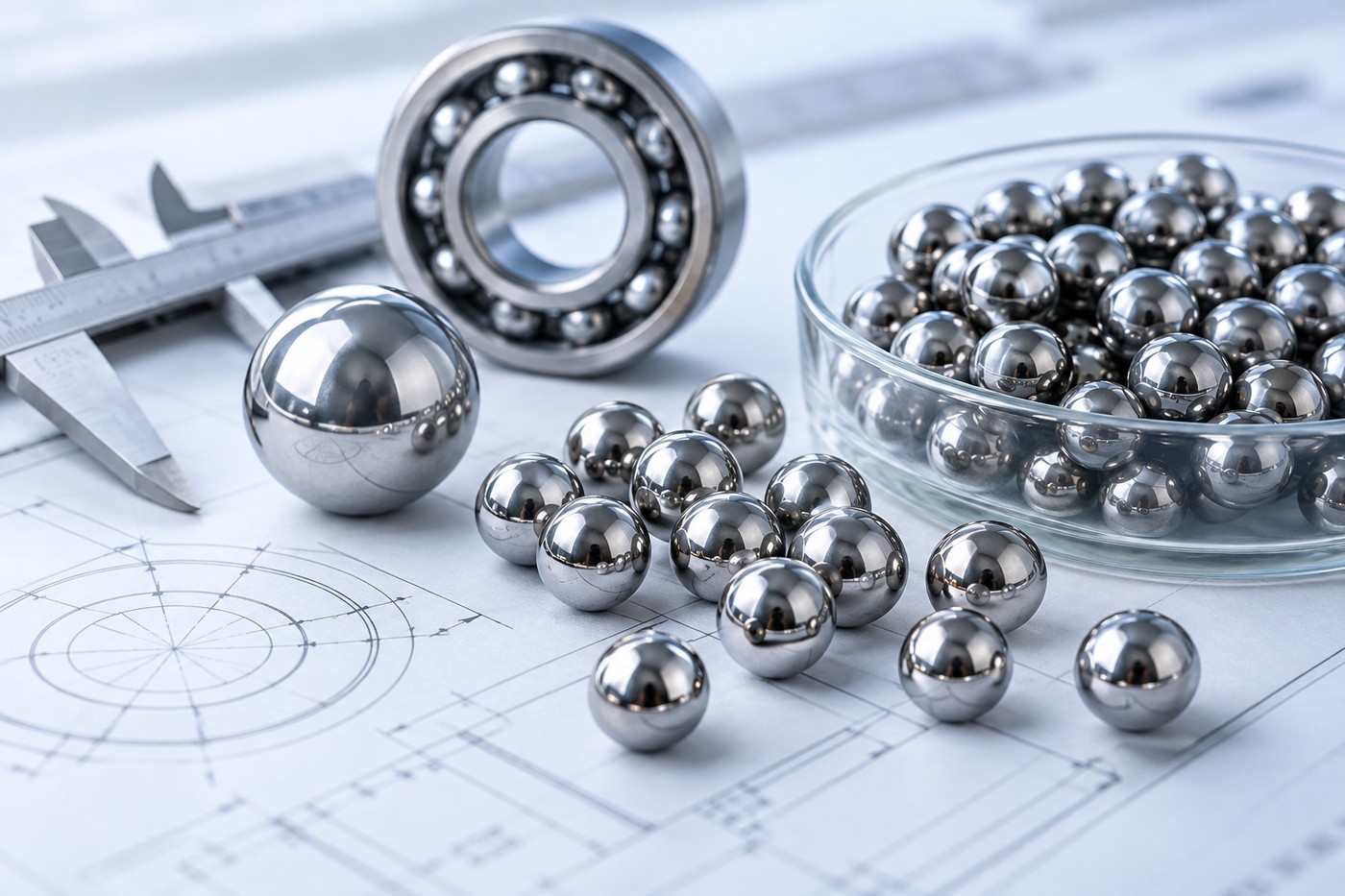
Roundness is one of the most important factors affecting steel ball rotational accuracy.
An ideal steel ball would have exactly the same radius at every point on its surface. In real manufacturing, however, extremely small deviations from a perfect sphere are unavoidable.
If a steel ball has excessive roundness error, it may cause:
- Increased radial runout
- Uneven contact pressure
- Irregular rolling movement
- Increased vibration
- Higher operating noise
- Localized wear
This is particularly important for bearing steel balls and precision steel balls, where consistent rolling motion is required.
High-quality steel balls therefore require carefully controlled grinding, lapping, and polishing processes to achieve the required roundness and sphericity.
2. Diameter Accuracy and Ball Diameter Variation
A steel ball must not only be round; its diameter also needs to be accurately controlled.
For example, two steel balls may both have a nominal diameter of 10 mm, but their actual diameters can differ slightly.
In precision bearing applications, excessive diameter variation between balls can result in uneven load distribution. Larger balls may carry a greater portion of the load, while smaller balls may carry less.
This can lead to:
- Uneven load distribution
- Increased contact stress
- Higher friction
- Vibration
- Noise
- Reduced operating stability
For this reason, precision steel ball manufacturing requires control over both individual ball diameter accuracy and diameter consistency within the same batch.
This is particularly important when steel balls are used as rolling elements in precision bearings.
3. Surface Waviness
Surface waviness is another important factor that should not be overlooked.
Waviness is different from conventional surface roughness. A steel ball may have acceptable dimensional accuracy while still exhibiting periodic surface deviations.
During high-speed rotation, these periodic deviations can generate repeated variations in contact conditions and potentially contribute to vibration and noise.
For precision applications, manufacturers may therefore need to control several characteristics simultaneously:
- Roundness
- Sphericity
- Waviness
- Surface roughness
- Diameter variation
For high-speed bearings, precision spindles, servo systems, and other demanding applications, controlling surface waviness can be particularly important.
4. Steel Ball Surface Roughness
Surface finish directly affects the interaction between a steel ball, its mating surface, and the lubricant.
If the ball surface contains excessive scratches, pits, grinding marks, or other defects, it may contribute to:
- Increased friction
- Unstable lubrication
- Higher contact stress
- Increased operating noise
- Accelerated wear
Precision steel balls are therefore subjected to controlled grinding, lapping, and polishing processes to achieve a consistent surface finish.
However, surface quality should not simply be understood as "the smoother, the better." The appropriate surface condition depends on the application, lubrication system, contact conditions, and required performance.
For bearing applications, the surface finish of both the steel ball and bearing raceway needs to be considered as part of the complete tribological system.
5. Material Quality
The material used to manufacture a steel ball has a direct influence on its mechanical performance and long-term dimensional stability.
Common steel ball materials include:
- Bearing steel such as AISI 52100 / GCr15 / 100Cr6
- Stainless steel such as 440C
- Carbon steel
- Other customized steel grades
Different materials provide different combinations of:
- Hardness
- Wear resistance
- Fatigue strength
- Corrosion resistance
- Dimensional stability
- Load-carrying capability
For precision bearing steel balls, material cleanliness and metallurgical quality are particularly important because the balls are subjected to repeated rolling contact and cyclic loads.
Choosing the correct material according to the application is therefore an essential part of precision steel ball manufacturing.
6. Heat Treatment
Heat treatment is a critical manufacturing stage for many steel ball products.
Processes such as quenching and tempering are used to obtain the required hardness, strength, wear resistance, and metallurgical structure.
However, heat treatment can also cause dimensional changes and residual stresses.
For this reason, heat treatment parameters must be carefully controlled, followed by precision grinding and finishing processes that correct dimensional and geometric deviations.
A stable heat treatment process combined with accurate post-treatment grinding is essential for producing high-quality bearing steel balls and precision steel balls.
7. Grinding, Lapping, and Finishing Processes
The final accuracy of a steel ball depends heavily on its finishing processes.
A typical manufacturing route may include:
Forming → Heat Treatment → Grinding → Lapping → Polishing → Cleaning → Inspection
Each stage has a specific purpose.
Grinding
Grinding is used to improve the basic dimensions and spherical shape of the ball.
Lapping
Precision lapping can further improve roundness, diameter consistency, and surface characteristics.
Polishing
Polishing helps achieve the required surface finish and appearance while minimizing undesirable surface defects.
If machining equipment is unstable or process parameters are not properly controlled, the steel ball may develop geometric errors, surface waviness, or inconsistent dimensions.
Therefore, high-precision steel ball production requires not only advanced equipment but also stable manufacturing processes and strict process control.
8. Internal Metallurgical Structure and Hardness Consistency
The quality of a steel ball cannot be evaluated only by its external appearance.
The internal metallurgical structure and hardness distribution are also important, especially for balls used under continuous rolling contact.
If the internal structure is inconsistent, the steel ball may experience differences in deformation, wear resistance, or fatigue behavior during long-term operation.
In demanding applications such as bearings, steel balls repeatedly experience:
Rolling Contact → Loading → Unloading → Repeated Loading
Stable material properties help the ball maintain its dimensional and mechanical performance over extended service periods.
This is why quality control should cover the entire manufacturing process, from raw material selection to heat treatment and final inspection.
9. Matching Between Steel Balls and Raceway
Even a highly accurate steel ball cannot guarantee excellent rotational performance if the components it operates with are not properly manufactured or matched.
For bearing applications, overall running accuracy can also be affected by:
- Raceway roundness
- Raceway waviness
- Raceway surface roughness
- Inner and outer ring alignment
- Internal bearing clearance
- Preload
- Ball diameter variation
This means that steel ball accuracy is part of a larger mechanical system.
For precision rotating equipment, the steel ball, bearing rings, shaft, housing, lubrication system, and installation conditions must work together to achieve the required performance.
10. Installation Accuracy
Installation conditions can also affect the final rotational accuracy of a bearing or rotating assembly.
For example, problems may occur when:
- The shaft is not sufficiently round
- The housing bore is eccentric
- The shaft and bearing are misaligned
- The bearing is installed at an angle
- The fit tolerance is inappropriate
- Excessive assembly stress is introduced
In such situations, even precision steel balls may not be able to compensate for errors elsewhere in the system.
Therefore, achieving high rotational accuracy requires both high-quality components and proper assembly control.
How Can Steel Ball Rotational Accuracy Be Improved?
For a professional steel ball manufacturer, improving rotational accuracy requires a comprehensive quality management system rather than relying only on final inspection.
1. Select High-Quality Raw Materials
Choose suitable bearing steel, stainless steel, carbon steel, or other materials according to the customer's application requirements.
2. Control Heat Treatment
Maintain stable heat treatment parameters to achieve consistent hardness and metallurgical properties while minimizing dimensional changes and residual stress.
3. Optimize Grinding and Lapping
Use controlled grinding and precision lapping processes to improve roundness, diameter consistency, and surface quality.
4. Maintain Manufacturing Equipment
Precision equipment needs regular maintenance and calibration to ensure stable processing conditions and consistent product quality.
5. Perform Comprehensive Inspection
Depending on the required precision grade and application, steel balls may be inspected for:
- Ball diameter
- Diameter variation
- Roundness
- Surface roughness
- Surface defects
- Hardness
- Material properties
- Overall dimensional consistency
6. Select the Appropriate Precision Grade
Not every application requires the highest available precision.
Steel balls used in general hardware components, furniture slides, valves, industrial machinery, and precision bearings may have significantly different performance requirements.
Selecting the appropriate precision level allows customers to achieve the required performance without unnecessarily increasing procurement costs.
Why Are Precision Steel Balls Important for Rotating Equipment?
A steel ball may be a small mechanical component, but its influence on a rotating system can be significant.
In high-speed and precision applications, small deviations in ball geometry or surface condition may eventually appear as:
Vibration → Noise → Friction → Heat → Wear → Reduced Service Life
This is why high-quality precision steel balls need to meet more than basic dimensional requirements.
Important characteristics include:
- High roundness
- Consistent ball diameter
- Controlled waviness
- Appropriate surface roughness
- Stable material properties
- Proper heat treatment
- Consistent grinding and lapping
- Reliable quality inspection
The difference between a standard steel ball and a precision steel ball is not simply its appearance. It lies in the level of control applied throughout the entire manufacturing process.
Why Choose Huarui Steel Ball for Precision Steel Ball Applications?
Changzhou Huarui Steel Ball Co., Ltd. is a professional steel ball manufacturer with extensive experience in the production of various industrial ball products.
Our product range includes bearing steel balls, stainless steel balls, carbon steel balls, and other customized steel ball products for different industrial applications.
We focus on controlling the complete manufacturing process, from raw material selection and heat treatment to grinding, precision lapping, polishing, cleaning, and final inspection.
Our steel balls can be supplied according to different requirements for:
- Diameter
- Material
- Precision
- Surface finish
- Hardness
- Application environment
- Customized specifications
Whether you are sourcing steel balls for bearings, automotive components, industrial machinery, automation equipment, valves, hardware components, or other rotating applications, selecting the right steel ball is an important step toward achieving stable and reliable system performance.
Contact Huarui Steel Ball to discuss your steel ball requirements and find the right precision solution for your application.
Frequently Asked Questions About Steel Ball Rotational Accuracy
What is the most important factor affecting steel ball rotational accuracy?
There is no single factor that determines rotational accuracy. Roundness, diameter variation, waviness, surface roughness, material properties, manufacturing processes, and mating component accuracy all contribute to the final performance.
Does a perfectly round steel ball guarantee high rotational accuracy?
Not necessarily. Roundness is important, but rotational performance also depends on diameter consistency, surface waviness, surface finish, bearing geometry, clearance, preload, alignment, and installation conditions.
Why is diameter consistency important for bearing steel balls?
Consistent ball diameter helps distribute loads more evenly among the rolling elements. Excessive diameter variation can cause uneven loading, vibration, friction, and accelerated wear.
What is the difference between roundness and surface roughness?
Roundness describes how closely the overall shape of a steel ball approaches a perfect sphere, while surface roughness describes much smaller surface irregularities. Both can affect the performance of precision steel balls, but they represent different characteristics.
Which steel balls are suitable for high-speed bearings?
High-speed bearing applications generally require precision steel balls with carefully controlled roundness, diameter variation, waviness, surface finish, hardness, and material quality. The appropriate specification should be selected according to the bearing design and operating conditions.
Can Huarui Steel Ball provide customized steel balls?
Yes. Steel balls can be produced according to customer requirements for material, diameter, precision, hardness, surface finish, and application requirements. Customers are encouraged to provide drawings, specifications, or application information for technical evaluation.