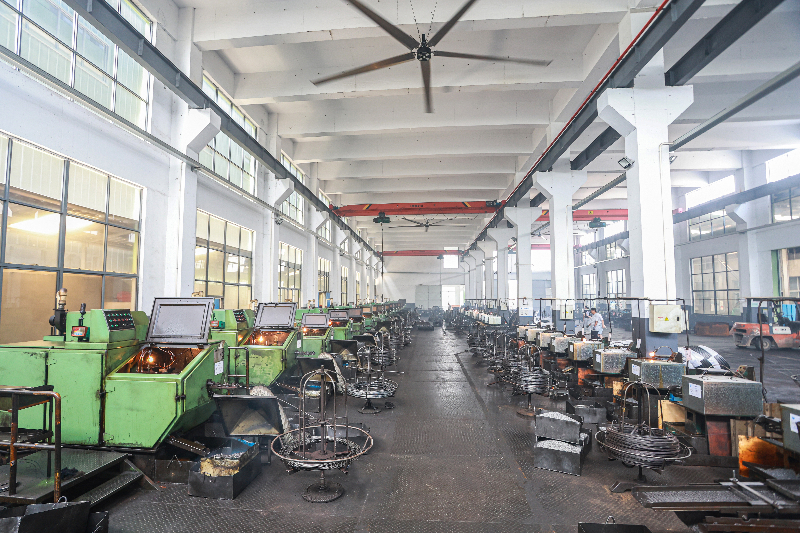
How Does Steel Ball Cold Heading Work?
The basic principle of cold heading is relatively straightforward:
A precisely prepared metal blank is compressed inside a forming die, causing the material to plastically flow until it fills the spherical cavity.
Before forming, the blank generally has a cylindrical shape.
During the forming process, the blank is subjected to substantial compressive force. Instead of being cut away, the metal flows within the confined die cavity.
The forming process can be understood in several stages:
- The steel blank enters the forming die.
- The dies close around the blank.
- Axial compression is applied.
- The material undergoes plastic deformation.
- Metal flows radially into the spherical cavity.
- The cavity becomes progressively filled.
- A near-spherical steel ball blank is formed.
The process depends on a combination of material properties, blank dimensions, die geometry, friction, lubrication, forming force, and machine stability.
For this reason, simply increasing forming pressure does not necessarily produce better steel balls. The entire forming system needs to be properly matched.
Why Is Blank Size So Important in Cold Heading?
One of the most critical factors in steel ball cold heading is the accuracy of the initial blank.
The blank must have controlled:
- Diameter
- Length
- Weight
- Volume
- End-face condition
- Surface quality
The fundamental principle is that the material volume is approximately conserved during plastic deformation. The process changes the shape of the material rather than removing a large amount of it.
If the blank is too small, there may not be enough material to completely fill the die cavity. This can result in undersized or incomplete ball blanks.
If the blank is oversized, excessive material may create larger flash or forming loads. This can increase die wear and make subsequent flash removal more difficult.
Therefore, accurate blank preparation is an important foundation for producing consistent steel ball blanks.
Step-by-Step Steel Ball Cold Heading Process
1. Selecting the Raw Material
Raw material quality is the starting point of steel ball production.
Depending on the application, manufacturers may use different materials, including:
- Bearing steel
- Stainless steel
- Carbon steel
- Alloy steel
For high-precision bearing steel balls, material quality is particularly important. Chemical composition, cleanliness, dimensional consistency, and internal quality can all affect the performance of the finished ball.
Material defects such as cracks, inclusions, or other internal imperfections may become more significant during subsequent forming and finishing operations.
This is why reliable steel ball manufacturers place strong emphasis on raw material inspection and supplier control.
2. Wire Drawing and Sizing
When steel wire is used as the starting material, wire drawing or sizing may be performed before cold heading.
The main purposes are to:
- Control wire diameter
- Improve dimensional consistency
- Meet feeding requirements
- Prepare the material for accurate cutting
- Provide stable material conditions for cold heading
Consistent wire diameter is important because variations in wire size can directly affect the volume and weight of each blank.
3. Precision Cutting
The steel wire is then cut into individual blanks with a controlled length.
Each blank should ideally have consistent:
Length + Diameter + Weight + Volume
The cutting operation may appear simple, but it has an important influence on forming stability.
Excessive burrs, uneven cutting surfaces, or dimensional variation can interfere with material flow during cold heading.
Depending on the material and production requirements, the blank end condition may therefore require additional control or preparation.
The Role of the Forming Die in Steel Ball Cold Heading
The forming die is one of the most important components in the cold heading process.
The die contains a cavity designed to produce the required spherical geometry. When the dies close around the blank, the applied force causes the material to flow into the cavity.
In simplified form:
Cylindrical Steel Blank + Precision Die + Controlled Forming Force = Steel Ball Blank
Die design must take multiple factors into consideration, including:
- Steel ball diameter
- Material grade
- Blank dimensions
- Die cavity geometry
- Forming load
- Friction conditions
- Lubrication
- Production speed
- Die material
- Required production volume
Because cold heading involves repeated high loads, die wear and dimensional stability are important considerations for manufacturers producing large quantities of steel balls.
A worn or improperly designed die can affect ball geometry, flash formation, dimensional consistency, and production efficiency.
What Happens to the Steel During Cold Heading?
From a materials engineering perspective, steel ball cold heading is fundamentally a plastic deformation process.
When the applied stress exceeds the material's yield condition, the steel begins to undergo permanent deformation.
Because the material is constrained by the die, the deformation occurs in a controlled direction.
The basic transformation can be represented as:
Axial Compression → Radial Material Flow → Cavity Filling → Spherical Blank Formation
During this process, the material experiences a complex distribution of stress and strain.
The exact forming behavior depends on factors such as:
- Material strength
- Ductility
- Work hardening
- Friction
- Lubrication
- Blank geometry
- Die geometry
- Forming speed
This is why successful cold heading requires more than simply applying high pressure. The material, die, machine, lubrication system, and process parameters must work together.
Why Does a Cold-Headed Steel Ball Need Further Processing?
A cold-headed steel ball is normally a ball blank, not the final precision product.
During forming, material may extend beyond the main spherical surface at the die separation area. This creates a characteristic ring or flash around the ball blank.
The subsequent manufacturing process is designed to remove this excess material and progressively improve the geometry and surface condition.
A typical process may include:
Cold Heading → Flash Removal → Rough Grinding → Heat Treatment → Fine Grinding → Lapping/Polishing → Cleaning → Inspection
The exact sequence depends on the steel grade, ball diameter, precision requirements, and intended application.
For high-precision steel balls, cold heading should therefore be viewed as the beginning of the precision manufacturing process rather than the final forming operation.
How Does Cold Heading Affect Steel Ball Quality?
Although cold heading primarily creates the initial ball geometry, its quality can influence many downstream manufacturing processes.
1. Ball Blank Dimensions
Variations in blank weight and dimensions can result in inconsistent ball blanks.
2. Sphericity
Uneven material flow can produce deviations from the ideal spherical shape and increase the amount of material that must be removed during grinding.
3. Flash or Ring Formation
The condition of the die interface can affect the size and shape of the flash formed during heading.
4. Surface Condition
Raw material quality, die condition, lubrication, and forming parameters can all influence the surface of the ball blank.
5. Grinding Efficiency
A consistent ball blank with a stable shape and controlled machining allowance can make subsequent grinding more predictable and efficient.
This means that cold heading has an indirect but important relationship with the final dimensional accuracy and surface quality of precision steel balls.
Key Factors Affecting Steel Ball Cold Heading Quality
Several variables need to be controlled carefully during production.
Raw Material Quality
Material composition, cleanliness, ductility, hardness, and internal quality can affect forming performance.
Blank Dimensions
Consistent blank diameter, length, and weight are essential for stable forming.
End-Face Condition
Irregular cutting surfaces, excessive burrs, or cracks can interfere with material flow.
Die Accuracy
Die cavity geometry and dimensional stability directly affect the shape of the steel ball blank.
Forming Force
Insufficient force may result in incomplete cavity filling, while excessive force can increase machine and die loads.
Lubrication
Proper lubrication can reduce friction between the steel and die, improve material flow, and reduce die wear.
Machine Stability
The feeding, cutting, forming, and ejection mechanisms need to operate consistently and accurately.
Cold Heading vs. Machining for Steel Ball Manufacturing
Cold heading and machining use fundamentally different approaches to producing metal components.
| Factor | Cold Heading | Machining |
|---|---|---|
| Forming principle | Plastic deformation | Material removal |
| Material utilization | Generally high | Generally lower |
| Production speed | Suitable for high-volume production | Usually slower for large-volume forming |
| Main equipment | Cold heading machine and dies | Machine tools and grinding equipment |
| Typical role in steel ball production | Ball blank forming | Precision finishing |
| Material waste | Relatively low | Higher due to material removal |
For mass production, cold heading can efficiently transform steel wire or bar into a near-spherical blank.
Precision grinding and lapping can then be used to achieve the final dimensional and surface requirements.
This combination provides an efficient manufacturing route for many industrial steel ball applications.
How Cold Heading Works Together with Precision Grinding
For precision steel balls, no single process determines the final quality.
Each stage has a specific role:
Cold Heading → Creates the basic spherical geometry
Flash Removal → Removes excess material
Grinding → Controls dimensions and improves roundness
Heat Treatment → Develops the required mechanical properties
Fine Grinding/Lapping → Further improves dimensional accuracy and surface finish
This division of responsibilities is important because cold heading is optimized for efficient forming, while grinding and lapping are designed for high-precision finishing.
A stable cold heading process can therefore provide a better starting point for downstream precision operations.
Quality Control Throughout Steel Ball Manufacturing
Industrial steel balls may require inspection of multiple characteristics depending on their application and specification.
Typical quality control items can include:
- Ball diameter
- Diameter tolerance
- Sphericity
- Surface roughness
- Surface defects
- Hardness
- Metallographic structure
- Material composition
- Internal defects
- Batch-to-batch consistency
For bearing steel balls and other precision components, consistency between individual balls within the same production lot is particularly important.
A comprehensive quality management system should therefore cover the complete production chain, from raw material inspection through cold heading, heat treatment, grinding, finishing, cleaning, and final inspection.
Applications of Cold-Headed Steel Balls
Cold-headed steel ball blanks are used as the starting point for many industrial steel ball products.
Common applications include:
- Ball bearings
- Automotive bearings
- Electric motor bearings
- Industrial machinery
- Automotive components
- Hardware components
- Valves and fluid-control equipment
- Power transmission systems
- Automation equipment
- Mechanical assemblies
Different applications require different combinations of material grade, ball diameter, dimensional tolerance, hardness, and surface finish.
For this reason, the manufacturing process should be selected according to the customer's specific application and technical requirements.
How Can Manufacturers Improve Steel Ball Cold Heading Efficiency?
For a B2B steel ball manufacturer, cold heading is not only a forming operation. It is also an important part of achieving consistent production efficiency and product quality.
Several factors can help improve process stability.
1. Control Raw Materials
Stable raw material quality provides a reliable foundation for the entire manufacturing process.
2. Maintain Consistent Blanks
Accurate blank length, diameter, and weight help stabilize material flow during forming.
3. Optimize Die Design
The die should be designed according to the material grade, ball diameter, blank geometry, and forming requirements.
4. Maintain Equipment
Stable feeding, cutting, forming, and ejection systems are essential for continuous production.
5. Monitor the Process
Regular inspection can help identify dimensional variation, abnormal flash, surface defects, and other forming problems before they develop into larger batch issues.
6. Coordinate Downstream Processes
Cold heading should be properly matched with flash removal, grinding, heat treatment, lapping, and final inspection.
Why Is Cold Heading Important for Steel Ball Manufacturers?
To the end user, a steel ball may look like a simple spherical metal component.
From a manufacturing perspective, however, producing a high-quality steel ball involves a series of carefully controlled engineering processes.
Cold heading establishes the basic geometry of the ball blank. Heat treatment develops the required material properties, while grinding and lapping progressively improve dimensional accuracy and surface quality.
Therefore, cold heading is an important foundation for the production of consistent industrial and precision steel balls.
For B2B buyers, evaluating a steel ball supplier should go beyond product price. It is also important to consider raw material control, manufacturing capability, process stability, inspection systems, production capacity, and the supplier's ability to maintain consistent quality across repeat orders.
Building Precision Steel Balls from a Stable Cold Heading Process
The technical principle of steel ball cold heading is based on controlled plastic deformation. A precisely prepared steel blank is compressed inside a specially designed die, allowing the material to flow and form a near-spherical ball blank.
From raw material selection, wire sizing, precision cutting, and cold heading to flash removal, heat treatment, grinding, lapping, and final inspection, every stage contributes to the performance of the finished steel ball.
For precision steel ball manufacturing, cold heading is not an isolated production step. It is an important part of an integrated manufacturing system.
By combining controlled raw materials, precision tooling, stable forming equipment, optimized process parameters, and advanced finishing processes, manufacturers can produce steel balls with consistent dimensions, reliable surface quality, and stable performance for demanding industrial applications.
Looking for a Reliable Steel Ball Manufacturer?
As an integrated B2B steel ball manufacturer and supplier, we provide steel balls in different materials, sizes, and precision levels according to specific application requirements.
Our product range can include bearing steel balls, stainless steel balls, carbon steel balls, and other industrial ball products, supported by controlled manufacturing and inspection processes.
Whether you require standard steel balls or customized specifications, our team can work with you to identify the appropriate material, diameter, tolerance, surface finish, and manufacturing requirements for your application.
Contact us to discuss your steel ball requirements and request a customized quotation.