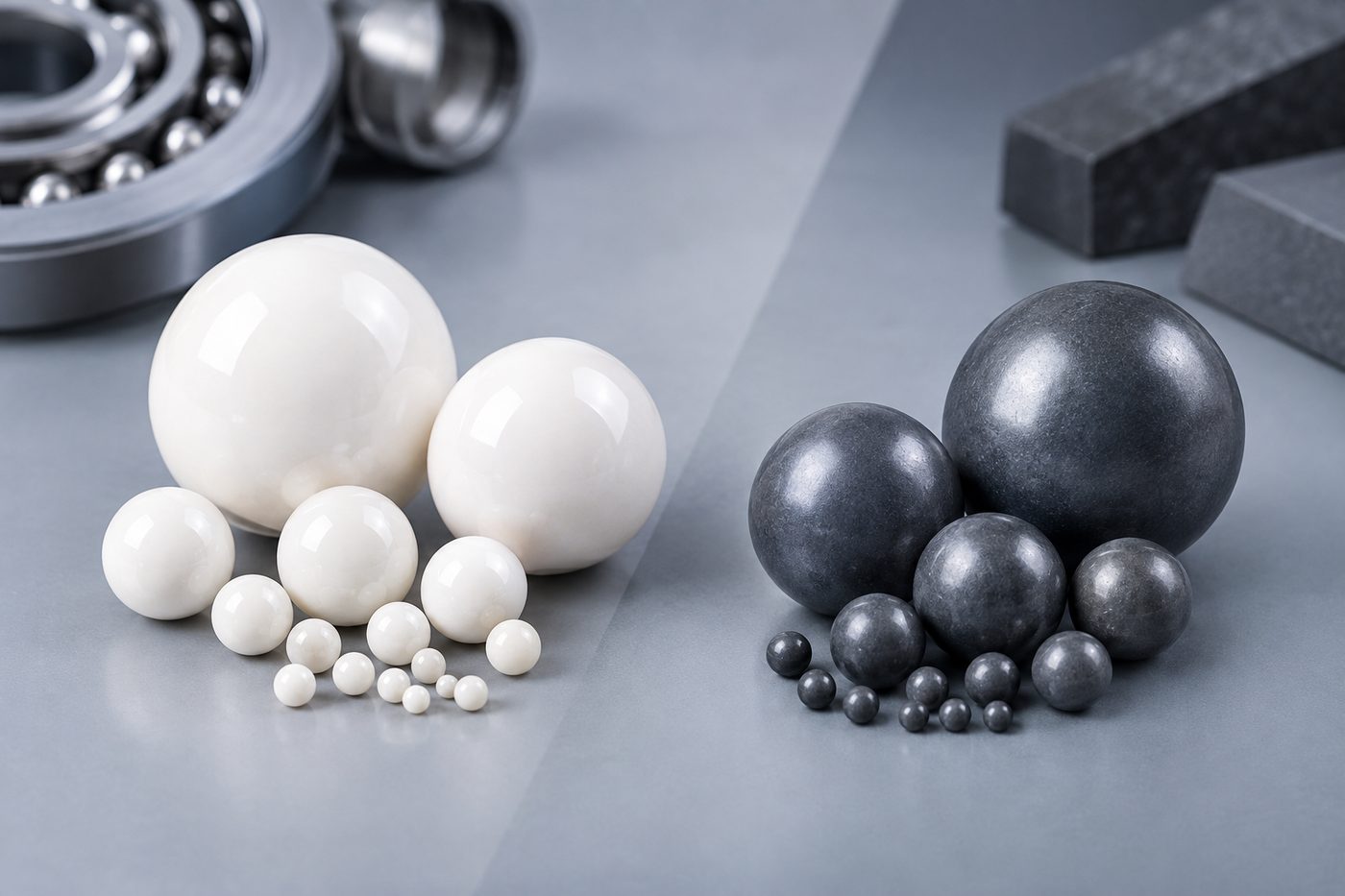
When selecting ceramic balls for industrial equipment, material selection plays an important role in determining wear resistance, dimensional stability, service life, and overall equipment performance.
Zirconia balls and silicon carbide balls are two high-performance ceramic ball materials widely considered for demanding industrial applications. Although both materials offer excellent hardness, wear resistance, and chemical stability, their physical and mechanical properties are significantly different.
So, which material is better for your application?
The answer depends on the operating conditions, including temperature, load, impact, chemical exposure, wear conditions, dimensional requirements, and thermal performance.
This article provides a detailed comparison of zirconia balls vs. silicon carbide balls, helping engineers, manufacturers, and industrial buyers understand their differences and select the right ceramic ball for their specific application.
1. What Are Zirconia Balls?
Zirconia balls, also known as zirconium oxide ceramic balls, are manufactured primarily from zirconium dioxide (ZrO₂).
Different stabilization systems can be used to improve the mechanical properties of zirconia. Common material systems include yttria-stabilized zirconia (Y-TZP) and other stabilized zirconia grades.
One of the most important characteristics of zirconia is its relatively high fracture toughness compared with many other technical ceramics. Certain stabilized zirconia materials can use transformation toughening mechanisms to help resist crack propagation.
This combination of hardness, strength, wear resistance, and toughness makes zirconia balls suitable for applications where both precision and mechanical reliability are important.
Key Characteristics of Zirconia Balls
- High hardness
- Excellent wear resistance
- High mechanical strength
- Relatively high fracture toughness
- Excellent corrosion resistance
- Low thermal conductivity
- Good electrical insulation
- Excellent dimensional stability
- Suitable for precision grinding and mechanical applications
Zirconia balls are commonly used in precision machinery, grinding systems, valves, pumps, ceramic bearings, and other applications requiring a combination of wear resistance and mechanical strength.
2. What Are Silicon Carbide Balls?
Silicon carbide balls, commonly referred to as SiC balls, are manufactured from silicon carbide, a high-performance non-oxide ceramic material.
Silicon carbide is recognized for its extremely high hardness, excellent wear resistance, low thermal expansion, high-temperature stability, and good thermal conductivity.
These characteristics make silicon carbide particularly attractive for demanding environments involving high temperatures, thermal cycling, abrasive media, and corrosive conditions.
Depending on the manufacturing process and material grade, silicon carbide can exhibit significantly different thermal and mechanical properties. Therefore, material grade and manufacturing method should always be considered when specifying SiC balls.
Key Characteristics of Silicon Carbide Balls
- Extremely high hardness
- Excellent wear resistance
- Excellent high-temperature performance
- High thermal conductivity
- Low thermal expansion
- Good chemical resistance
- Excellent dimensional stability at elevated temperatures
- Suitable for demanding industrial environments
Silicon carbide balls can be considered for high-temperature equipment, chemical processing systems, specialized mechanical components, semiconductor-related equipment, and other applications requiring advanced ceramic materials.
3. Zirconia Balls vs. Silicon Carbide Balls: Performance Comparison
Although zirconia and silicon carbide are both advanced ceramic materials, their performance characteristics are different.
| Performance | Zirconia Balls | Silicon Carbide Balls |
|---|---|---|
| Material | ZrO₂ | SiC |
| Hardness | High | Extremely high |
| Wear Resistance | Excellent | Excellent |
| Mechanical Strength | High | High |
| Fracture Toughness | Relatively high | Relatively lower |
| Thermal Conductivity | Low | High |
| Thermal Expansion | Relatively higher | Low |
| High-Temperature Performance | Excellent | Excellent to outstanding |
| Corrosion Resistance | Excellent | Excellent |
| Electrical Insulation | Excellent | Material dependent |
| Impact Resistance | Relatively good | More brittle |
| Precision Applications | Excellent | Application dependent |
| High-Temperature Applications | Good | Excellent |
| Typical Advantage | Toughness and mechanical performance | Hardness and thermal performance |
The actual performance of a ceramic ball depends on material composition, purity, grain structure, stabilization system, manufacturing process, heat treatment, and precision finishing.
Therefore, these values should be considered as general material characteristics rather than universal specifications for every zirconia or silicon carbide ball.
4. Hardness and Wear Resistance
Hardness is one of the most important properties when ceramic balls are used in abrasive or high-wear environments.
Silicon carbide has extremely high hardness and is therefore highly suitable for applications involving abrasive particles, sliding contact, and severe wear.
Zirconia also provides excellent wear resistance. However, its major advantage is not simply hardness. Certain zirconia grades combine wear resistance with relatively high fracture toughness and mechanical strength.
This difference can be important in applications where ceramic balls experience both wear and mechanical impact.
Choose Silicon Carbide When:
- Extremely high hardness is required
- Abrasive wear is severe
- High-temperature wear is involved
- Low thermal expansion is important
Consider Zirconia When:
- Wear resistance and toughness are both important
- Mechanical contact loads are significant
- Impact resistance matters
- Precision movement is required
5. Fracture Toughness: An Important Advantage of Zirconia
Ceramic materials are generally known for their hardness, but many ceramics are also relatively brittle.
This is why fracture toughness should not be overlooked when selecting ceramic balls.
Certain stabilized zirconia materials benefit from transformation toughening, which can help slow crack propagation. As a result, zirconia can offer a useful combination of strength and toughness compared with many conventional ceramics.
For applications involving rolling contact, mechanical loading, or occasional impact, this characteristic can make zirconia balls an attractive option.
Silicon carbide, in contrast, is primarily valued for its exceptional hardness, wear resistance, thermal properties, and high-temperature stability.
Therefore, when mechanical toughness is a major consideration, zirconia may have an advantage.
6. High-Temperature Performance: Why Silicon Carbide Stands Out
Temperature is one of the most important factors when choosing between zirconia and silicon carbide.
Silicon carbide is particularly well known for its high-temperature capabilities. Its combination of high thermal conductivity, low thermal expansion, and excellent thermal stability makes it suitable for demanding thermal environments.
Different SiC grades and manufacturing processes can provide different temperature capabilities, so the actual maximum operating temperature should always be confirmed based on the specific material grade and operating atmosphere.
Zirconia also provides excellent temperature resistance, but its thermal conductivity is much lower than that of silicon carbide.
This creates an important distinction:
Zirconia → lower thermal conductivity and good thermal insulation characteristics.
Silicon carbide → high thermal conductivity and excellent thermal stability.
For applications where rapid heat transfer or thermal shock resistance is important, silicon carbide may be the more appropriate material.
7. Thermal Conductivity and Thermal Expansion
Thermal properties can directly affect the performance of ceramic components.
Silicon carbide generally offers:
- High thermal conductivity
- Low thermal expansion
- Good thermal shock resistance
- Excellent high-temperature dimensional stability
Zirconia generally offers:
- Low thermal conductivity
- Higher thermal insulation capability
- Good thermal stability
- Good resistance to many high-temperature environments
Therefore, the two materials can actually serve very different purposes in thermal applications.
If the objective is to transfer heat efficiently, silicon carbide is generally more attractive.
If the objective is to reduce heat transfer, zirconia may be more suitable.
8. Corrosion and Chemical Resistance
Industrial ceramic balls may come into contact with water, oils, solvents, acids, alkalis, chemical solutions, or other aggressive media.
Both zirconia and silicon carbide offer excellent chemical resistance compared with many conventional metallic materials.
Zirconia can be used in various chemical processing, valve, pump, and fluid-control applications.
Silicon carbide is also highly resistant to many corrosive environments and is particularly attractive when corrosion resistance needs to be combined with high-temperature performance.
However, chemical compatibility should always be evaluated according to the actual application.
Important factors include:
- Chemical composition
- Concentration
- Operating temperature
- pH value
- Pressure
- Exposure time
- Flow conditions
A professional material recommendation should therefore be based on the complete operating environment rather than the material name alone.
9. Density Difference Between Zirconia and Silicon Carbide
Density is another important factor in ceramic ball selection.
Zirconia is significantly denser than silicon carbide.
For the same ball diameter, a zirconia ball will generally have a considerably higher mass than a silicon carbide ball.
This difference can affect:
- Rotational inertia
- Acceleration and deceleration
- Equipment energy consumption
- Dynamic loading
- Grinding efficiency
- Mechanical system design
For applications where reducing moving mass is important, silicon carbide can provide an advantage.
On the other hand, the higher density of zirconia can be beneficial in certain grinding applications where greater media mass is desirable.
10. Applications of Zirconia Balls
The balanced combination of strength, toughness, wear resistance, and chemical stability makes zirconia balls suitable for a wide range of industrial applications.
Precision Bearings
Zirconia balls can be used in selected ceramic and hybrid bearing applications where corrosion resistance, wear resistance, and electrical insulation are important.
Grinding Media
Zirconia grinding balls are widely considered for fine grinding and dispersion applications, including:
- Ceramics
- Paints and coatings
- Inks
- Minerals
- Chemicals
- Advanced materials
Their high density and wear resistance can contribute to efficient grinding performance.
Industrial Valves
Zirconia balls can be used as valve balls in applications requiring wear resistance, corrosion resistance, and dimensional stability.
Pumps and Fluid Control
Zirconia ceramic balls can be considered for pumps, flow-control systems, and other equipment exposed to abrasive or corrosive media.
Precision Mechanical Components
When tight dimensional tolerances and high surface quality are required, precision-ground zirconia balls can be manufactured for demanding mechanical applications.
11. Applications of Silicon Carbide Balls
Silicon carbide balls are particularly suitable for applications where extreme hardness, high-temperature performance, and thermal stability are important.
High-Temperature Equipment
SiC balls can be considered for specialized high-temperature equipment, including:
- Heat-treatment systems
- Industrial furnaces
- High-temperature mechanical systems
- Thermal processing equipment
Abrasive Environments
Because of their high hardness and wear resistance, silicon carbide balls can be used in environments involving severe abrasive wear.
Chemical Processing Equipment
Silicon carbide's chemical resistance makes it suitable for selected chemical processing applications.
Semiconductor Equipment
Silicon carbide is widely used as an advanced engineering ceramic in semiconductor-related manufacturing equipment, particularly where high temperature, chemical resistance, and dimensional stability are required.
Specialized Industrial Machinery
When an application combines high temperature, abrasion, corrosion, and thermal cycling, silicon carbide can be a strong candidate.
12. Which Is Better: Zirconia or Silicon Carbide?
There is no universal answer to the question:
"Which is better, zirconia or silicon carbide?"
The better material depends on the application.
Zirconia Balls May Be a Better Choice When You Need:
- High mechanical strength
- Better fracture toughness
- Excellent wear resistance
- Precision dimensions
- Good corrosion resistance
- Mechanical contact performance
- Grinding media with high density
- Valve or fluid-control components
- Precision ceramic components
Silicon Carbide Balls May Be a Better Choice When You Need:
- Extremely high hardness
- Excellent high-temperature stability
- High thermal conductivity
- Low thermal expansion
- High-temperature wear resistance
- Low component weight
- Severe thermal cycling performance
- Specialized chemical or semiconductor applications
The most appropriate choice should always be determined by the actual working conditions.
13. What Parameters Should You Confirm Before Ordering Ceramic Balls?
Industrial buyers should provide more information than simply the material name when requesting a quotation.
For example, "zirconia ball" does not fully define the required product.
The following parameters are recommended:
1. Material Grade
Specify the required ceramic material and grade, such as:
- Y-TZP zirconia
- Stabilized zirconia
- Sintered silicon carbide
- Reaction-bonded silicon carbide
- Other customized SiC grades
2. Ball Diameter
Common sizes may include:
- 1 mm
- 2 mm
- 3 mm
- 5 mm
- 10 mm
- 20 mm
- 30 mm
- Custom sizes
3. Diameter Tolerance
Precision applications may require strict diameter tolerances to ensure consistent mechanical performance.
4. Sphericity
High sphericity is important for bearings, valves, precision mechanisms, and other rolling-contact applications.
5. Surface Roughness
Surface finish can have a direct influence on friction, wear, sealing, and contact performance.
6. Operating Temperature
Provide the expected:
- Normal operating temperature
- Maximum temperature
- Heating rate
- Cooling rate
- Thermal cycling conditions
7. Working Medium
Examples include:
- Water
- Oil
- Acids
- Alkalis
- Chemical solvents
- Powders
- Gas
- Abrasive materials
Providing these details allows a manufacturer to recommend a more suitable ceramic ball specification.
14. Why Custom Ceramic Balls Matter for Industrial Applications
Industrial ceramic balls are rarely a true one-size-fits-all product.
Two customers may order the same 10 mm zirconia balls but use them for completely different applications.
One customer may need them for a chemical valve.
Another may use them as grinding media.
A third customer may require them for precision mechanical components.
Although the diameter is identical, their requirements for material grade, density, hardness, sphericity, tolerance, and surface roughness can be completely different.
For this reason, a professional ceramic ball manufacturer should be able to support customers with:
- Material selection
- Custom dimensions
- Tight tolerances
- Precision grinding
- Surface finishing
- Batch consistency
- Technical specification confirmation
- OEM and non-standard production
15. Why Choose Huari for Industrial Ceramic Balls?
For industrial buyers, choosing a ceramic ball supplier is not simply about comparing unit prices.
Product consistency, manufacturing capability, dimensional accuracy, quality control, and stable batch production are equally important.
Huari specializes in the manufacturing and supply of industrial balls and can provide customized ball solutions according to different customer requirements.
Our product range can cover different industrial ball materials and specifications, including ceramic balls for demanding applications.
For zirconia balls, silicon carbide balls, and other industrial ceramic balls, customers can provide specifications such as:
- Material
- Ball diameter
- Diameter tolerance
- Sphericity
- Surface roughness
- Operating temperature
- Working medium
- Application environment
- Required quantity
Based on these requirements, we can help evaluate the appropriate ball specification and production solution.
For non-standard sizes and customized industrial ball requirements, OEM and custom manufacturing can also be discussed according to drawings or technical specifications.