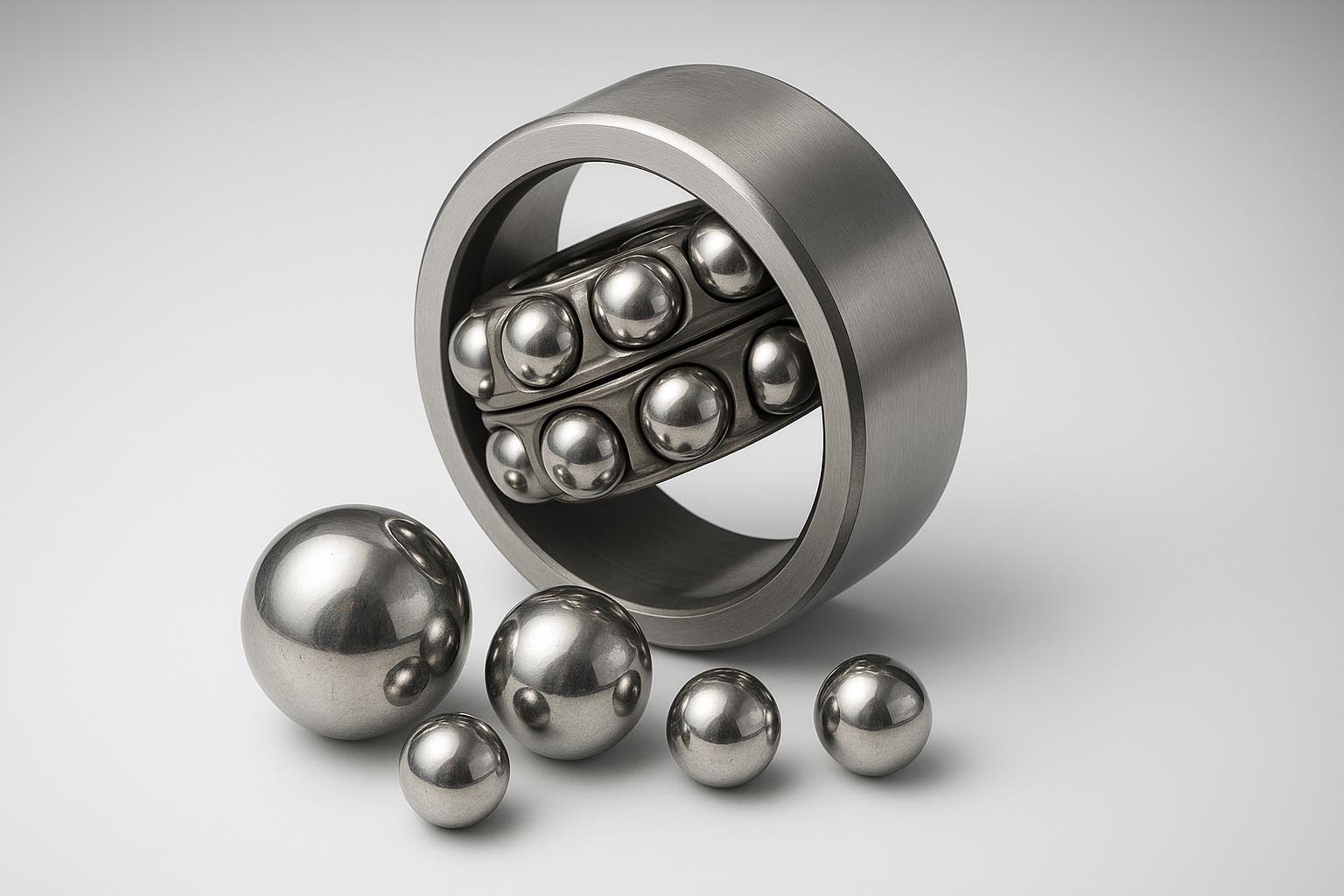
In the world of industrial manufacturing, steel balls may appear small, but they play a crucial role in ensuring smooth mechanical operation. Whether used in bearings, valves, automotive components, rail systems, or precision instruments, the right steel ball can significantly affect performance and durability. This article explains how to choose the most suitable steel ball based on material, hardness, corrosion resistance, and precision.
1. Choosing by Material
-
Stainless Steel Balls
-
Features: Corrosion-resistant, rust-proof, and shiny surface.
-
Grades: 304, 316, 420, 440C.
-
Applications: Food machinery, medical devices, chemical equipment, outdoor components.
-
-
Bearing Steel Balls (GCr15 / AISI 52100)
-
Features: High hardness, excellent wear resistance, high precision.
-
Applications: Bearings, transmission systems, high-speed motors, precision machinery.
-
-
Carbon Steel Balls
-
Features: Economical, high strength, easy to process.
-
Applications: Bicycles, drawer slides, toys, general machinery.
-
-
Brass & Copper Balls
-
Features: Excellent electrical conductivity and corrosion resistance.
-
Applications: Electrical contacts, valves, instruments, decorative components.
-
-
Aluminum & Alloy Balls
-
Features: Lightweight, non-magnetic, oxidation-resistant.
-
Applications: Aerospace, electronics, lightweight structures.
-
2. Choosing by Hardness and Wear Resistance
Different mechanical systems require different hardness levels:
-
High hardness (e.g., bearing steel): Suitable for high-load, high-speed operations.
-
Medium hardness (e.g., carbon steel): For general mechanical components.
-
Lower hardness (e.g., stainless steel, copper): Ideal for environments requiring corrosion resistance rather than high load.
3. Choosing by Corrosion Resistance and Environment
If the working environment involves moisture, oil, or chemical exposure, corrosion resistance is key:
-
440C Stainless Steel: Combines hardness and corrosion resistance.
-
316 Stainless Steel: Excellent performance in marine and chemical environments.
-
Copper or Aluminum Balls: Ideal for non-magnetic and anti-rust conditions.
4. Choosing by Precision Grade
Precision affects the smoothness and lifespan of machinery. Steel balls are classified by G-grade (G10, G100, G1000) — the smaller the number, the higher the precision.
-
High precision (G10–G100): Bearings, precision instruments, high-end equipment.
-
Medium precision (G100–G500): General machinery and hardware.
-
Low precision (G500+): Toys, decorations, non-load applications.
5. Balancing Cost and Performance
When selecting steel balls, consider:
-
Operating environment (humidity, temperature, chemicals)
-
Load and speed requirements
-
Budget and maintenance cycle
Examples:
-
For precision machinery, choose bearing steel or 440C stainless steel.
-
For cost-effective use, select carbon steel balls.
-
For corrosive environments, use 304 or 316 stainless steel balls.
6. Conclusion
Though small in size, steel balls are vital to mechanical performance and reliability. The right material and precision can reduce wear, extend service life, and enhance efficiency.
As a professional B2B manufacturer and trading supplier, we provide a wide range of steel balls in various materials, grades, and specifications, offering customized solutions to meet diverse industrial needs.