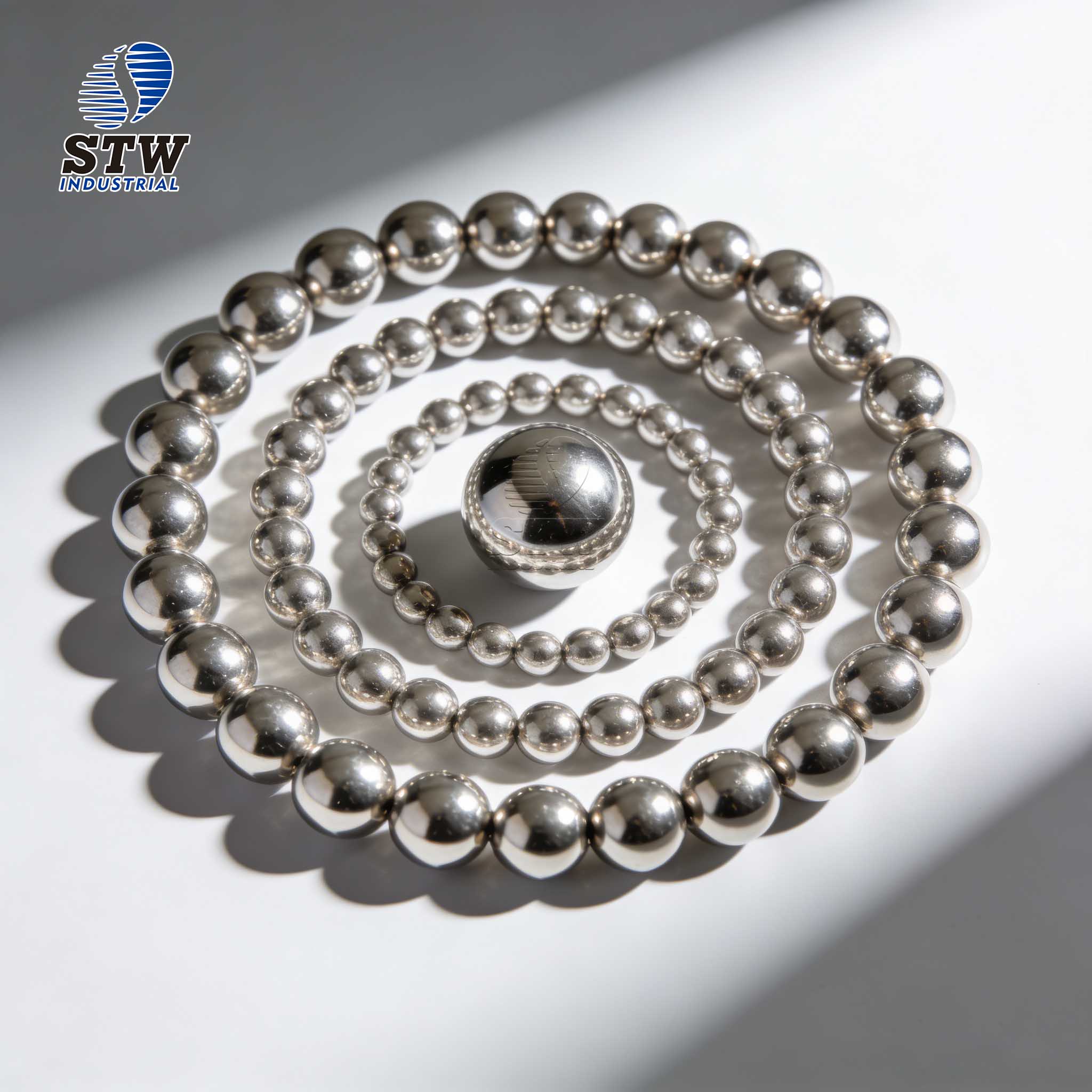
In the world of precision bearings, valve components, and medical devices, selecting the right material for stainless steel balls is a critical decision that impacts product longevity, safety, and performance. For procurement managers and engineers, the most frequent dilemma is: "Is 304 sufficient, or do I need to invest in 316L?"
This guide breaks down the technical differences between these two alloys to help you make an informed, cost-effective choice for your specific industrial application.
1. Chemical Composition: The Molybdenum Advantage
At first glance, Grade 304 and Grade 316L stainless steel balls look identical. However, their chemical "DNA" reveals why 316L is superior in harsh conditions.
-
Grade 304 (18-8): Comprising approximately 18% Chromium and 8% Nickel. It is the "workhorse" of the industry, offering excellent formability and oxidation resistance.
-
Grade 316L (Low Carbon): In addition to Chromium and Nickel, 316L contains 2-3% Molybdenum. The "L" stands for low carbon content ($<0.03\%$), which minimizes harmful carbide precipitation during welding or high-temperature processing.
2. Corrosion Resistance: Fighting Pitting and Chlorides
The presence of Molybdenum in 316L is not just a minor detail—it fundamentally changes how the steel reacts to chemicals.
-
304 Stainless Steel Balls: Excellent for freshwater, common atmospheric conditions, and organic acids. However, they are susceptible to pitting corrosion when exposed to chlorides (salt) or coastal environments.
-
316L Stainless Steel Balls: The Molybdenum provides a robust defense against chlorides. 316L is the standard for marine applications, chemical processing, and environments where high concentrations of salt or sulfuric acids are present.
3. Comparison Table: 304 vs. 316L at a Glance
| Feature | 304 Stainless Steel Balls | 316L Stainless Steel Balls |
| Pitting Resistance | Moderate | Superior |
| Magnetic Properties | Practically non-magnetic (can be slightly magnetic after cold work) | Exceedingly Low Magnetic Permeability |
| Intergranular Corrosion | Standard | High Resistance (due to Low Carbon) |
| Common Applications | Appliances, food hardware, light industrial | Marine, Pharmaceutical, Oil & Gas |
| Cost | Cost-effective | Premium |
4. Application Guide: How to Choose?
Choose 304 Stainless Steel Balls if:
-
Your application involves freshwater or indoor environments.
-
You are manufacturing household appliances, consumer electronics, or basic furniture hardware.
-
Cost-efficiency is a priority and the environment is non-saline.
Opt for 316L Stainless Steel Balls if:
-
The components operate in marine environments or are exposed to seawater.
-
The application is in the Pharmaceutical or Medical field (316L is biocompatible and withstands rigorous sterilization).
-
The balls are used in Chemical Processing (handling acetic, sulfuric, or phosphoric acids).
-
Your project requires low magnetic permeability for sensitive electronic instruments.
5. Why Partner with an Integrated Manufacturer (Factory & Trade)?
As an integrated manufacturer, we bridge the gap between high-volume production and specialized international trade standards.
-
Verified Material Integrity: We provide MTC (Material Test Reports) for every batch, ensuring the Nickel and Molybdenum content meet ASTM standards.
-
Precision Engineering: Available in grades from G10 to G1000, ensuring the perfect sphericity and surface finish for high-pressure valves and high-speed bearings.
-
Global Logistics: Large stocks of standard sizes (0.5mm to 50mm) ready for immediate air or sea freight.